
You just inherited a house in Colorado, and the first thing you Googled was whether you owe inheritance tax. Good instinct. The answer is no, and no state agency collects a dime from you on the transfer. What your inheritance actually costs sits somewhere else, and knowing where spares you a surprise when you sell.
What Colorado Inheritance Tax Actually Means for You
Colorado has no state inheritance tax, and nothing is owed on the transfer itself. On the state side, that settles it. You won’t write a check to the state because someone left you a house. Receiving an inheritance isn’t a taxable event under state law. Heirs who stop reading there miss the bills that do apply.
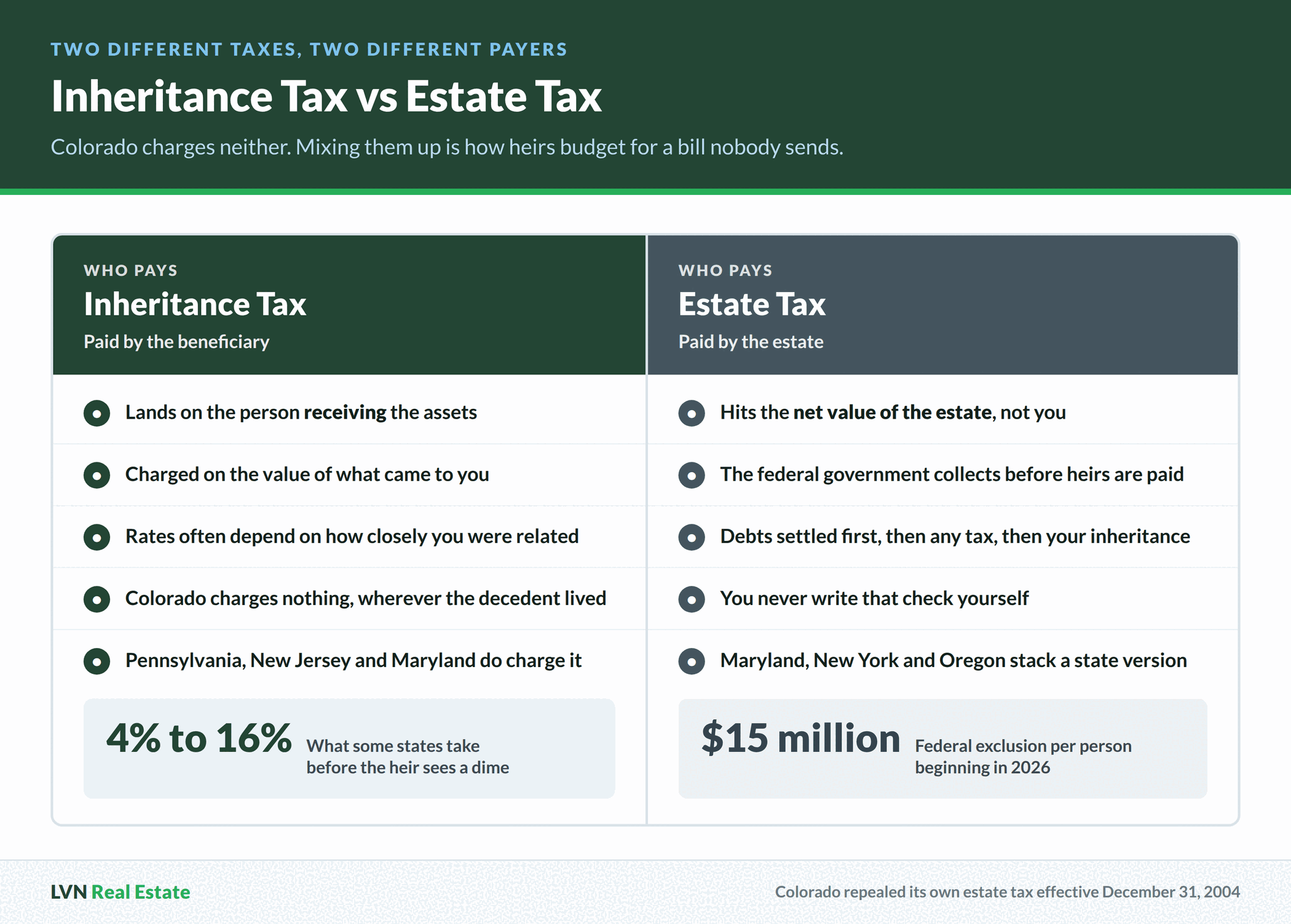
People who move here from Pennsylvania, New Jersey, or Maryland are usually stunned. Those states slice 4 to 16 percent off an inheritance before the heir sees a dime. The absence of an inheritance tax in Colorado is one of the quieter financial advantages of the Centennial State.
Type “Colorado inheritance tax” into a search bar and you’re chasing one of three questions. Do you owe the state money right now? Will you owe when you sell the house? And what did the estate pay before your inheritance reached you? Only the first has a one sentence answer.
How an Inheritance Tax Differs From an Estate Tax
Two terms get swapped constantly, and mixing them up is how heirs budget for a bill nobody will send. An inheritance tax lands on the person receiving the assets. You, the beneficiary, pay on the value of what came to you, and rates often depend on how closely you were related to the decedent. This state charges nothing either way, wherever the decedent lived.
The estate tax works from the other direction. By definition it hits the net value of a decedent’s estate, and the federal government collects before an inheritance reaches anyone. Debts get settled, any tax due gets paid, and the rest becomes your inheritance. You never write that check yourself.
Our state imposes neither, so no state deadline hangs over you. Plenty of people still budget for a Colorado inheritance tax bill that never arrives. The personal representative’s federal filing schedule, though, sets your timeline for clear title.
Does Colorado Have an Estate Tax?
No. Colorado doesn’t stack a state charge on top of the federal one. Maryland, New York, and Oregon are states that do exactly that. Colorado repealed its own estate tax effective December 31, 2004. Before then the state piggybacked on the federal system through a “pickup tax,” now gone. The state imposes no gift tax either, so lifetime transfers from a parent trigger no bill.
The Federal Estate Tax and When It Applies
Federal legislation enacted in 2025 lifted the basic exclusion amount to $15 million per individual beginning in 2026, and removed the reduction that had been scheduled. An estate has to exceed that figure before the federal estate tax exemption stops sheltering it. Value above the line gets assessed on a sliding scale, with rates starting at 18% and topping out at 40%. Married couples get portability, so a surviving spouse can claim whatever exclusion the first didn’t use. Most Colorado families never come near that line, state or federal.
Who Files IRS Form 706, and When
When the value does clear the threshold, the personal representative files IRS Form 706, the United States Estate (and Generation-Skipping Transfer) Tax Return. It’s generally due nine months after the date of death, and a six month extension is available. The form reports gross value, deductions, and any gifts the decedent made while alive.
That representative, sometimes called the executor, pays what’s owed and hands the rest to heirs. You don’t hold clear title to the inherited house until that’s paid. Most Colorado probates stay far smaller, with a final return for the decedent, a Form 1041 covering income earned during administration, and no 706 at all.
How the Stepped-Up Basis Works on an Inherited House
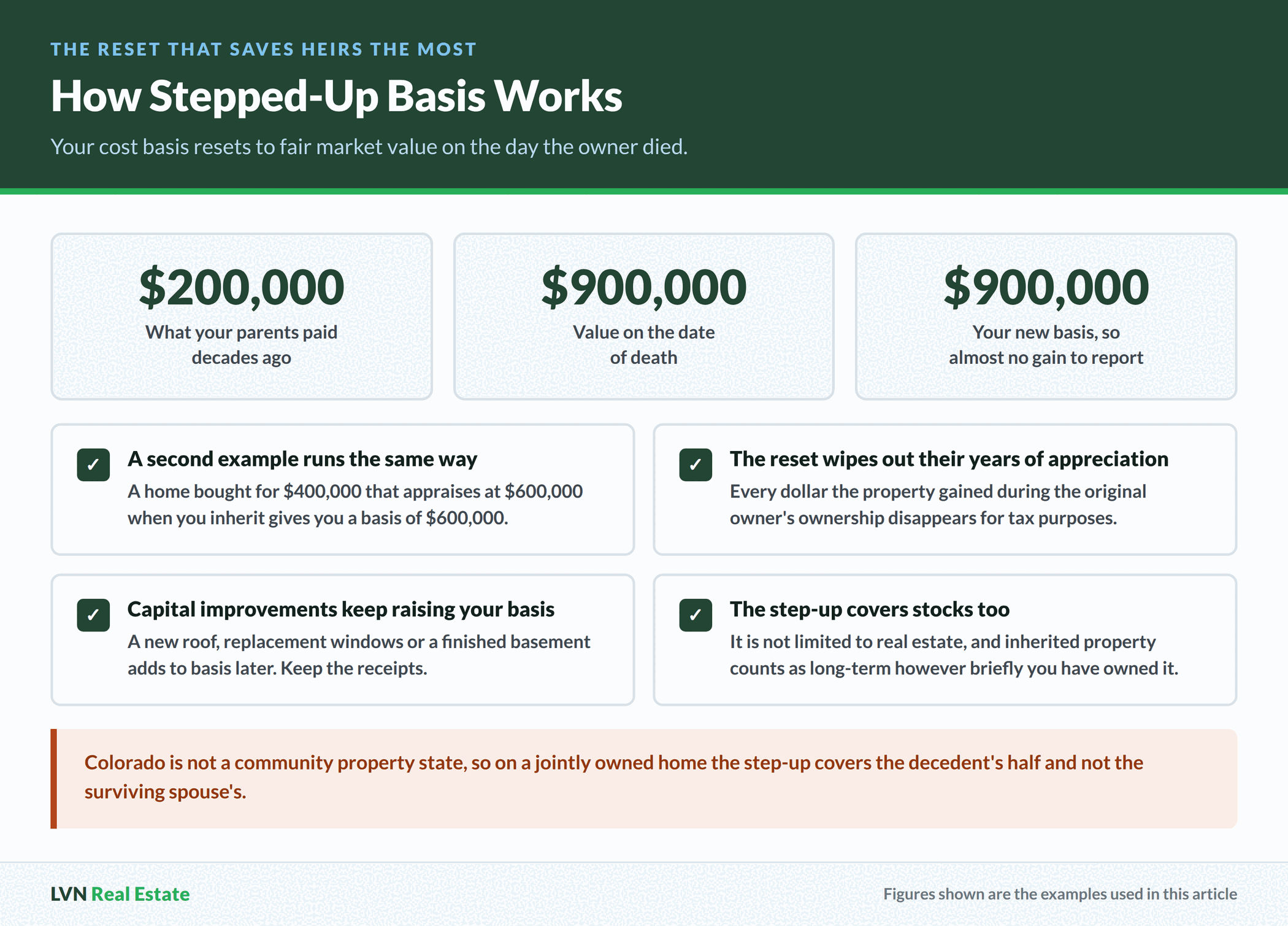
Now for the part that saves you money, which plenty of people get backwards. When the owner dies, the cost basis of appreciated property resets to fair market value on the day of death. Say your parents bought their home decades ago for $200,000 and it’s worth $900,000 when you inherit. Your basis becomes $900,000. Sell soon after and there’s likely little or no gain to report. Every dollar of appreciation from their years of ownership vanishes for tax purposes on inheritance property, and the reset covers stocks too.
Run the arithmetic on another house and nothing changes. A home bought for $400,000 that appraises at $600,000 when you inherit gives you a basis of $600,000. Certain selling costs come off too. Keep your receipts, because every capital improvement you make later, a new roof, replacement windows, a finished basement, adds to basis and lowers what you’d owe years from now. This reset is the biggest inheritance tax benefit an heir gets.
Date of Death Value and Why an Appraisal Matters
IRS rules make you establish the fair market value of inherited property on the date of death, or on the alternate valuation date the executor elects. A qualified appraisal from a licensed real estate appraiser is the standard way to document that number. Don’t skip it. If you sell later and the IRS questions your basis, the appraisal is your defense. An agent’s price opinion won’t do the same job. Order it within a few months of the date of death value you’re claiming.
Capital Gains Tax on an Inherited House in Colorado
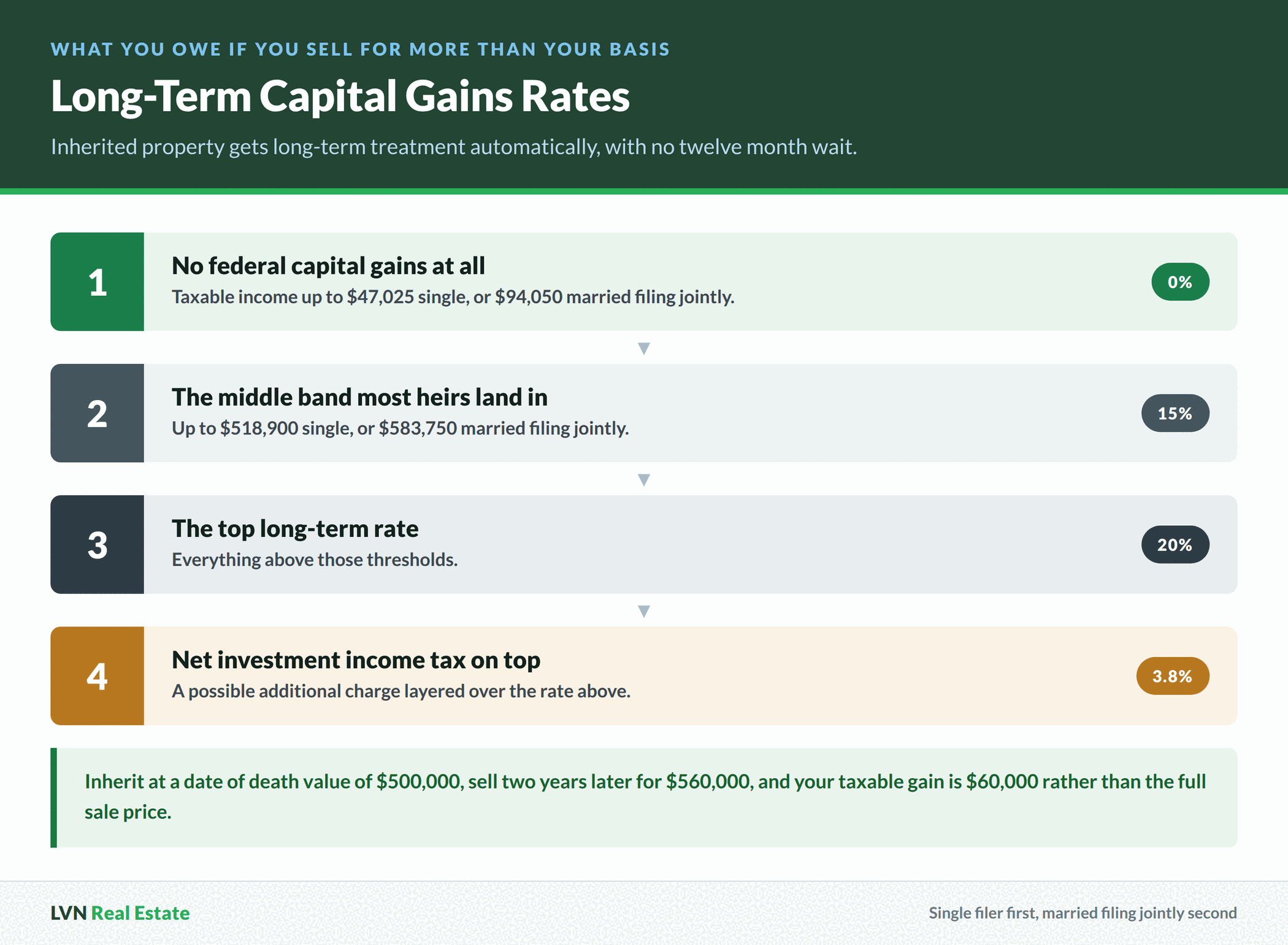
Capital gains blindside heirs more than anything else here, usually the ones who hold for years. Inherited property carries a stepped-up basis equal to fair market value at death, so the capital gains bill reaches only what the property gained after it came to you. Inherit at a date of death value of $500,000, sell two years later for $560,000, and your taxable gain is $60,000 rather than the full sale price. The reset wiped out the original owner’s lifetime of appreciation, so you answer only for your watch. That’s one of the real inheritance tax benefits an heir gets. See our Colorado capital gains tax guide for how the state handles it.
One rule helps every heir. Long-term rates currently run 0% up to $47,025 (single) or $94,050 (married filing jointly), 15% up to $518,900/$583,750, and 20% above that, plus a possible 3.8% net investment income tax. Inherited property counts as long-term automatically, however briefly you’ve owned it. Sell the week the deed clears and you still get long-term treatment, with no twelve month wait.
Many heirs owe no capital gains at all, since they sell close to the value they inherited. On a home held for thirty years the reset can save an heir hundreds of thousands of dollars. Hold a decade instead and appreciation stacks above your stepped-up basis, so the eventual capital gains bill on the inheritance grows with it. One wrinkle hits a surviving spouse. Colorado isn’t a community property state, so the step-up covers the decedent’s half of a jointly owned home and not the spouse’s. That’s a reason to put holding time into the math, not a reason to rush.
Probate and the Clock on Your Timeline
Probate, the court process that settles a deceased person’s estate, sets your calendar as an heir. It runs from a few months to well past a year, depending on how tangled things are. Until it closes or the court authorizes a sale, you generally can’t sell the inherited property. Waiting costs money. Those inheritance holding costs start the day the owner dies, not the day your name lands on the deed.
Property taxes don’t pause for probate either. The estate owes them for every day it holds the property, separate from anything the IRS wants. Property tax proration comes later: once the property sells, the bill gets split between buyer and seller by actual days of ownership. Watch the senior homestead exemption too, since it belonged to the original owner and doesn’t follow the parcel.
The state also allows a beneficiary deed, sometimes called a transfer-on-death deed. The owner records it while living, naming who receives the property at death, and the property bypasses probate entirely. If that’s how the inherited house came to you, title is probably already yours, which shortens your inheritance timeline by months. Without one, patience becomes part of the plan.
What It Costs to Hold an Inherited House
Property tax in Colorado is assessed at the county level and paid to the county treasurer, not to the Colorado Department of Revenue. Rates vary, and reassessment or a lost exemption can push the bill sharply higher after a death. If the assessed value comes back above what the property would actually sell for, appeal it with the County Board of Equalization. The state deadline is June 1, and missing it means waiting a full year.
Your parent’s insurer won’t cover an empty house forever. Standard homeowner policies often lapse once a property sits vacant, and many are void past 30 to 60 days. You’ll need a vacancy endorsement or a separate vacant home insurance policy, and that coverage commonly runs 25% to 50% above what your parent was paying. Colorado’s attractive nuisance doctrine can hold an owner liable when a child is injured on the property, trespassing or not.
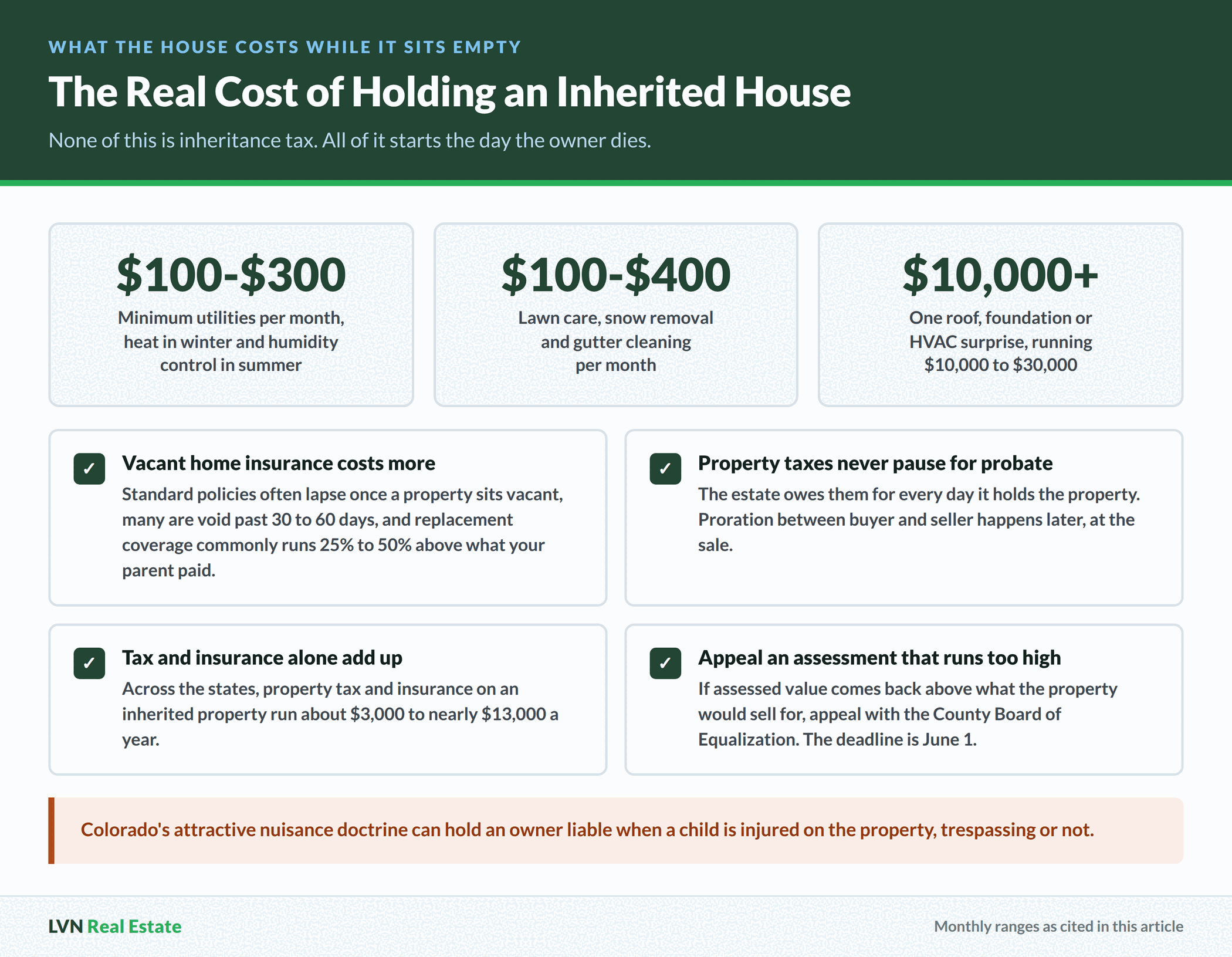
Smaller costs add up fast. Minimum utilities have to run to prevent damage, heat in winter and humidity control in summer, at $100 to $300 per month. Lawn care, snow removal, and gutter cleaning add $100 to $400 per month. One bad surprise, a roof, a foundation, or an HVAC replacement, lands at $10,000 to $30,000 or more. Across the states, property tax and insurance alone on an inherited property run about $3,000 to nearly $13,000 a year. None of that is inheritance tax. All of it is what the inheritance takes from you while the property sits empty.
Steps to Take Right After Inheriting a House in Colorado
Order a licensed appraisal on the inherited home as soon as you can. That document sets your stepped-up basis, the foundation under every capital gains calculation you’ll run on this property. Without it you’re guessing, and the IRS doesn’t take guesses. Keep it permanently.
Next, contact the county assessor and update the ownership record. That gets future bills to the right mailbox and shows you the assessed value. If the estate is large, the executor faces real federal paperwork, so find a Colorado accountant who knows both state and federal rules. Even on a small one, an hour with a CPA is money well spent.
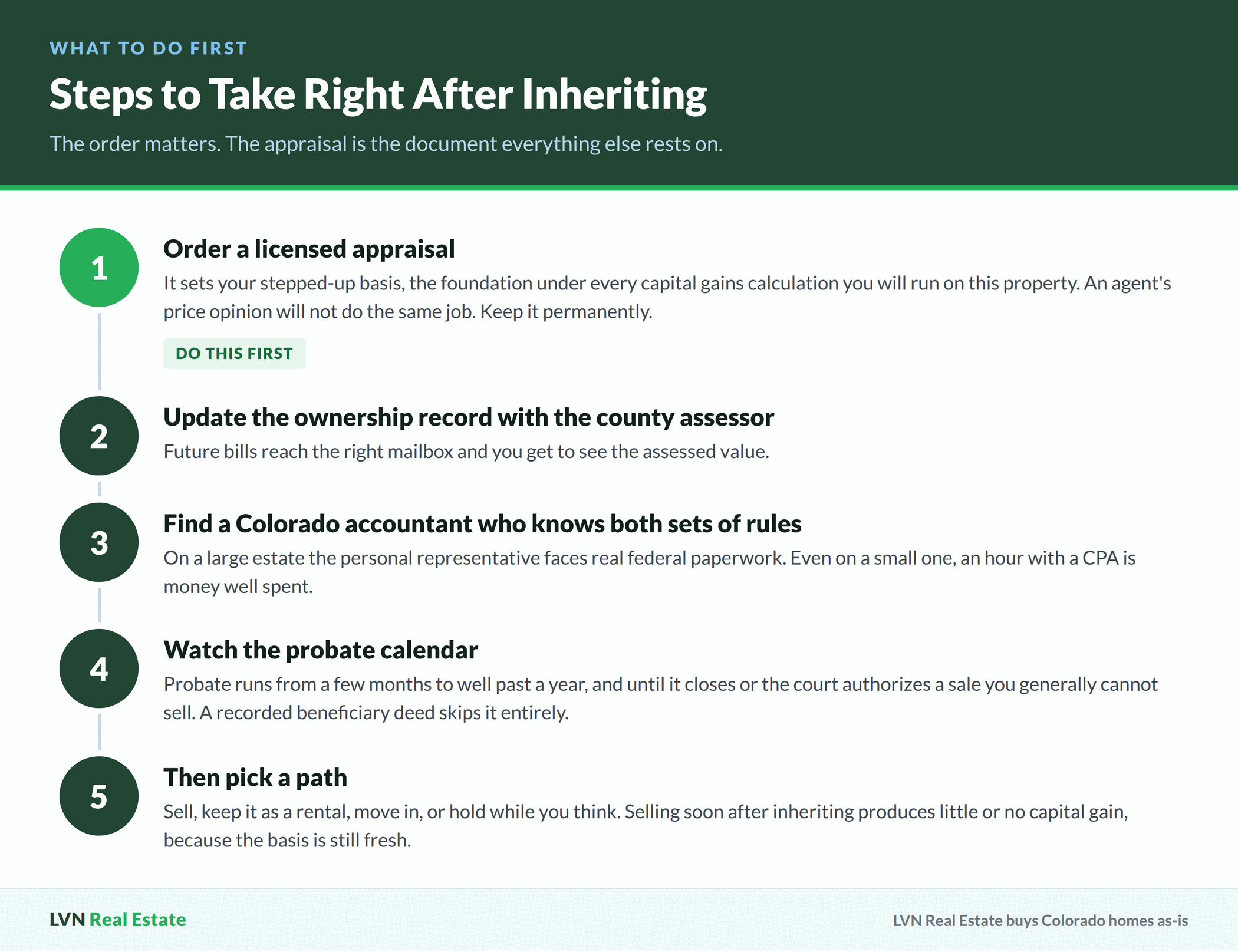
Then pick a path. You can sell the place, keep it as a rental or move in yourself, or hold the property while you think. Selling soon after inheriting produces little or no capital gain, because the basis is still fresh. Keep the inheritance property while it appreciates and you may owe on the increase above your adjusted basis. Renting brings landlord obligations and depreciation rules that change basis over time. The inheritance cost of waiting is never zero.
Frequently Asked Questions About Colorado Inheritance Tax
Do I owe inheritance tax when I inherit a house in Colorado?
No. Colorado charges no inheritance tax, and no state bill follows the transfer. Two other charges can still reach you. One is the federal estate tax, which only a very large estate triggers, and the other is capital gains if you sell for more than your stepped-up basis.
Will I owe capital gains if I sell the inherited house right away?
Probably very little, if anything. Your basis on the inherited property resets to fair market value on the date of death, so a sale close to that number produces almost no gain. It all rests on a solid appraisal documenting the figure. Without one you’d argue your basis from memory if the IRS ever asks.
What taxes does the estate itself pay before I receive anything?
The estate may owe a final federal income tax return for the decedent, plus another covering income earned during administration. Add a federal estate tax return when the value exceeds the exclusion. Colorado has no state-level version at all. Outstanding debts come out of estate assets first, and the personal representative handles every piece of it before the inheritance reaches you.
Does Colorado have its own estate tax separate from federal?
No. The state repealed its own version long ago and nothing replaced it. There’s no state form to file and no state exclusion to track. The only question an heir faces here is the federal one, and that threshold sits high enough that most families never reach it.
What happens to property taxes while the estate is in probate?
They keep accruing, and the personal representative pays them out of estate assets. If there’s no cash to cover the bill, that may mean arranging a sale or borrowing against the house. Once title passes to you, that bill is yours going forward. Check with the county treasurer for the balance and due dates, because unpaid property taxes eventually turn into a tax lien on the inherited house.
Your Next Move as a Colorado Heir
Short version. Colorado inheritance tax doesn’t exist, and the state charges heirs nothing for receiving a house. What you actually owe falls into two buckets: federal capital gains on appreciation above your stepped-up basis when you sell, and the monthly cost of holding the inheritance while you decide. You control one of those by timing. The other runs whether you pay attention or not.
Get the appraisal early and document the value as of the death date. That single step protects your stepped-up basis, which is the largest financial advantage an heir gets. Probate takes time and money, and it needs a personal representative to manage federal filings even when nothing is owed. A CPA and a real estate attorney who work Colorado probate regularly are worth the consultation fee.
When you’re ready, you have real options. You can list the inherited house with an agent, rent it out if the numbers work, or sell as-is for cash and skip the repairs and the showings. At LVN Real Estate we’ve been buying Colorado homes as-is across the Front Range and the rest of the state since 2013. We’re veteran-owned and BBB accredited, and we look at property in any condition. If you want a no-obligation conversation about what the inheritance might be worth in a cash sale, call 720-259-9274. No pressure, just a straight look at your options.
This article is general information only, not legal or fiscal advice. Laws here change often, so check the date on anything you read. Talk to a licensed CPA or estate attorney about your situation. For current IRS rules on inherited property and stepped-up basis, visit IRS.gov. Colorado property assessment appeals run through the Colorado Division of Property Taxation. For federal estate filing requirements, see the IRS Form 706 instructions.
Where LVN Real Estate Buys Inherited Houses Across Colorado
Most of the inherited property we look at sits in the Denver metro, though we buy across Colorado. If the house came to you in Denver, Aurora, Lakewood, Littleton, Thornton or Colorado Springs, we already know how that county assessor handles a change of ownership and how long recording takes there. Our service area runs the length of the Front Range and reaches the mountain towns and the Western Slope.
Talk Through What the Inherited House Is Worth to You
You don’t have to decide anything today. If you want a straight read on what an inheritance is likely to fetch in a cash sale, and how that compares with listing it, contact us and we’ll take a look. There’s no obligation and nobody chasing you afterward. If you’d rather read first, our common questions page covers how an offer gets built and what happens once you accept. Or fill out the short form below and we’ll come back to you with a number. Colorado inheritance tax won’t be part of that math, and now you know why.