
A red placard on the front door doesn’t mean your house is worthless. It means a building official decided nobody can safely live inside until something gets fixed. Those are two very different things. The gap between them is where Colorado sellers either protect their equity or hand it away. I’ve bought houses across Colorado with tags on the windows and plywood over the doors. The owners who did best were the ones who read the notice closely. So let’s walk through selling a condemned house in Colorado the way I’d explain it on your porch.
What Does It Mean When a House Is Condemned in Colorado?
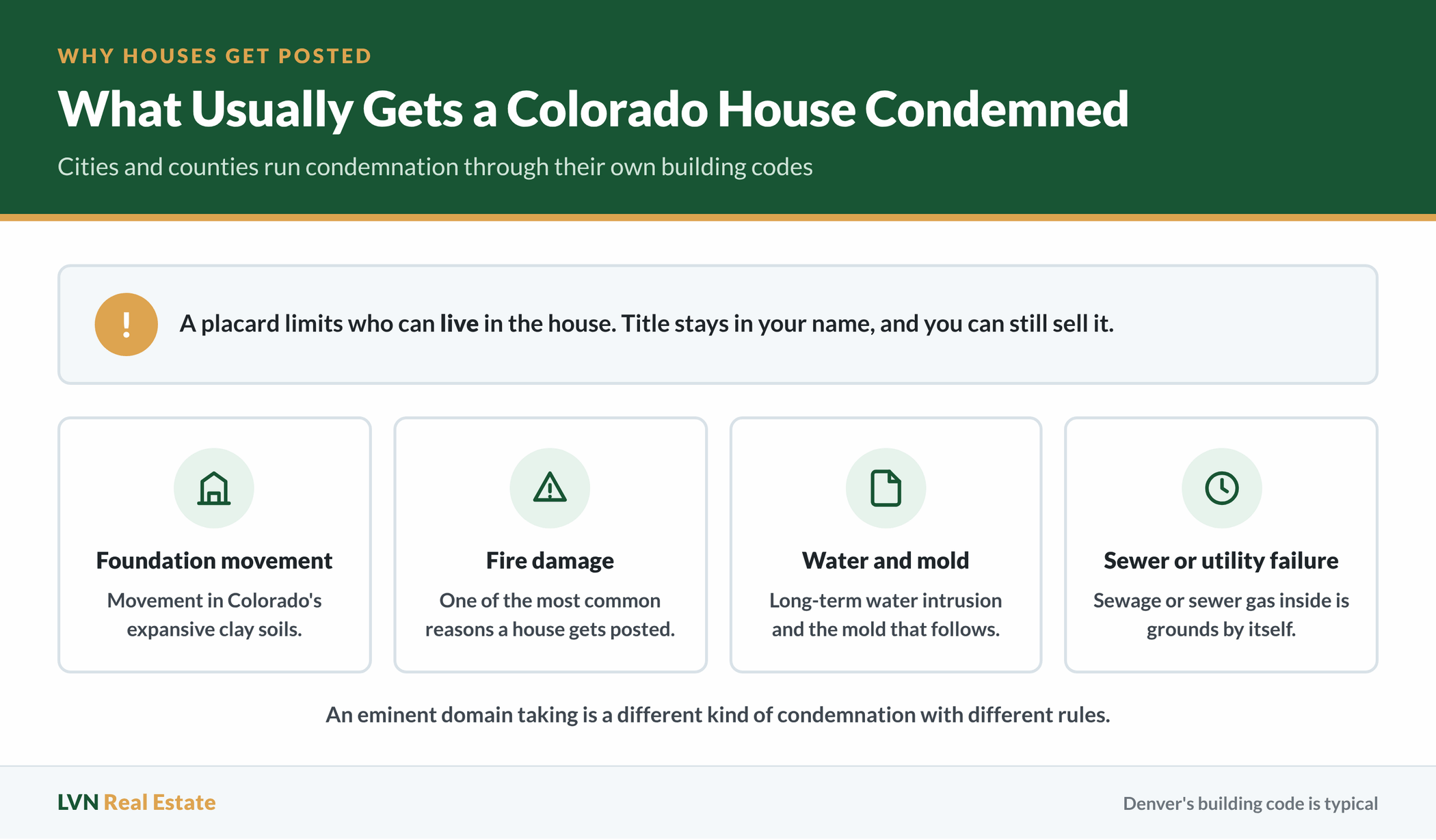
A red “UNSAFE DO NOT ENTER” placard nailed to a front door in Denver means the building official already made the call. Condemnation in Colorado isn’t one statewide process. Cities and counties run it through their own building codes. Denver’s rules are typical. After an inspection, if the building official decides a structure is unsafe, the problem has to be abated by repair, replacement, removal, or demolition once notice goes out. You can read the current version in the 2025 Denver Building & Fire Code. Officials there can also order the unsafe building vacated and post signs barring entry.
In my experience, four problems put most of these houses on the list. Foundation movement in our expansive clay soils tops it, followed by fire damage, long-term water intrusion with the mold that follows, and sewer or utility failures. Under Denver’s code, leaking water, sewage, or sewer gas inside a building is grounds for an unsafe finding all by itself.
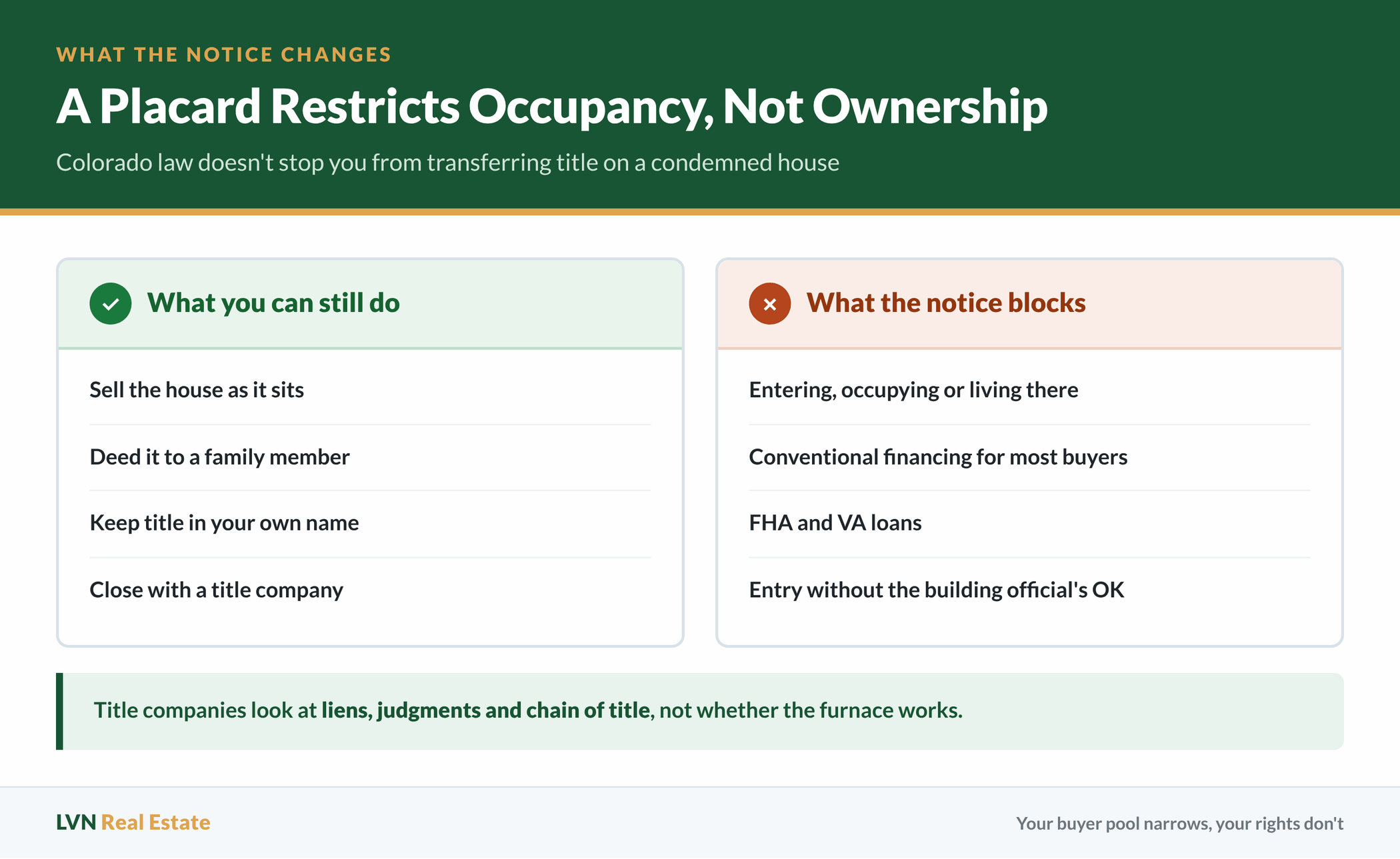
A condemned house in Colorado usually hasn’t been seized by anyone. Title stays in your name. Property taxes keep coming. You can still sell it, refinance against it in theory, or deed it to a family member.
The word “condemnation” also gets used here for eminent domain. In that case a government entity takes land for a road or a utility easement and pays you for it, a different animal entirely. Did your notice come from a building or health department instead of a transportation agency? Then you’re facing the habitability version, and the house is still fully yours to sell.
Can You Legally Sell a Condemned House in Colorado?
“No buyer will touch it and no title company will close it.”
Colorado law says otherwise, since nothing in it stops you from transferring title. The restriction attaches to occupancy, not ownership. Denver’s code can order an unsafe structure vacated so nobody can occupy it, yet it says nothing about recording a deed. Title companies across Colorado close these transactions regularly for exactly that reason. They care about liens, judgments, and a clear chain of title, and whether the furnace works isn’t their concern.
What does change is your buyer pool. Conventional financing dies fast on a red-tagged house here. Appraisers can’t certify habitability, and lenders won’t fund a house their collateral review flags as unlivable. Standard FHA and VA loans usually fall away for the same reason. Cash buyers, renovation lenders, and the occasional owner-occupant with a hard-money bridge are who’s left.
Some jurisdictions record the unsafe determination with the county, and Denver’s code allows it. Your county clerk and recorder can tell you what’s actually on title. Their answer shapes your timeline more than anything else.
One more wrinkle is specific to this state. State statutes and regulations require meth-contaminated properties to be cleaned up to state Board of Health standards. The owner may choose to tear the house down instead, so you aren’t stuck with only one path forward. If contamination caused your condemnation rather than structural damage, that choice belongs to you. It changes the math on every offer you’ll receive.
What Legal and Disclosure Rules Apply to a Condemned House?
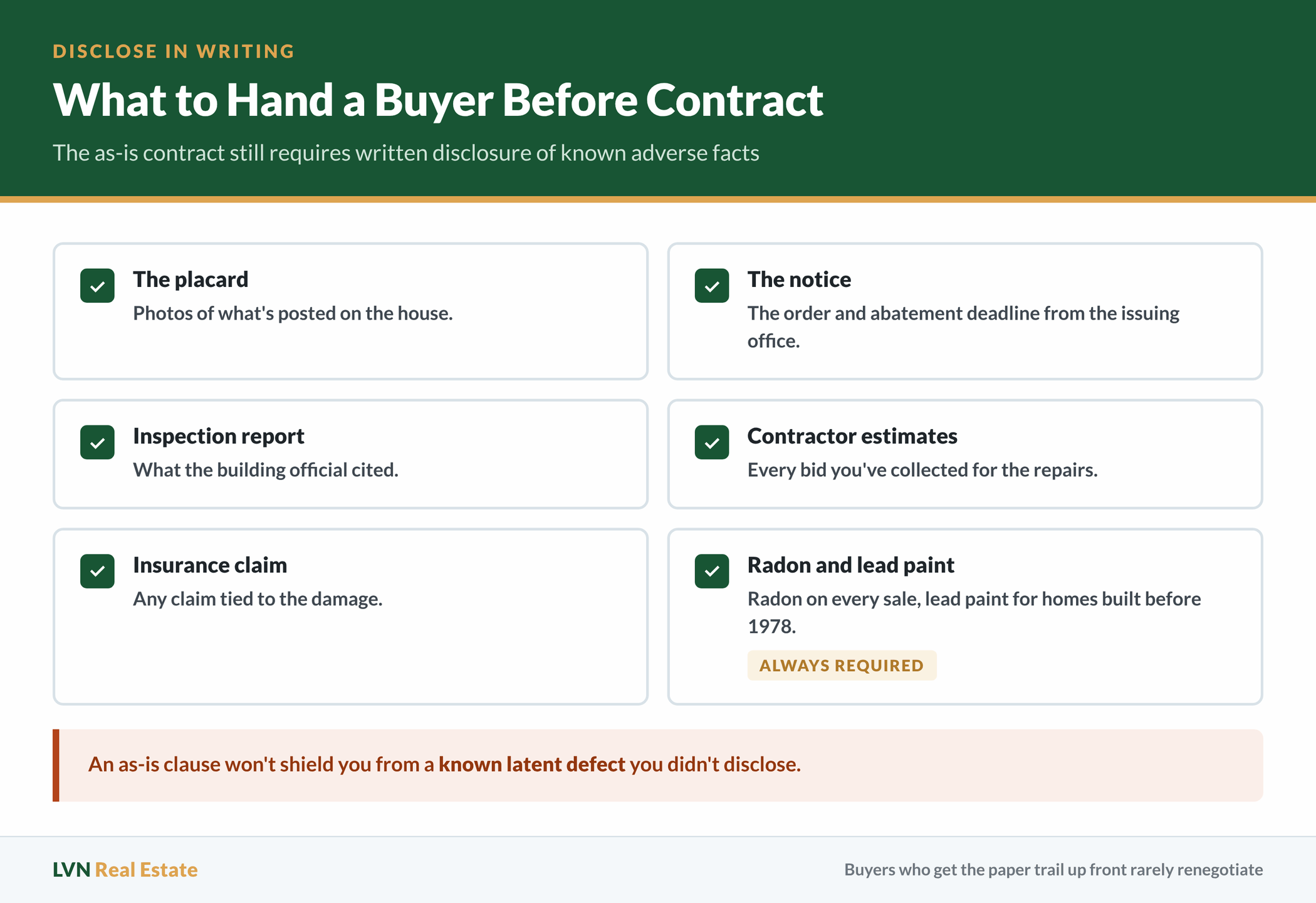
Courts here have been consistent on this point. An as-is clause won’t shield a seller who fails to disclose a known latent defect. This Colorado law firm’s article on seller disclosure walks through why. It’s worth ten minutes of your time before you sign anything.
Most sales in the state run on the Real Estate Commission’s standard contract. It conveys the property as-is. The very same section requires the seller to disclose any adverse material facts known as of the contract date. You aren’t promising the property works, only that you told the truth about it.
Disclose the placard and the notice. Hand over the inspection report, the contractor estimates, and the insurance claim. A condemned house in Colorado comes with a paper trail. Buyers who get the trail up front rarely renegotiate later, while the ones who find it during escrow almost always do.
Federal and state rules add a few disclosures regardless of condition. Every residential sale contract in Colorado has to carry a radon disclosure. Homes built before 1978 also need the federal lead-based paint disclosure.
If meth is part of your story, the rules get specific. Residential property found to be meth-affected after August 7, 2023 goes on a public state list. It stays there for five years after the final certificate of compliance is issued unless the property is demolished. An owner who cleans up under the regulations gains immunity from civil suits by future owners, occupants, or neighbors. That immunity holds only as long as a qualified professional does the verification testing and the results go to the local governing body. CDPHE’s cleanup page lays out the standards. I’d still call the local health department directly before assuming anything about your house.
What Are Your Options If You Own a Condemned House?
One red-tagged house I walked through sold in nineteen days to an investor who tore the roof off and rebuilt it. Its owner sold it as it stood, which is one of four paths open to you.
Selling as-is to a cash buyer is the quickest of them. You skip the repairs and the permit office, and you trade some of the top-line price for speed.
Repair and relist means fixing enough to clear the unsafe determination, then selling through the MLS at full retail. It produces the highest gross number and the highest risk. Construction costs and permit timelines along the Front Range have a way of swallowing the spread.
Demolition and land sale works when the structure is beyond saving but the dirt has value. In Denver neighborhoods like Berkeley, Sunnyside, and Baker, lot value alone can carry a sale because builders want infill. Out in Grand Junction or Alamosa, land rarely covers demolition cost, so that path narrows fast.
Donating or deeding the house to a nonprofit or the city is the last option. I’d call it a mistake more often than not. A condemned house in Colorado almost always has a buyer somewhere, and price is what decides the sale.
Get both numbers at the same time. LVN Real Estate will give you an as-is figure in a few days. Put it next to a contractor’s repair estimate and the decision gets obvious instead of theoretical.
Then ask yourself whether you can pay for the repairs and carry the house through months of permits. Answer that honestly and three of these four options disappear.
How Do You Sell a Condemned House As-is in Colorado?
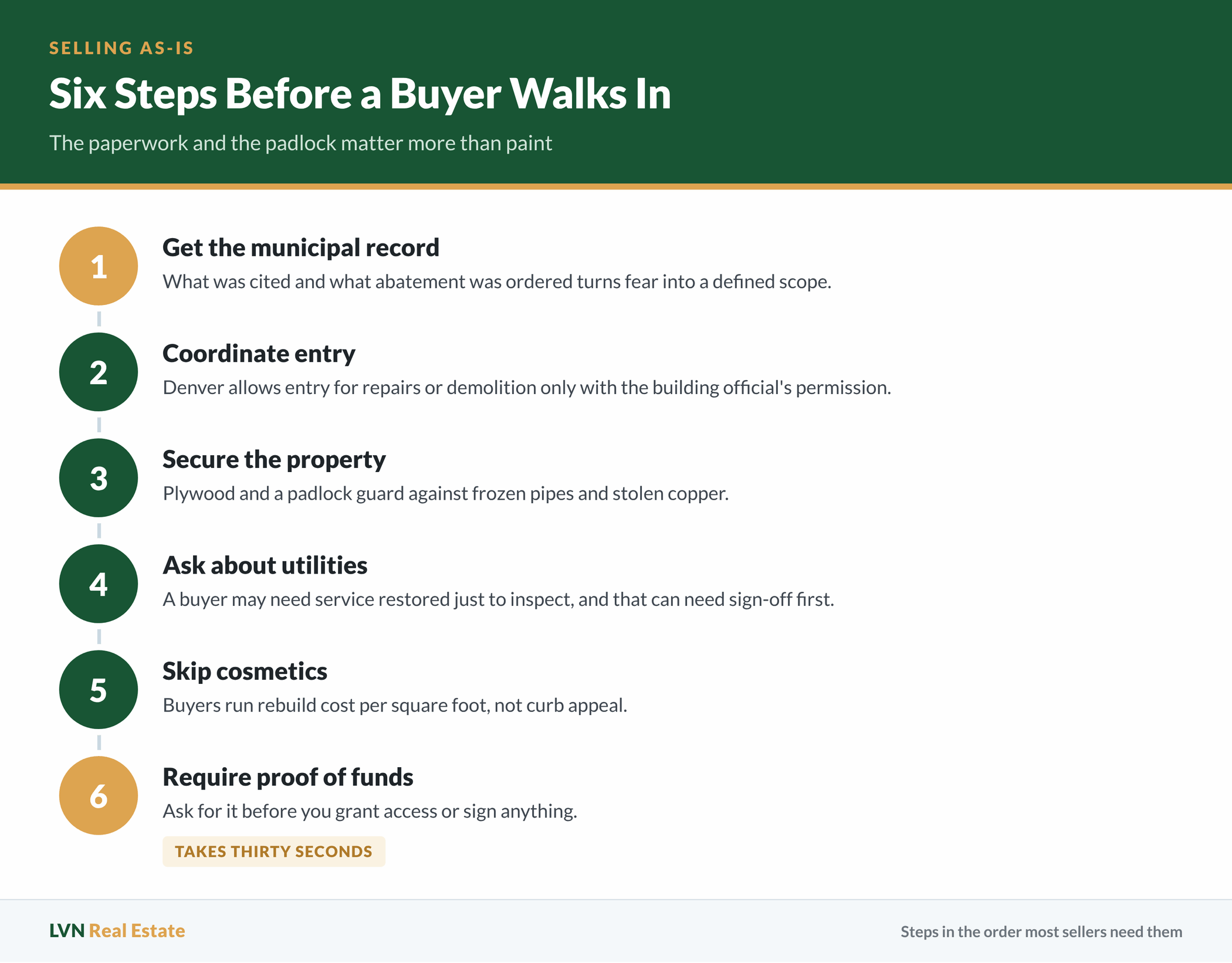
Start with the paper trail. The city or county that posted the house keeps a record of what it cited and what abatement it ordered. It’s the single most valuable thing you can hand a buyer, since it turns vague fear into a defined scope of work.
Denver’s code allows entry for repairs, rehabilitation, or demolition only with the building official’s written permission, so check in with that office before anyone walks in.
An empty house takes a beating in a Colorado winter. Pipes freeze, roofs fail under snow load, and thieves strip copper out of vacant Front Range basements. Plywood and a padlock protect your sale price.
Utilities are the detail that quietly kills a lot of these sales. If service was cut as part of the unsafe determination, your buyer may need it restored just to run an inspection. Sometimes the building department has to sign off first. Ask early, before you’re deep into a contract.
Nobody buying a condemned house in Colorado is evaluating curb appeal. They’re running a spreadsheet on rebuild cost per square foot. Money spent on cosmetics here is money burned.
Finally, insist on proof of funds before you grant access or sign anything. I’ve watched sellers tie up a house like this for forty days with a buyer who was shopping the contract to someone else. Requesting a bank statement takes thirty seconds.
How Do You Price a Condemned House Correctly?
“What’s it worth if I just walk away from fixing it?”
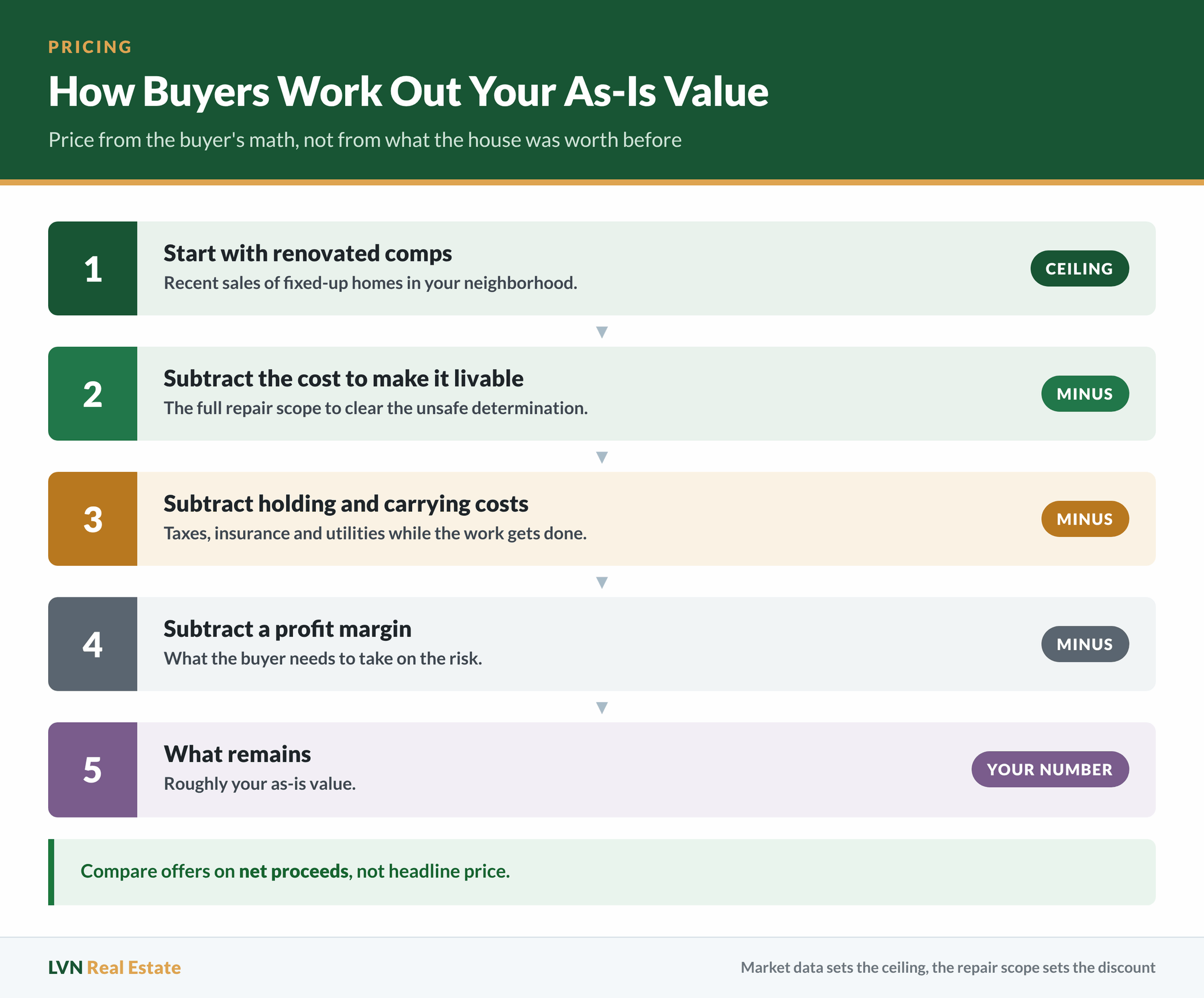
Find what comparable renovated homes in your Colorado neighborhood have sold for recently. Subtract the full cost to make the condemned house livable. Then take off the buyer’s holding and carrying costs, plus a profit margin. What’s left is roughly your as-is value.
Statewide, Colorado’s median sales price dipped 0.9 percent to $545,000 in October 2026 as sales fell nearly 19 percent, according to the Colorado Association of REALTORS. The same report puts single-family homes at an average of 68 days on market. Slower sales mean investors underwrite more conservatively, and your offers reflect that.
Regional spread is real in this state. Colorado Springs posted a $455,000 median sale price in October 2026, down 4 percent from $473,500 a year earlier, per Great Colorado Homes. A condemned house in El Paso County and one in Boulder County are not the same asset, even with identical damage.
Don’t lean on the county assessor’s number either. Assessors value a livable home and lag the market badly, and I’ve seen assessed values double the real as-is worth of a condemned house.
Should you get more than one offer? Yes, always, and compare them on net proceeds rather than headline price. A lower offer with no inspection contingency often puts more in your pocket at closing than a higher one that erodes through amendments.
Who Buys a Condemned House in Colorado?
Flippers and rehabbers make up the largest share. They like structural problems because those scare off competition. A condemned house in Colorado with a documented scope is easier for them to underwrite than a cosmetically tired house with mystery issues.
Buy-and-hold landlords step in now and then when the repair list is narrow, say a failed sewer line or a single compromised wall. Rental demand along the I-25 corridor supports that math.
Owner-occupants with renovation financing exist too. They’re the slowest and least reliable group for a condemned house, since their lenders require draws, inspections, and licensed contractors at every stage.
Local companies that buy direct round out the list. LVN Real Estate works with Colorado owners in this spot. Local buyers already know what a Castle Rock foundation repair costs compared with a Lakewood one, and out-of-state platforms usually don’t.
A man from Fruita called me on a Thursday afternoon after two agent listings expired without a single offer. His garage still held his father’s woodworking bench and half a 1970s tractor. He’d gotten so used to hearing no that he apologized before describing the house. His agents weren’t the problem. The listing channel simply wasn’t built for a condemned house in the first place.
Frequently Asked Questions About Selling a Condemned House in Colorado
What Is the Difference Between a Home That’s Uninhabitable and One That’s Condemned?
Uninhabitable describes a condition, and condemned describes an official action. A house can have no working heat, serious mold, or a collapsed floor and still carry no government notice. It’s uninhabitable in practice but not formally posted. Condemnation happens when a Colorado building official inspects, decides the structure is unsafe, and issues an order and usually a placard. Both situations hurt your resale value, yet only one brings a municipal file and an abatement deadline.
Can You Legally Live in a Condemned House in Colorado?
No. Once a structure is posted as unsafe under a Colorado municipal code, entering or occupying it is prohibited, and that applies to the owner as much as anyone else. Limited entry for repairs, rehabilitation, or demolition is generally allowed with the building official’s permission, so call the office before you or a contractor goes inside. If you’re living there now and received a notice, contact the issuing department right away about relocation timelines and any local help.
Do I Have to Repair a Condemned House Before Selling It in Colorado?
Not at all. You can transfer a condemned house in Colorado exactly as it sits, and plenty of buyers prefer it that way because they’d rather control the renovation themselves. What you can’t do is stay quiet about what you know, since the disclosure duty described earlier survives any as-is clause. Hand over your inspection notice and contractor bids with the offer package, and you’ll usually get a cleaner, faster contract.
How Fast Can I Sell a Condemned House in Colorado?
With a cash buyer and clean title, two to four weeks is realistic. The limiting factor is usually title work rather than the property’s condition. Liens, probate, unpaid taxes, or a recorded municipal order can stretch that, which is why pulling your title history early saves real time. Listing a condemned house on the open market takes far longer, as the market figures above suggest, and financing problems tend to surface after you’ve already waited.
Talk Through Your Condemned House With Us
You don’t need to fix anything before you call. Tell us what the notice says and what you know about the repairs, and we’ll give you an honest as-is number. If repairing and listing makes more sense for your house, we’ll tell you that too. When you’re ready, reach out to LVN Real Estate or fill out the form below.