

A pest inspector once told me the most expensive words in Colorado real estate are “we don’t have termites here.” That belief costs Front Range sellers of a house with termites real money every year. Colorado State University Extension says the idea that the state has no termites is part of the problem, since builders who believe it skip basic protections. CSU also says the way we water our yards has changed the picture. Sprinklers aimed at foundations and downspouts that dump water by the wall keep the soil damp. Termites follow that moisture, and they now show up more often around homes. So if you’re sitting on a house with termites in Colorado and wondering whether you just lost a third of your equity, keep reading, because odds are you didn’t.
Can You Sell a House with Termites in Colorado?
Sellers walk in thinking the sale is dead until the bugs are gone and every board is new, so reality surprises them. Then they find out a neighbor in Lakewood closed on a 1960s ranch with an active infestation under the deck, at a price that barely flinched. Nothing in Colorado law stops you from selling a house with termites. No state inspection has to clear the property first. You also won’t find a pest certificate hanging over your closing, as in parts of the Southeast.
What changes is the buyer pool and the leverage.
Conventional buyers financing through a local lender can usually close on a house with termites in Colorado. The structure has to be sound, though, and the appraiser can’t flag active damage to load-bearing framing. VA and FHA files get fussier, since those appraisers are told to look for termites and the damage they leave. Cash buyers barely care.
Right now the Colorado market gives you room, too. Statewide, the median sale price in October 2026 was $545,000, down about 1% from a year earlier, according to the Colorado Association of Realtors. Buyers have options. That doesn’t make a home with termites unsellable. It means you price it like a property with a known condition instead of pretending the condition isn’t there.
Early last year an heir in Montrose called me about her late father’s house. It was a tidy brick place with a detached garage still holding his welding rig. A contractor found termites had chewed the sill plate behind the kitchen cabinets and quoted her a full kitchen rebuild. The quote came in north of what the whole kitchen added to the home’s value, so she sold as-is and kept the difference.
Do Colorado Sellers Have to Disclose Termite Damage?
Hiding termites is the single dumbest move you can make.
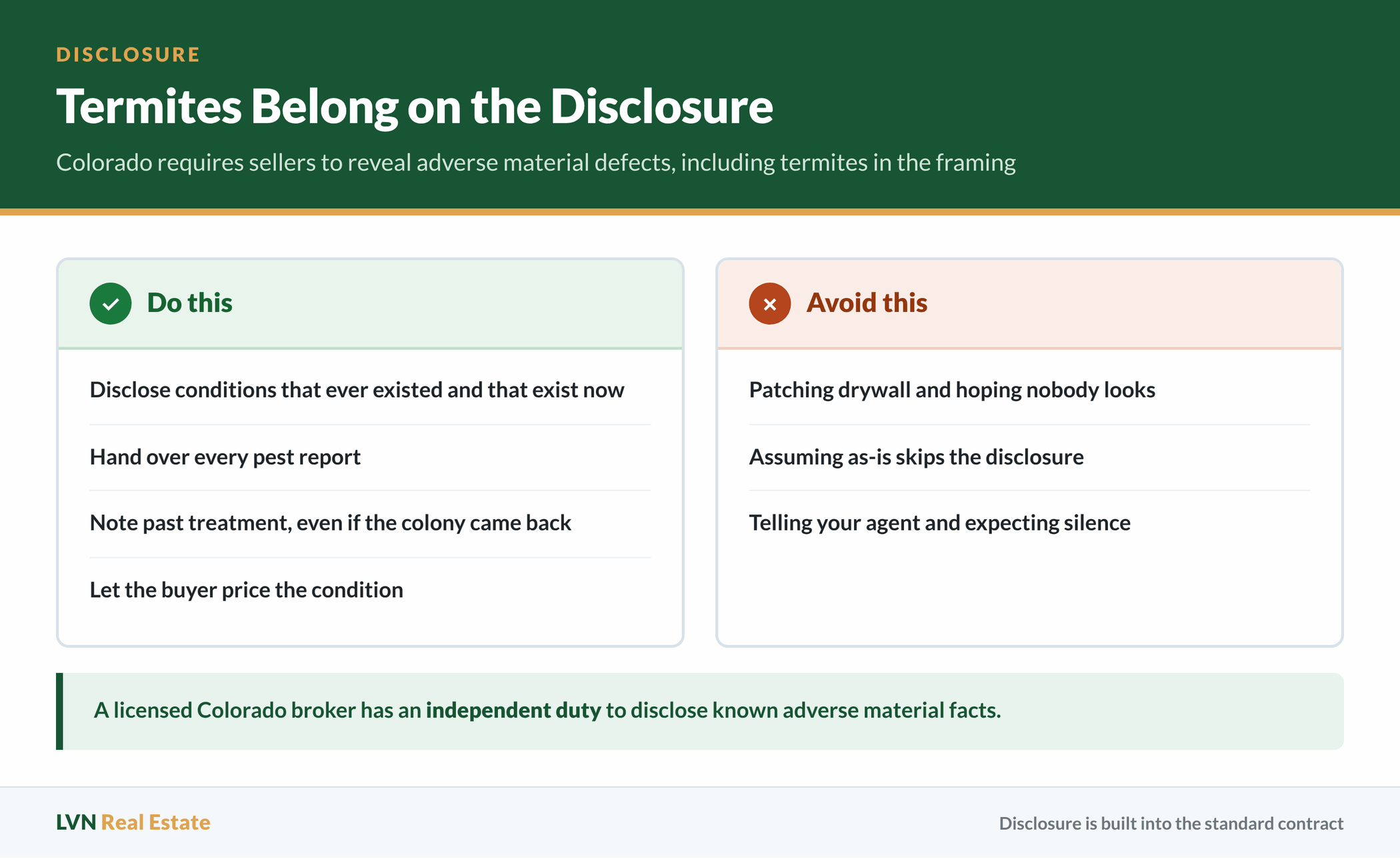
Colorado’s setup is unusual, and it trips people up. No statute forces you to fill out the written Seller’s Property Disclosure form. Instead, the duty is built into the standard Contract to Buy and Sell Real Estate. Colorado’s Real Estate Commission approves that form, and nearly every home sale uses it. That contract also requires sellers to disclose adverse material facts they actually know about, even when the specific defect isn’t printed on the form. Termites in the framing qualify.
Plenty of sellers brush off the disclosure form. Its questions split between conditions that ever existed and those that exist now, and sellers often blow past that line. Treated for termites five years ago and the colony came back? Both answers belong on the page.
Bringing in an agent adds another layer. A licensed Colorado broker has a separate duty to tell a buyer about known adverse material facts. The duty covers only what the broker knows, not what they might have uncovered by digging. Your agent can’t sit on what you told them about the termites.
Write it down, hand over the pest reports, and let the buyer decide. The seller who discloses termites up front rarely ends up in court. One who patches the drywall and hopes nobody looks is buying a lawsuit at a discount.
What Does Termite Damage Do to Your Colorado Home’s Value?
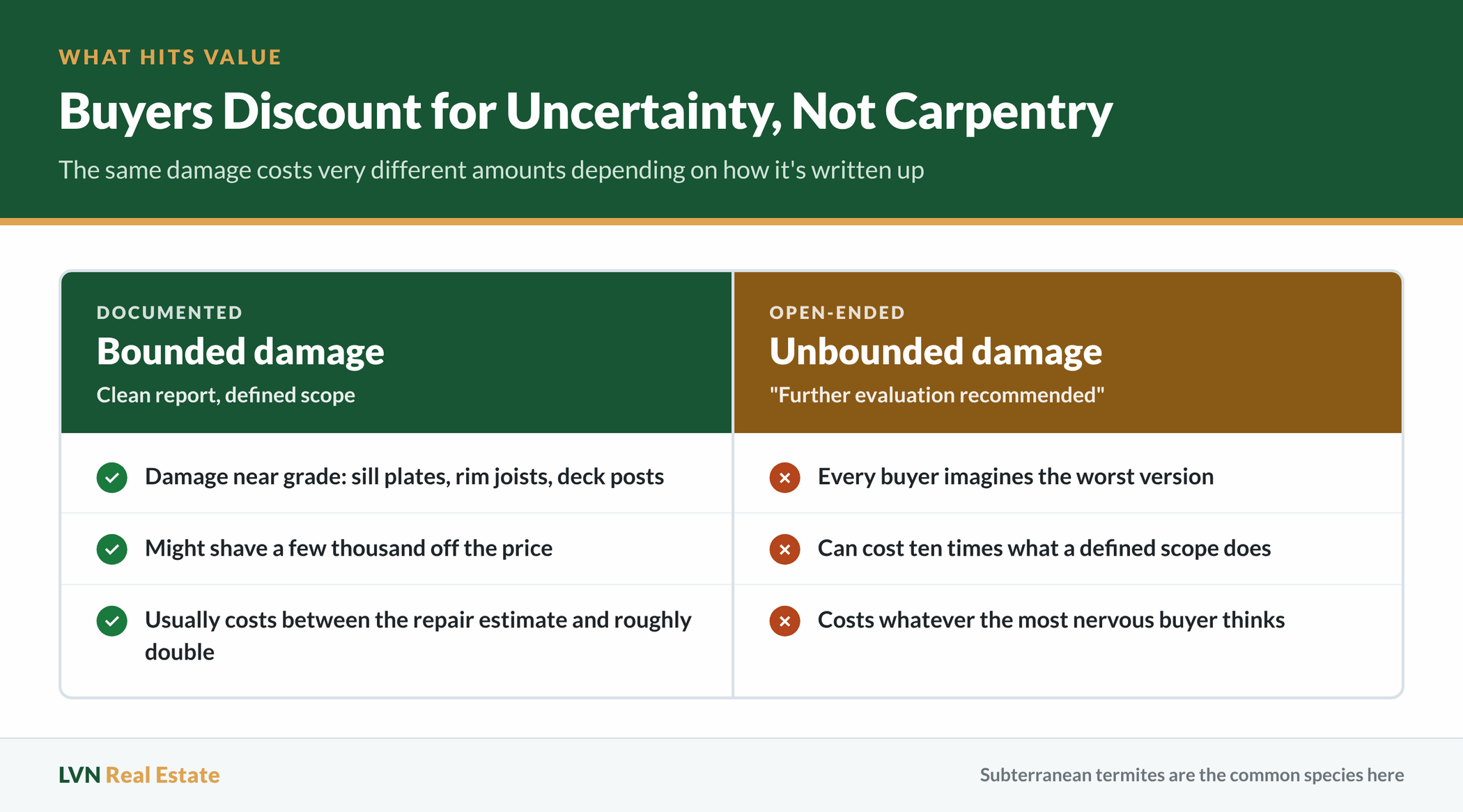
For years I assumed the hit to a sale price tracked the repair bill. Wrong, and not even close. Buyers discount for uncertainty, not for carpentry. A clean inspection report with a defined scope might shave a few thousand off your price. An open-ended “possible structural damage, further evaluation recommended” line can cost you ten times that, because every buyer in the room now pictures termites in every wall.
The species involved helps your case here. Subterranean termites don’t live inside the wood they eat. They spend their lives in the soil and travel through mud tubes, and drywood termites are rare in Colorado. CSU points to one small area in Grand Junction with drywood termites, which need different management. Damage from subterranean termites tends to concentrate near grade: sill plates, rim joists, basement framing, deck posts. That’s a knowable, manageable problem, and knowable problems hold value.
Where the house sits moves the number too. Termites hurt less in a tight market than in a slow one. Denver-area home prices came in at $571,000 in October 2026, down 0.8% from a year earlier, according to the same Realtors report. Deep buyer demand like that softens a condition issue. Compare that with El Paso County, home to Colorado Springs. Single-family homes there took an average of 56 days to sell that month, up from 51 a year earlier. Slower markets mean buyers push harder on every defect they find.
In most Colorado neighborhoods, I’d put documented, bounded termite damage somewhere between the repair estimate and roughly double it. Damage nobody has measured costs whatever the most nervous buyer thinks it might cost.
How Much Does Termite Damage Repair Cost in Colorado?
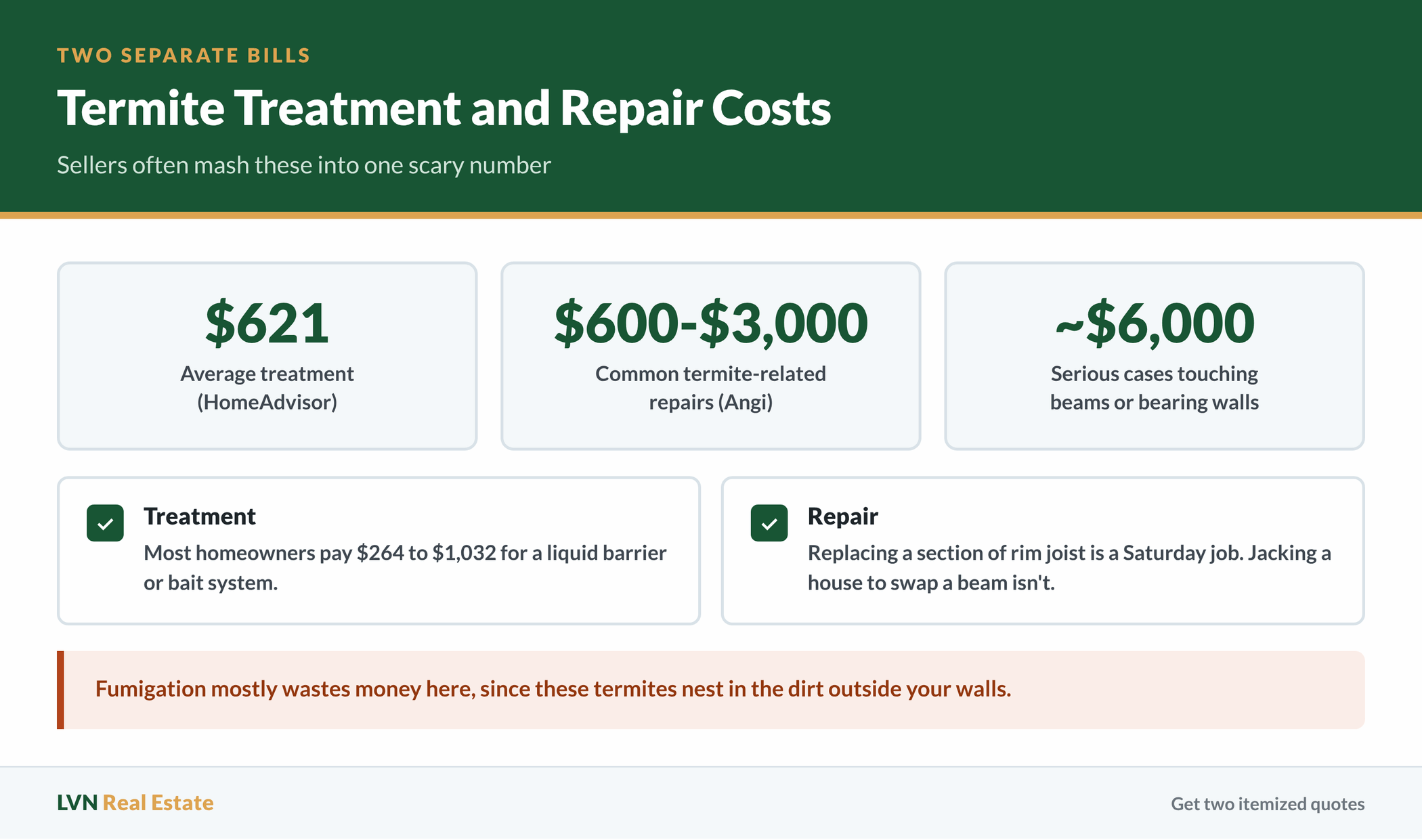
Which brings up the number everyone wants first. Treatment and repair are two separate bills, and sellers constantly mash them together into one terrifying figure.
Of the two, treatment is the cheaper half. HomeAdvisor’s national cost data puts the average termite treatment at $621, with most homeowners paying between $264 and $1,032. For the subterranean termites Colorado has, you’re looking at a liquid barrier or a bait system rather than tenting. CSU Extension explains that a chemical barrier in the soil keeps termites from reaching the wood and can keep working for years. Baiting is the other route, though CSU notes it costs more and doesn’t give immediate control. Fumigation mostly wastes money here, since these termites nest in the dirt outside your walls.
Repairs after termites span a much wider range. Angi puts most termite damage repairs between $600 and $3,000, with serious work on load-bearing walls or beams running up to $6,000. Replacing a section of rim joist in a Wheat Ridge bungalow is a Saturday job for a good framer. Jacking a house to swap a beam is not.
Colorado’s dry climate helps on one side and hurts on the other. Mountain and plains air keeps most crawl spaces dry. Watered lawns and flower beds against the foundation undo that, leaving exactly the damp soil termites want. I’ve bought houses in Aurora where the sprinkler heads pointed straight at the foundation for a decade.
Get two quotes. Make both pest-control companies itemize the inspection, the treatment, and the warranty separately, and then you’re comparing apples to apples.
Should You Treat Termites Before Listing Your Colorado Home?
Sitting at the kitchen table, I’d tell you: treat, don’t rebuild.
For a few hundred dollars, a finished termite treatment with a transferable warranty pays back better than almost anything else a Colorado seller can buy. It turns an active infestation into a treated property with documentation. Buyers stop imagining. Appraisers stop flagging. The conversation shifts from “is this house falling apart” to a clear record of what was done and when.
Full structural repair before listing is usually a losing trade. You eat the contractor markup and absorb the schedule risk. Then you find the second problem behind the first wall. Colorado contractors stay busy, so a two-week job turns into six.
Would you rather hand a buyer a receipt for treating the termites, or a renovation you managed from out of state?
One timing detail is worth knowing. Winged adults emerging inside a building, usually in spring or fall, are often how people first spot termites. CSU’s insect calendar for Pueblo and Fremont counties notes swarming can start as early as January and February, continuing into late winter. Termites swarming during a buyer’s final walkthrough can end the sale. Treating ahead of swarm season protects your contract, and CSU Extension’s termite fact sheet is worth ten minutes of your time.
Pair the treatment with a short written summary of where the technician found termites and what got treated. Plain language, one page.
Who Buys a House with Termites in Colorado Without Repairs?
A landlord in Pueblo inherited a duplex from an aunt and found mud tubes running up the basement wall behind a stack of old storm windows. He had no interest in becoming a remodeler at sixty-three.
Three groups buy houses with termites as-is in this state. Local investors renovate and resell, and buy-and-hold landlords add them to rental portfolios. Owner-occupants paying cash make up the third group, mostly people with construction backgrounds who see a discount instead of a disaster.
What these buyers share is the ability to price risk without a lender’s permission. No appraiser flags their file, and no underwriter demands a clear pest report before funding. They walk the property, estimate the framing work the termites left, and make an offer on the spot.
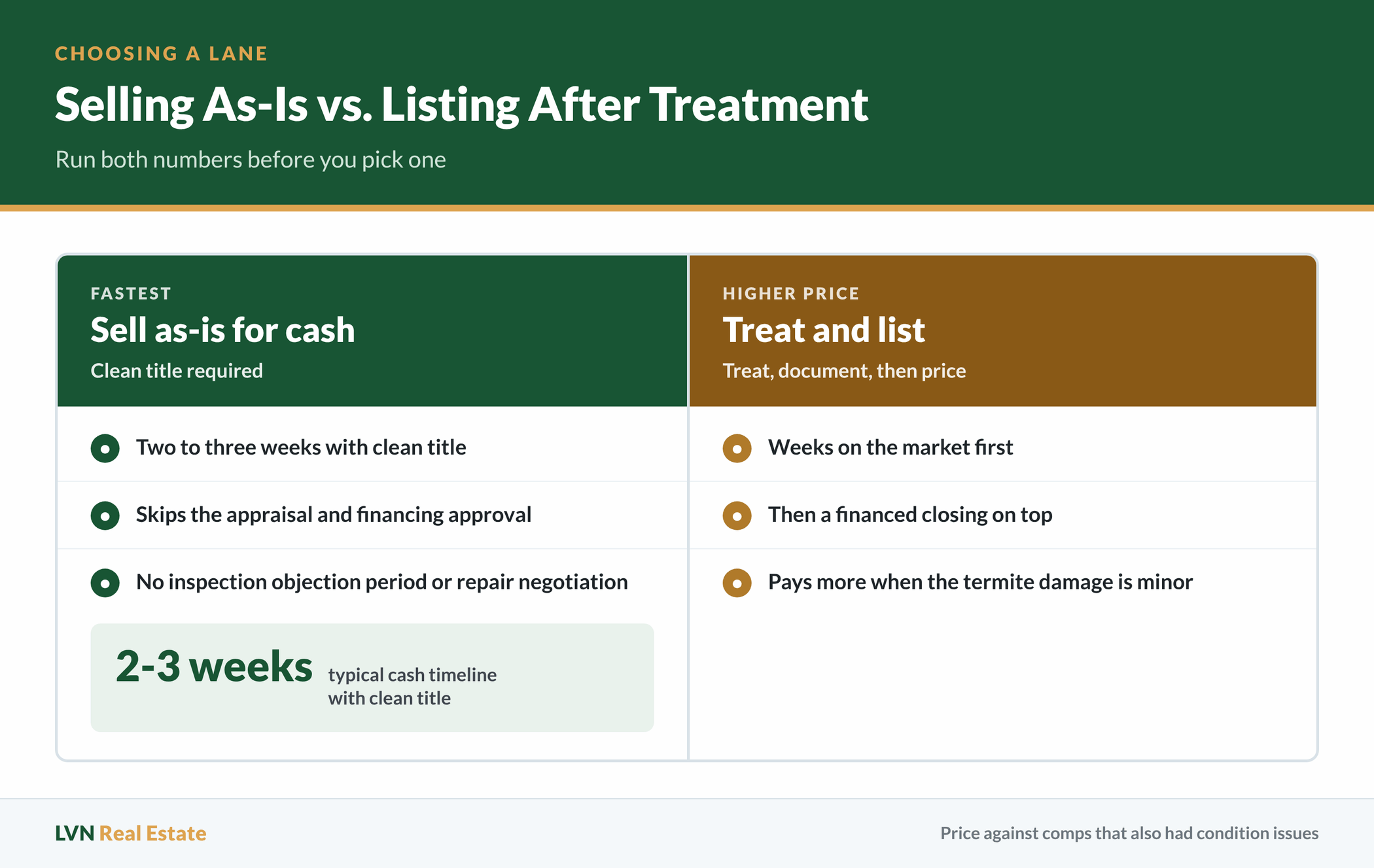
The tradeoff is real and I won’t dress it up. As-is offers land below retail, because the buyer is absorbing the repair cost plus the uncertainty plus their margin. If the termites left only minor damage and you have time and patience, the open market pays you more.
As-is wins when the repair bill, the carrying costs, and the delay all stack up against each other. LVN Real Estate works with Colorado homeowners in exactly that position, and we’ll tell you plainly when listing makes more sense than selling direct.
One pattern I keep seeing: sellers overestimate what the open market will pay for a repaired house and underestimate how long the repair takes. Run both numbers before you pick a lane.
What’s the Fastest Way to Sell a Termite-damaged House in Colorado?
“How quickly can this actually be done?”
Two to three weeks, if you sell to a cash buyer and your title is clean. The limiting factor is almost never the buyer or the termites. It’s the title commitment and the payoff statement from your lender.
Speed comes from cutting contingencies, not from marketing harder. A cash sale skips the appraisal and the financing approval. There’s also no inspection objection period or repair negotiation over termites to drag things out. A listed sale stacks weeks on the market ahead of a financed closing, and a direct sale skips both halves.
If you’d rather list, do three things first. Treat the termites, document the work, and price the house against recent comparable sales that also had condition issues. Don’t price it against the pristine flip down the block.
A couple in Littleton reached me after carrying two mortgages for close to a year. They’d moved to Grand Junction for work in the spring, then listed the old house that summer with the termites disclosed. Three buyers walked away from the contract during inspection. They’d been mowing a lawn they no longer lived near on alternating weekends, driving four hours each way. Selling as-is ended the double payment in under three weeks.
Before you commit to either path, get an honest valuation on the property in its current condition. LVN Real Estate will walk a house with termites in Colorado and give you a straight number without pushing you toward a sale.
Frequently Asked Questions About Selling a House with Termites in Colorado
Will a Lender Refuse to Finance a House with Termites in Colorado?
Not automatically. Conventional lenders usually fund the loan unless the appraiser calls out active structural damage. If termites turn up, a completed treatment with paperwork often settles the question. Government-backed loans apply tighter standards, so a buyer using VA or FHA financing may need the damage repaired before closing.
Does Homeowners Insurance Cover Termite Damage in Colorado?
Almost never. Standard policies treat termites as a maintenance issue rather than a sudden covered loss, so expect to pay for treatment and repairs yourself. Read your own policy language, but don’t build your selling plan around an insurance payout.
Can I Sell a House with Termites in Colorado As-is and Skip the Disclosure?
Selling as-is doesn’t erase your duty to reveal known material defects. The as-is language covers who pays for repairs, not what you’re obligated to tell a buyer. Disclose the termites, hand over any reports you have, and let the price reflect the condition.
Should I Lower My Price or Offer a Repair Credit for Termite Damage?
A repair credit usually works better once the termites are treated and the damage is written up. It keeps your list price intact. The buyer gets money toward the sill plate or rim joist work and picks their own contractor. A price cut fits better when nobody has measured the termite damage, since buyers discount for uncertainty anyway. Either way, tie the number to a written repair estimate instead of a guess.
Talk Through Your Termite Report With Us
Send us what the pest inspector found, even if it’s a rough photo of the report. We’ll walk you through what the house is worth as it sits and what it might bring after treatment. If listing it yourself is the better move, we’ll say so. When you’re ready, contact LVN Real Estate or use the form below.