
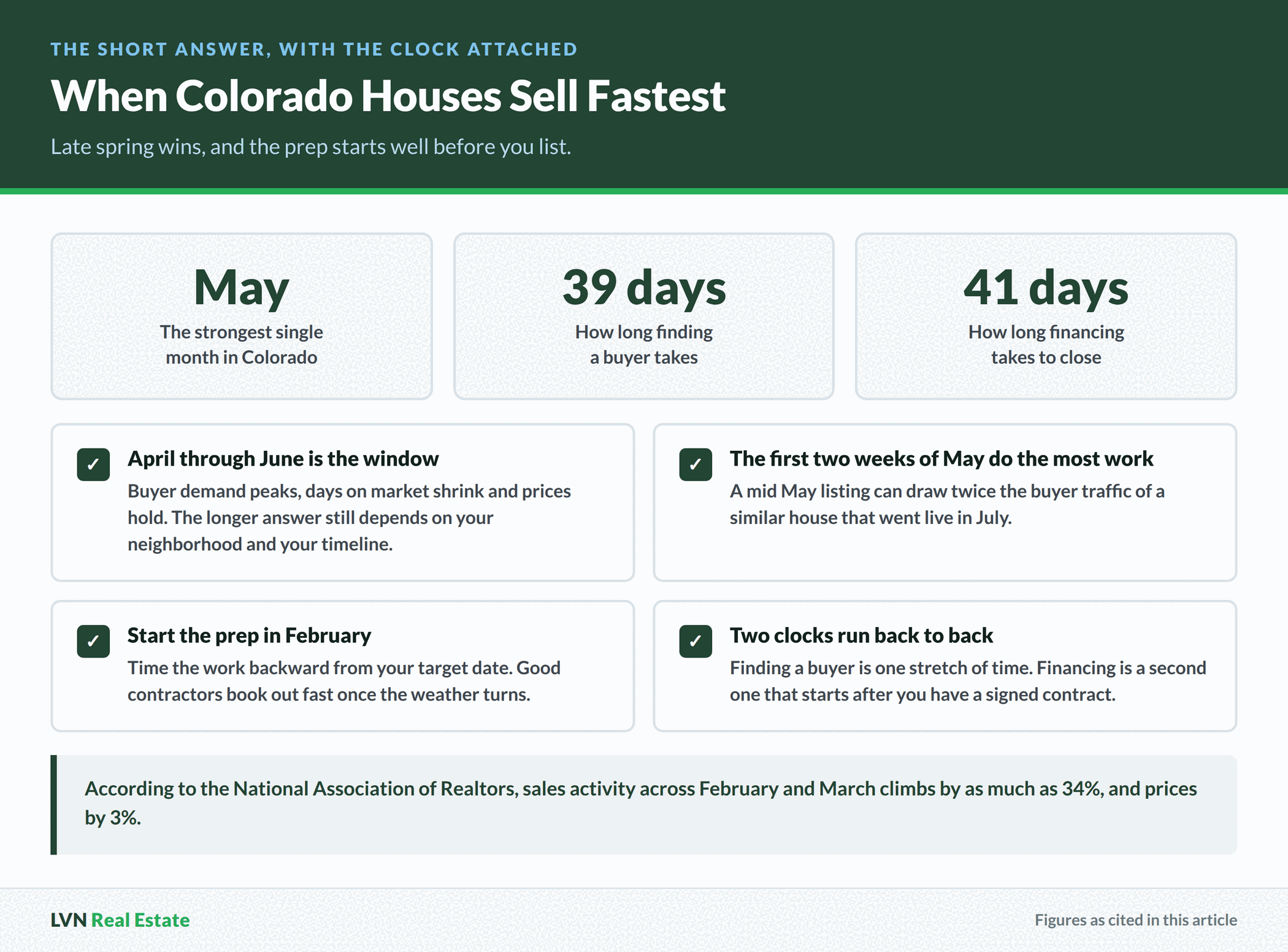
List in spring. You’ve heard that a hundred times, and it’s mostly right. What the advice never tells you is how it lands on your own house along the Front Range, or what to do when spring doesn’t fit your life. Late spring, roughly April through June, is the best time to sell a house in Colorado. Buyer demand peaks, days on market shrink, and prices hold. That’s the short answer, and the longer one depends on your neighborhood and your timeline.
Why Timing Your Sale Matters More in Colorado Than You Think
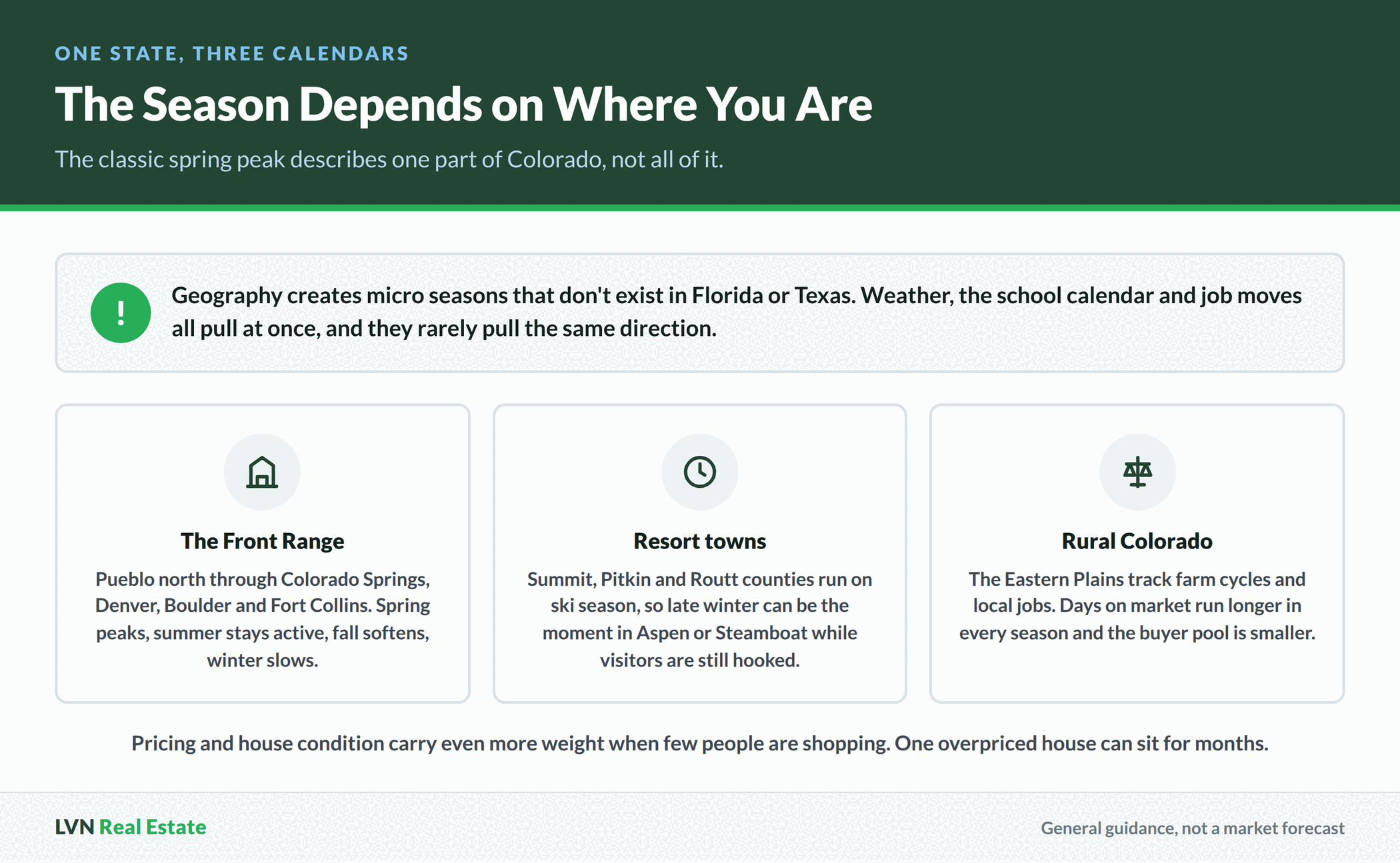
Colorado isn’t a typical market. Geography creates micro seasons that don’t exist in Florida or Texas. A late April snowstorm can wipe out a weekend of showings on the Front Range. A dry winter in a resort town softens demand and makes a house harder to move. Weather, the school calendar and job moves all pull at once, and they rarely pull the same direction.
Timing shapes two things sellers care about, how fast the house goes and what price it brings. A house that sits 60 days in a slow stretch closes under what it would have brought in a brisk spring market. Buyers start wondering what’s wrong with it. Agents start asking about price history. That’s how buyers think, not scare talk. Get the calendar right and you keep a real edge.
There’s a supply side most sellers miss. When you list your house matters partly because of how many other houses are chasing the same buyers. A January listing faces a smaller buyer pool. It also faces far less rivalry, sometimes a lot less in mountain towns. Weigh that trade honestly. Plenty of Colorado sellers pick a month out of habit, without checking what the house down the street did.
How Colorado’s Seasonal Market Actually Behaves
The Colorado Association of Realtors (CAR) publishes monthly trend reports by region, and they’re the most solid state numbers you’ll find. Their Market Trends Housing Report has the state’s housing market closing 2025 balanced and cautious. Balance cuts both ways. Sellers can still do well, and getting the price right matters more than it did in the 2021 and 2022 frenzy. A sloppy number got rescued back then, and it doesn’t now.
Early 2026 has looked a lot like 2025, 2024 and 2023: steady sales, stable prices, high but workable supply. So the old pattern is back. When the market ran white hot, your listing month barely registered. The calendar counts again, and the year over year data keeps saying so.
Pull real figures for your own county before you list your house. REcolorado, Colorado’s main MLS, puts out public market numbers. The Denver Metro Association of Realtors puts out a monthly report for the seven county region. The Federal Reserve’s FRED database carries Colorado days on market going back years. Read three things: days on market in your price range, months of inventory, and the share of list price that homes are closing at.
Days on Market and Months of Inventory by Season
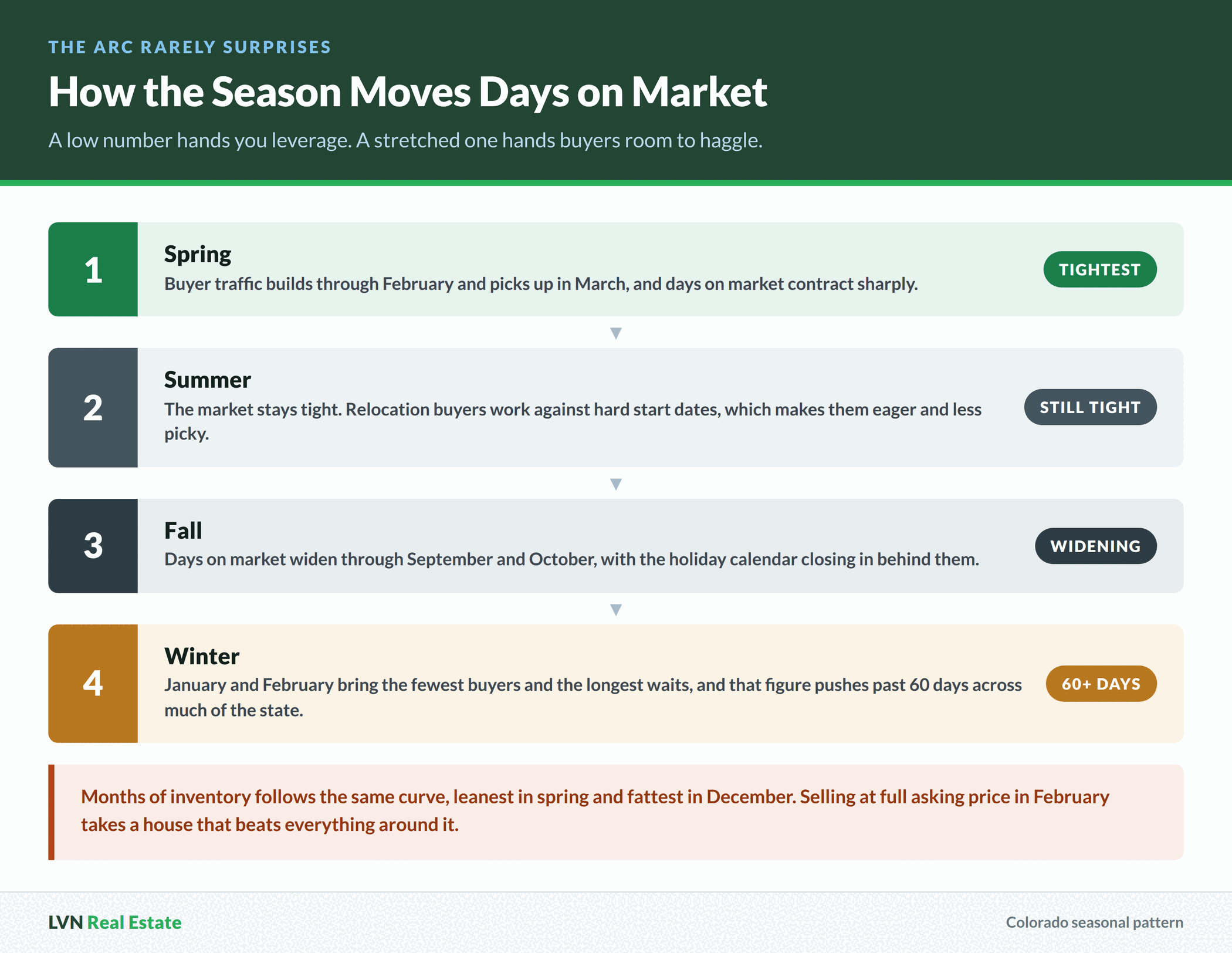
Days on market measures how long a listing takes to reach a signed contract, and DOM is the clearest read on where you stand. A low number hands you leverage, while a stretched one hands buyers room to haggle. In Colorado, the arc rarely surprises. It contracts sharply in spring, stays tight through summer, widens in fall, then peaks in January and February. How long Colorado real estate contracts last depends on which of those windows you list in.
Denver’s June days on market have crept up each of the last four years, and even the slowest of those Junes sat inside the peak season. In winter, that figure pushes past 60 days across much of the Front Range. A house drawing three showings a weekend in May can sit a full week in January. Months of inventory follow the same curve, leanest in spring and fattest in December. Selling at full asking price in February takes a house that beats everything around it.
Spring Is the Best Time to Sell a House in Colorado
Buyer traffic builds through February, then picks up in March as tax refunds land, families plan summer moves, and warm weather pulls buyers into open houses. By April you’re facing the most pre-approved buyers the year will bring. According to the National Association of Realtors, sales activity across February and March climbs by as much as 34%, and prices by 3%.
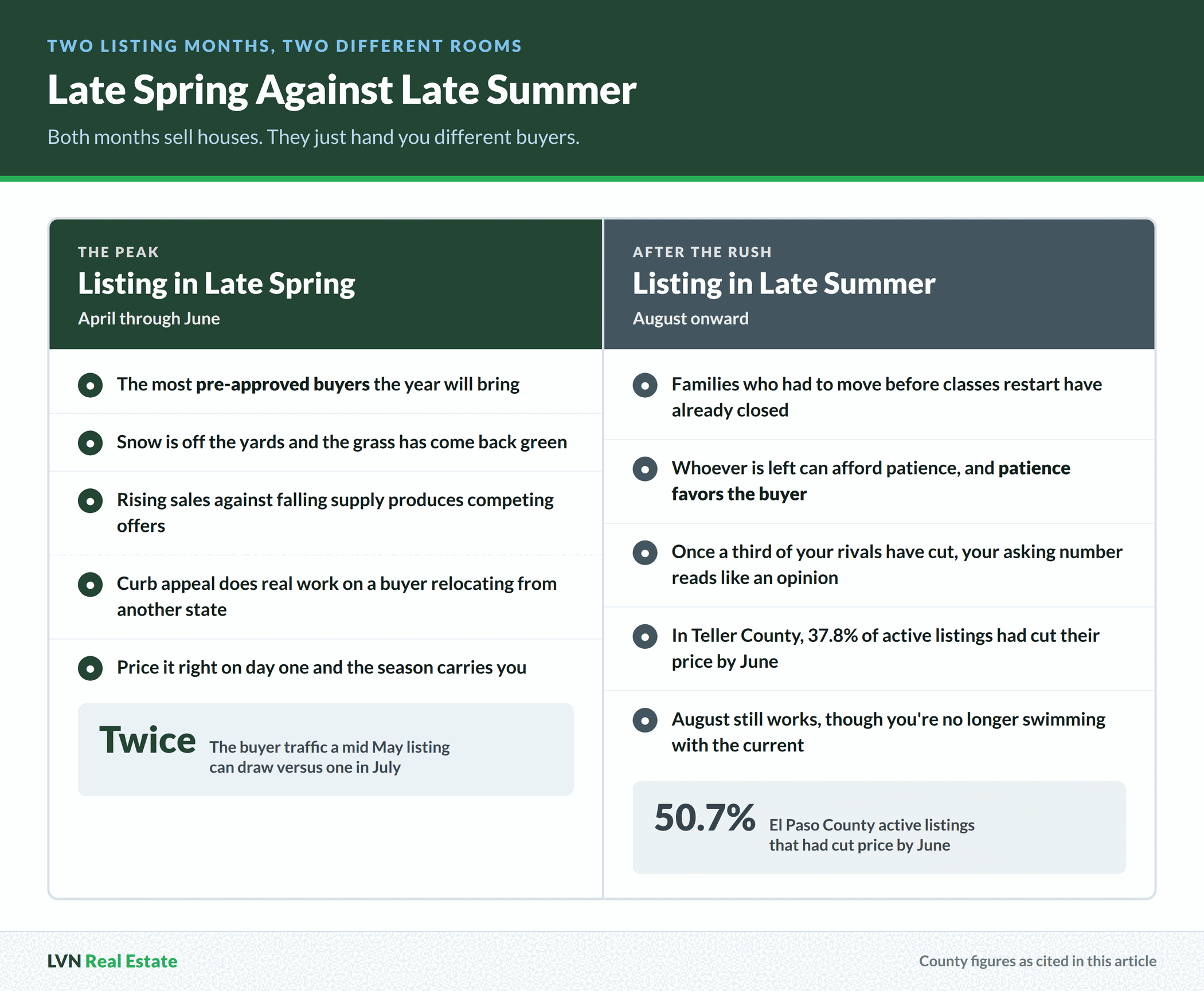
May is usually the strongest month in Colorado, and its first two weeks are the best of it. A mid May listing can draw twice the buyer traffic of a similar house that went live in July. Sold listings along the Colorado Front Range have run ahead of the prior year in May, with median price up slightly and active listings down. Rising sales against falling supply is the mix that produces competing offers. The Colorado spring market rewards a seller who prices the house right on day one.
Spring flatters a house, too. Snow is off the yards, the grass has come back green, and the peaks behind it are still white. For a homebuyer relocating from another state, that picture does real work on curb appeal. Time the prep backward from your target date. Finding a buyer takes about 39 days, and financing takes roughly 41 days to close, so start decluttering and making repairs in February. Good contractors book out fast once the weather turns.
Summer Keeps Selling, Then Loses Steam
Summer keeps the market humming, though the buyer pool changes character. Spring shoppers skew local, move up families and first timers. Summer brings people transferring into Denver, Colorado Springs, Fort Collins or Pueblo for work. Relocation timing runs against a hard start date, which makes those buyers eager and a lot less picky. One can go from first showing to signed contract over a weekend.
Families drive more of this than sellers expect. Anyone who wants to be settled before classes restart in late August is making offers in June and July. A house listed in June or early July still sells well in most Colorado towns, above all in a strong school district.
August is where the season loses its edge. The families who had to move before school started have closed. Whoever is left can afford patience, and patience favors the buyer. In El Paso County, 50.7% of active listings had cut their price by June, along with 37.8% in Teller County. Once a third of your rivals have cut, your asking number reads like an opinion. August still works, though you’re no longer swimming with the current.
Fall Gives You a Second Window to List Your House
September and October make a genuine second window, and sellers who write fall off lose a real option. Supply drops as owners who struck out over the summer pull their houses off the market. The buyers still shopping in October want to close before the holidays.
In October Colorado recorded 9,659 new listings and 7,353 home sales, with active listings at 30,803, about 4.3 months of supply. Your home looks great in photos in a Colorado fall. Aspen gold in the foothills, blue skies, easy showing weather. Nobody walking a yard in October is fighting a July heat wave.
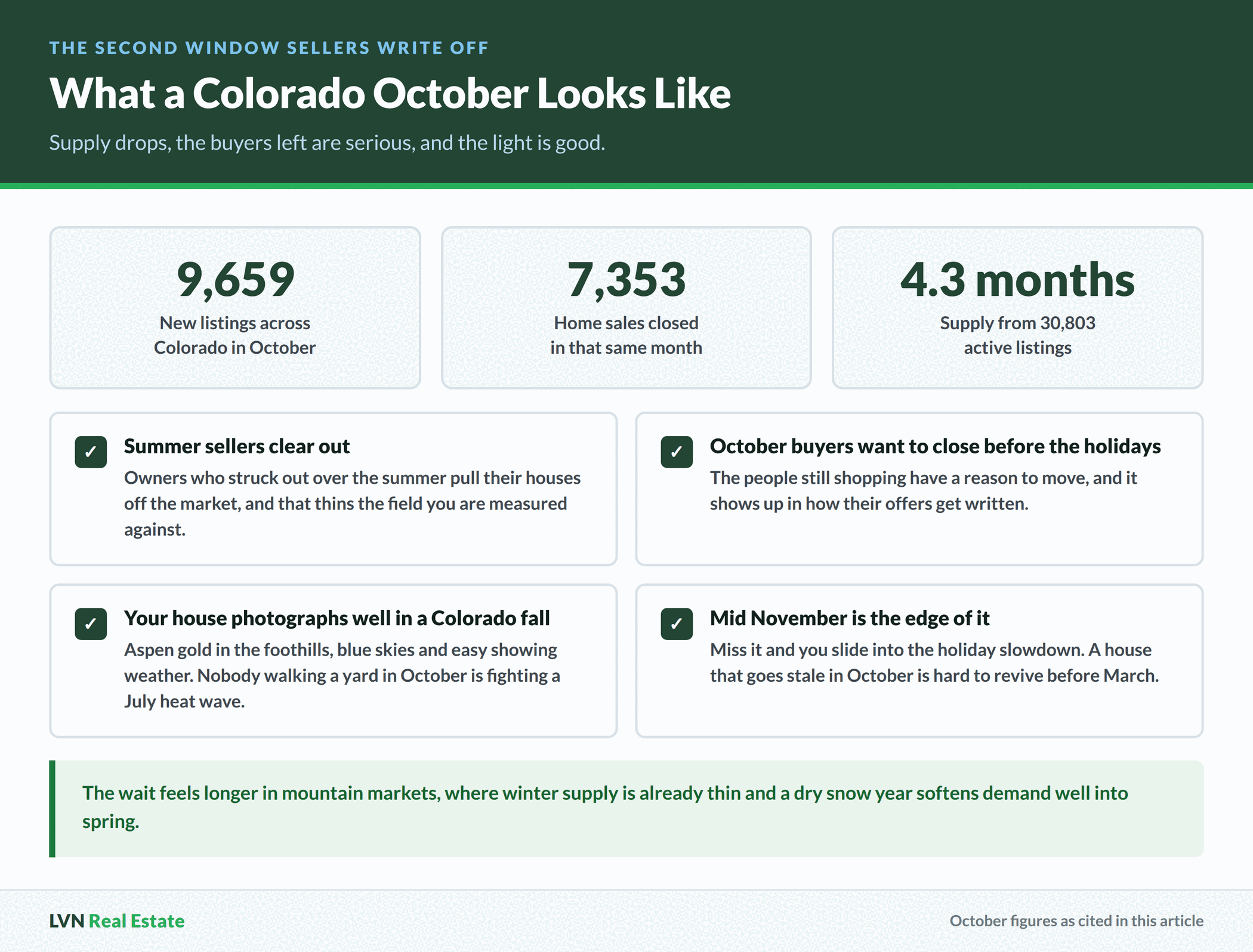
The risk is what sits behind it on the calendar. Miss mid November and you slide into the holiday slowdown. A Colorado house that goes stale in October is hard to revive before March, and that wait feels longer in mountain markets where winter supply is already thin.
Why Winter Is the Hardest Time to Sell a House in Colorado
January and February are the slowest months in Colorado, with the fewest buyers and the longest waits. Cold weather and the holidays thin the active pool, which drags out marketing time and pulls median prices under the rest of the year. In Colorado mountain towns that gap runs wide.
Winter still isn’t a dead zone, and winter home selling works for plenty of eager Colorado sellers. Buyers out in the cold tend to be serious, and a thin field helps a house that’s priced well and staged with some care. Be the only sane listing in your neighborhood in January and you get attention by default.
Your exterior is the real problem. Snow hides the yard, the driveway looks grim, and short daylight makes showings hard to set up. A mountain view off the back deck may not survive a 4 p.m. photo in fading light. Save your summer drone shots. Keep the walkways clear, show the interior at its warmest, and highlight what a winter buyer actually wants: a gas fireplace, a heated garage, a mudroom that swallows ski gear. Lean into what the house already offers instead of fighting the season.
How the Denver Metro and Front Range Differ From the Rest of the State
The Front Range, running from Pueblo north through Colorado Springs, Denver, Boulder and Fort Collins, keeps a rhythm of its own. Here the seasonal pattern above holds up well. Spring peaks, summer stays active, fall softens, winter slows. Employers, growth and commuting drive the Denver metro market, and all three feed your final price.
Resort towns like Summit County, Pitkin County and Routt County run on a different clock. Ski season creates a winter surge, so the best time to sell in Aspen or Steamboat can be late winter, while visitors are still hooked on the place. Those markets carry heavier supply and more weather risk. A dry snow year softens demand well into spring.
Rural Colorado, the Eastern Plains especially, tracks farm cycles and local jobs more than anything else. Days on market run longer out there in every season, and the buyer pool is smaller. Pricing and house condition carry even more weight when few people are shopping. One overpriced house can sit for months.
What Mortgage Rates and Price Reductions Tell You
Rates and seasonal demand run on different clocks, and where they meet shapes your plan. Buyers shop off what their monthly payment allows, so mortgage rates still set the ceiling. In April 2026 the 30 year fixed spent most of the month between 6.29% and 6.56%, averaging around 6.37%. That isn’t low enough to create urgency. It is steady enough for house hunters to plan around.
Nobody should count on a rate drop to bail out an overpriced house. Colorado sellers who set a realistic number at the start stay out of the price cut cycle entirely. Price reductions signal weakness, invite lower offers, and cost more than the reduction itself. Two cuts in six weeks tells every buyer’s agent in town to wait you out.
Check the reduction rate in your zip code first. If 40 or 50 percent of the active listings have already cut, the neighborhood has been asking too much, and yours gets measured against the corrected numbers. Price it honestly and you’ll sell faster without chasing the market down.
Your Timeline Matters as Much as the Market
From a market perspective, spring wins. From yours, the best time to sell is whenever your life requires it. What good is a May peak to someone who has to close in November? Divorce, a job transfer, a family member’s health, an inherited property, money pressure: none of it waits for seasonal buyer demand to show up.
If you have flexibility, use it. Get the house ready in February, list in late March or April, and let the spring selling season carry you. If you don’t, don’t let the calendar freeze you in place. Houses sell in every month of the year in Colorado. The plan barely changes either way. Price for the market you’re in, show the place well, and stay honest about what your month will bear.
Plenty of sellers aren’t chasing the highest number anyway. They’re after a sure thing. A job starts on a fixed date. An estate has to be settled by one. A normal listing creates real problems on a firm deadline, between open houses, contingencies, financing delays and the chance a sale collapses late. A cash sale timeline sidesteps most of that. No financing contingency means no waiting on an underwriter, and no inspection contingency means no fights over repairs after the fact. The closing date gets agreed upfront and it holds.
Frequently Asked Questions
What is the best time to sell a house in Colorado?
Late spring, and May shows the strongest mix of buyer demand, pricing strength and short days on market. April and June sit close behind. List between late March and mid June and you’re working with the current instead of against it. Local market conditions and your own schedule still shape what the best time to sell means for you.
How long does it take to sell a house in Colorado?
That depends on season and location. In Greeley, homes have been selling in 17 days on market at about 99% of list price. Denver has run slower, with June climbing from 30 days in 2023 to 42 days in 2026. Winter adds real time across the board. Check your own county first, because a Colorado house listed in the spring market sells on a different clock than it does in January.
Does the Front Range follow the same seasonal trends as mountain communities?
Not exactly. The Front Range follows the classic spring peak and winter trough. Resort towns see winter demand spikes tied to ski season, and they swing with the snow and the mood of vacation home buyers. If you’re outside the Front Range, treat the general advice as a start and check it against local data.
Can I sell a house in Colorado during winter and still get a good price?
Yes, within reason. In the Colorado Springs region, homes stayed on the market an average of 57 days in December, and months’ supply rose from 2.4 to 2.9 months year over year. That’s a real slowdown, not a collapsed market. Price the house accurately, stage it, and keep the exterior easy to walk. You may not see the multiple offer scramble May produces, though a clean sale at a fair price is very much on the table.
Making the Right Call
For most sellers, the best time to sell a house in Colorado is the spring market. That’s what data from CAR, REcolorado and years of Front Range sales keep showing. If your timeline lines up with April, May or June, take it.
The calendar isn’t everything, though. A house priced wrong struggles in May about as badly as it would in January, and a house priced right can sell in any month. Know your local Colorado market conditions, set the right number, and present the home at its best for whatever season you’re in.
Maybe you’re facing a hard deadline, a relocation, or an estate. Which matters more to you, the last few thousand dollars or a date you can count on? LVN Real Estate has been buying houses as-is across Colorado since 2013. We’re glad to look at yours with no pressure and no strings. If you’d like a second set of eyes on your timeline, we’re around.
Where LVN Real Estate Buys Houses in Any Month
The season doesn’t change what we look at. We buy houses in Denver, Aurora, Lakewood, Arvada, Thornton and Boulder, and a January listing gets the same attention a May one does. You get to sell on your own schedule. If you need to sell a house in Colorado on a date that has nothing to do with the spring market, that’s a normal week around here. Our service area runs the length of the state and reaches the mountain towns and the Western Slope.
Talk Through Your Timing With No Pressure
Nothing has to happen today. If you’d like a straight read on what your house would bring in a cash sale, and how that stacks up against waiting for the best time to sell a house in Colorado, contact us and we’ll take a look at it. There’s no obligation and nobody will chase you afterward. If you’d rather read first, our common questions page covers how a cash offer gets built and what happens once you accept one. Or fill out the short form below, tell us the timeline you’re working with, and we’ll come back to you with a number you can weigh against a spring listing.