
You’ve decided you don’t want to hand over a listing commission. Fair enough. Plenty of Colorado sellers have run their own sale from pricing through closing and come out happy. They knew what they were signing up for before the sign went in the yard. This guide covers what it takes to sell your house by owner in Colorado: the paperwork, the pricing, the sticking points, and when to call a pro.
What It Means to Sell a House by Owner in Colorado
For sale by owner means you take on every task a listing agent would handle. Pricing the house, shooting photos, marketing it, fielding calls, scheduling showings, negotiating, and tracking deadlines all land on you. Nothing gets handed off. Three of those punish guesswork: the price, the Colorado disclosures, and the buyer negotiation.
The National Association of Realtors puts the FSBO share at about 5% of homes sold last year, the lowest NAR has recorded since it began tracking in 1981. The number keeps shrinking, mostly because sellers underestimate the work. Sellers who plan ahead and treat it like a project pull it off. Along the Front Range a well-priced house finds a buyer, though condition matters a lot.
Read this before you list, because problems in for sale by owner transactions almost always trace back to something the seller never saw coming.
Colorado Laws and Disclosures Every FSBO Seller Must Know
Colorado law puts real duties on a seller. Ignoring them creates liability that follows you past closing.
The Colorado Real Estate Commission publishes the standard form, the Colorado Contract to Buy and Sell Real Estate, and you can download it from the Colorado Division of Real Estate. Printed portions carry Commission approval, and the current version has a mandatory effective date. To sell a house by owner here, you fill that form out yourself, skipping the generic contracts online.
Most of the purchase agreement reads clearly once you see the structure. It names the parties, the house, the price, the financing method, and a table of deadlines covering title review, loan application, appraisal, survey, inspection, and closing. Business days and calendar days count differently. Miss one date and you can trigger a default or waive a right. Put every deadline on a calendar the day it gets signed, because nobody gets one back.
Sellers have to disclose any known issue that could hurt value or put a buyer’s safety or health at unreasonable risk. Colorado provides a standard Seller’s Property Disclosure form that gets attached to the contract. The form covers the house from the foundation to the roof. Fill it out honestly, including the repair you keep meaning to finish. Anyone who finds an undisclosed defect later has legal remedies, and Colorado courts take those seriously.
A few other disclosures matter here. If you know the house was ever used to produce methamphetamine, say so. Sellers also disclose their water source, which matters on rural wells. The Green Disclosure Form covers energy-related additions, solar leases included. Guessing hands someone a reason to walk.
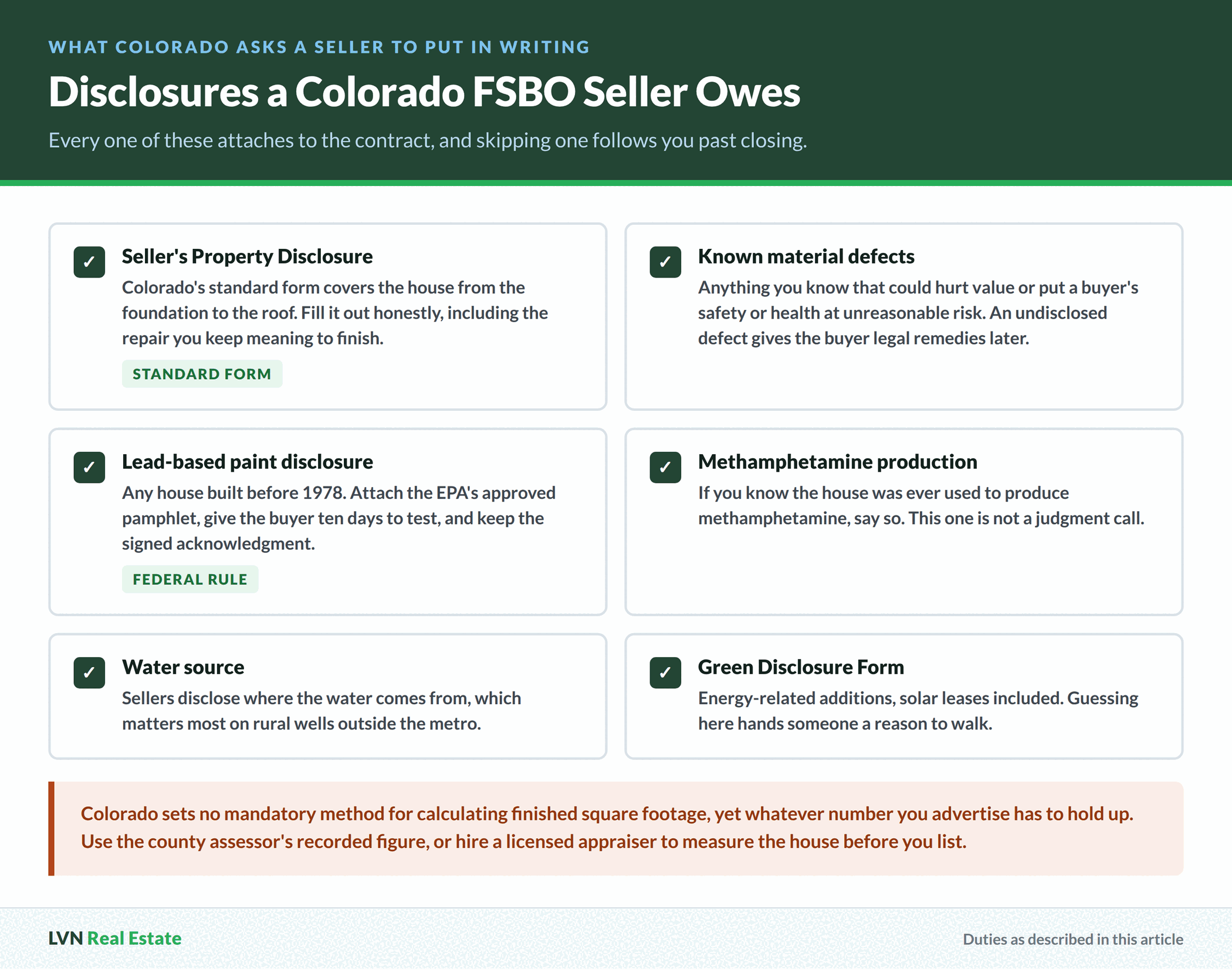
Any home built before 1978 needs a lead-based paint disclosure at transfer. That means whatever you know about lead there, plus the materials explaining the risk. The rule is federal, not Colorado-specific. Attach the EPA’s approved pamphlet, give the buyer ten days to test, and keep the signed acknowledgment.
Colorado sets no mandatory method for calculating finished square footage, yet whatever number you advertise has to hold up. Disputes after the sale usually start with a square footage disclosure nobody could back up. Use the county assessor’s recorded figure, or hire a licensed appraiser to measure the house before you list.
How to Price Your House to Attract a Serious Buyer
Pricing is where most for sale by owner sellers win or lose. Too high and the house sits, too low and you leave money behind.
Without MLS access, you’re on public data. The county assessor’s website shows recent prices by address, and Zillow and Redfin post sold data that lags. Look for comparable sales within a half-mile that closed in the last 90 days, with square footage within 15% and a similar bedroom, bathroom, and lot size. Three to five solid comps beat a dozen loose ones. Run comparative market analysis tools, or pay $300 to $600 for a professional appraisal you can defend in Denver or Colorado Springs. That beats a Zillow estimate when someone pushes back.
Anchoring to what you need rather than what Colorado buyers will pay is the most common mistake. Your mortgage payoff, your renovation costs, your moving expenses, none of it belongs in the math. Ignoring condition is the second mistake, since a house that needs a new roof won’t fetch what the turnkey place two streets over gets.
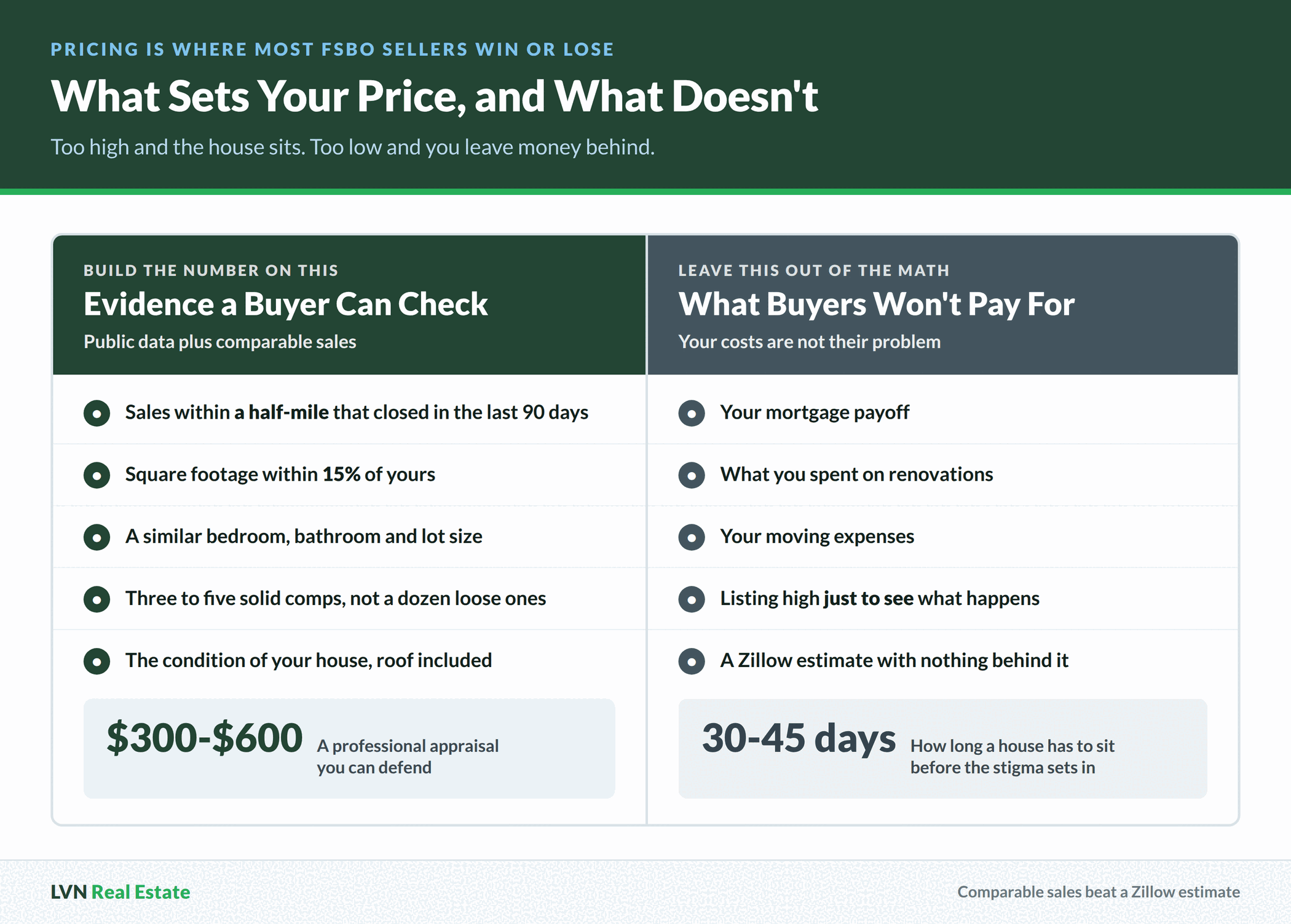
Resist listing high just to see. Buyers and their agents watch days on market closely. A house that sits 30 or 45 days carries a stigma, and everyone shopping your zip code notices. After a price cut you’ll field weaker offers than the first two weeks would. Price it accurately and you sell your house faster, with less back and forth before the sale.
Getting Your Colorado House Ready to Sell
Before you sell your house, it has to look cared for, which doesn’t mean a renovation. Fix the leaky faucet, patch the scuffed drywall, swap the burned-out bulbs, power-wash the driveway. The driveway surprises people most, since a clean one says the house was maintained.
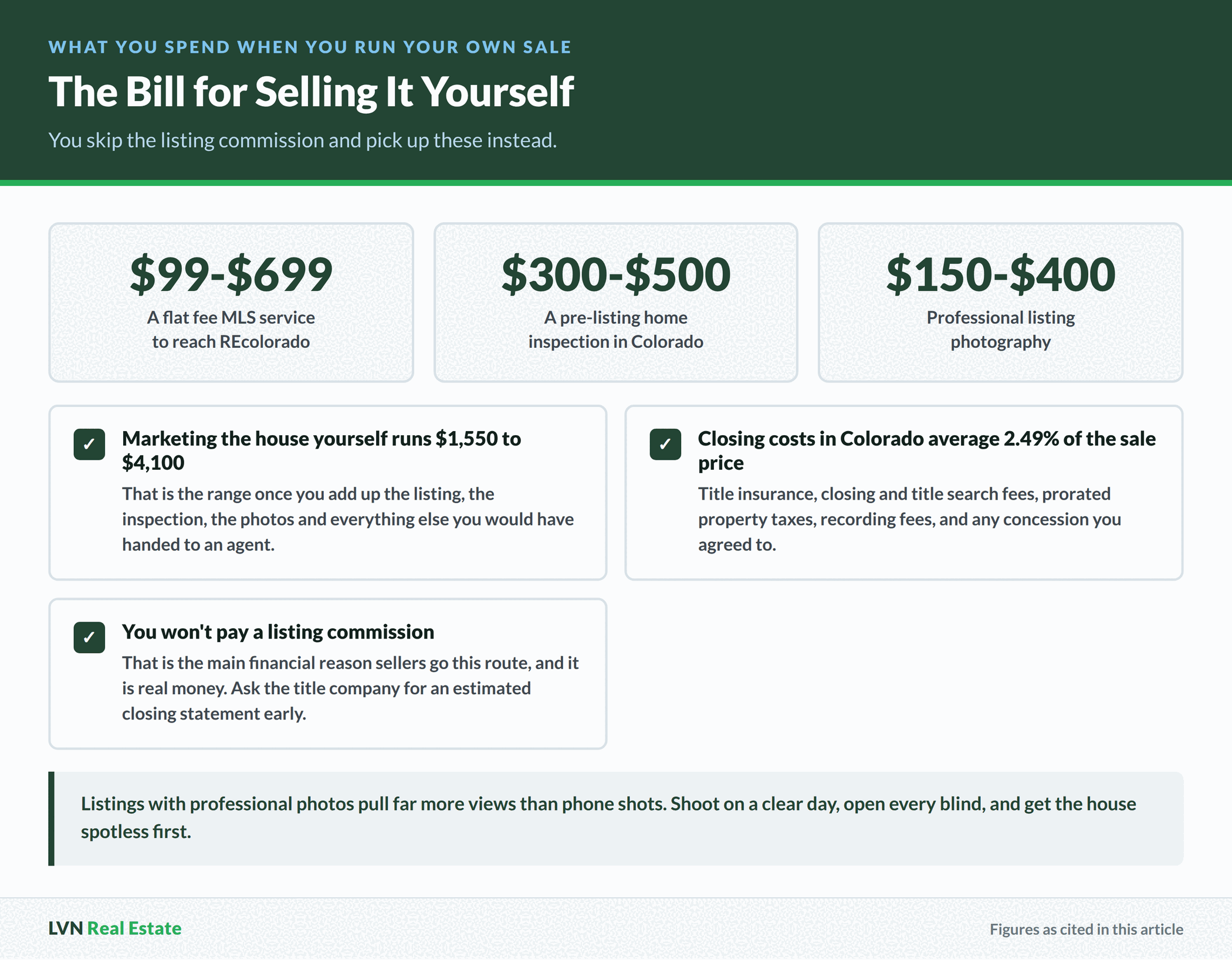
Plenty of Colorado sellers order a home inspection before they list. Handling the findings upfront makes buyers comfortable writing an offer, and a pre-listing inspection runs $300 to $500 here, with a report you can hand to anyone. Knowing about a cracked heat exchanger beats learning about it under a deadline.
Photography gets treated as an afterthought. Listings with professional photos pull far more views than phone shots, and the work costs $150 to $400, a small fraction of what’s riding on the sale. Shoot on a clear day, open every blind, get the house spotless first.
How to List and Market Your House as For Sale by Owner
You can sell a house by owner in Colorado without ever touching the MLS, though your pool of buyers shrinks. Most buyers start on Zillow, Realtor.com, or Redfin, and all three pull from MLS data. A flat fee MLS service is the cheapest way back in.
REcolorado is the state’s primary MLS. Brokers maintain it as a private database, so homeowners can’t post to it directly. Flat fee MLS services get around that, so you pay once, a licensed broker submits your listing, and nobody takes over. Expect $99 to $699. You still control the description, the photos, and the showing instructions, and you decide who to sell your house to. Read the fine print, because some charge extra for changes, and some leave every piece of paperwork to the seller.
Beyond the MLS, post on Zillow’s For Sale By Owner section, Facebook Marketplace, and Craigslist. A yard sign still works where people cruise the streets on weekends. Put a lockbox on the door so a real estate agent can run showings without you blocking out afternoons. Work your personal network too, since neighbors and coworkers turn up more buyers than anyone expects.
Handling Buyer Inquiries, Showings, and Offers
Set up a dedicated email address and a Google Voice number so your contact information stays private. Answer every inquiry within a few hours, because people who wait move on, and there’s usually another house on the same street.
Give buyers a reasonable window to walk through without you hovering. Nobody says what they actually think about a house while the seller stands in the kitchen, so step outside, or leave. Have a one-page fact sheet ready with square footage, year built, HOA fees, utility averages, and upgrades, which cuts the follow-up questions and signals you did the homework.
When an offer arrives, read the whole purchase agreement before you respond. Check the price, the financing contingency, the inspection deadline, the closing date, and the earnest money. The bigger number isn’t always the better offer, though. Thin earnest money and a vague contingency lose to a pre-approved buyer with a solid down payment.
Negotiating the Purchase Agreement on Your Own
Nobody hands you a script when you sell a house by owner. Negotiating without a real estate agent means talking straight with a buyer, or with a buyer’s agent who has run this play many times. Keep your emotions out of it, because a calm seller who sticks to the numbers holds up fine.
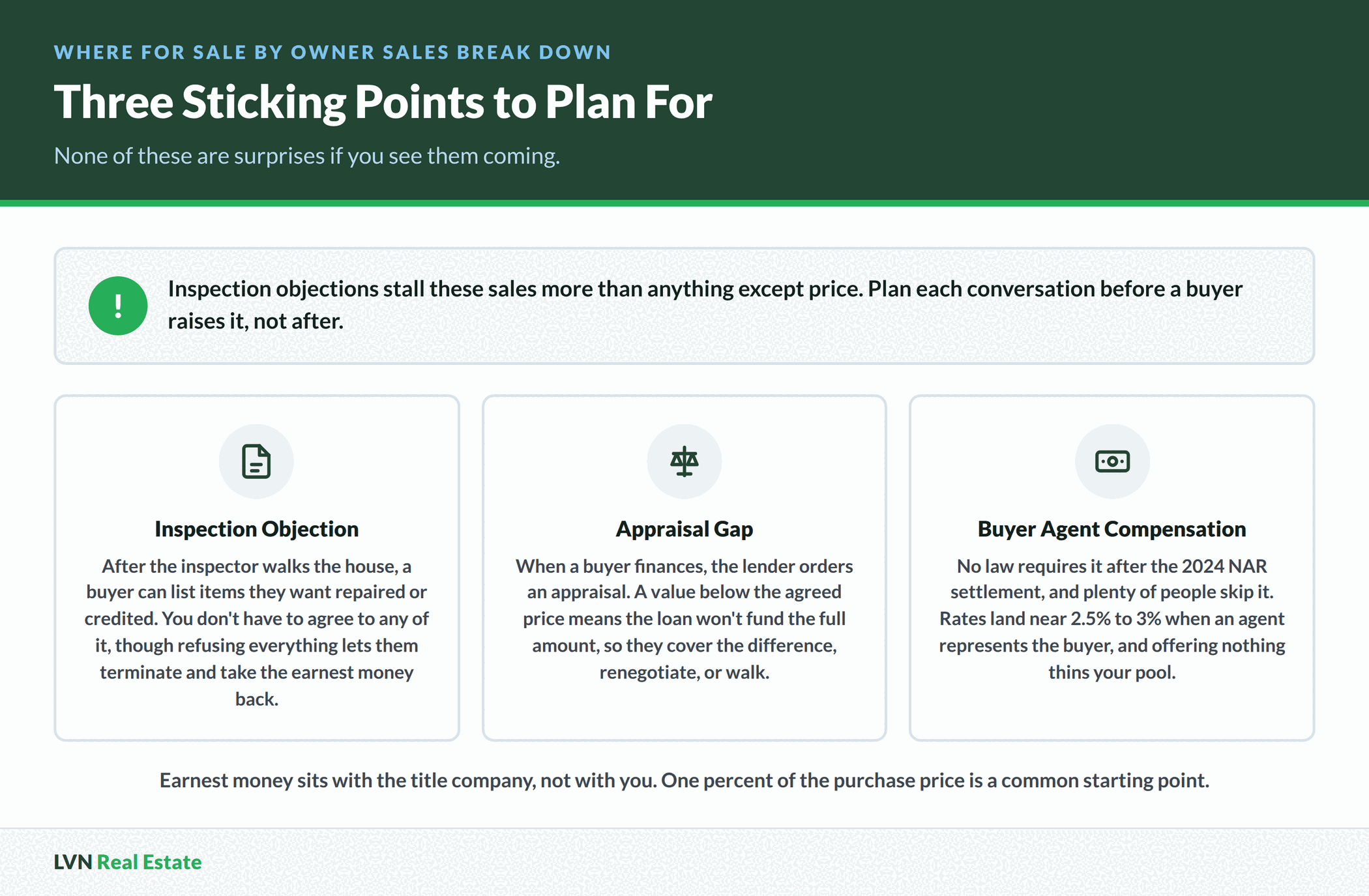
A buyer puts up earnest money when they sign. In Colorado the title company holds it, not the seller. The amount is negotiable, though 1% of the purchase price is a common starting point. Someone who terminates inside an allowed contingency period gets it back. Terminate outside those windows with no basis, and you may keep it, so read that section twice.
After the 2024 NAR settlement, buyers and sellers negotiate fees with their own agents. Most still expect a concession covering their agent’s cost. Offer nothing and you raise the cash they bring, which thins your pool. Other Colorado sellers on the same street offer one, so your house can look expensive beside theirs. No law requires buyer agent compensation, and plenty of people skip it, though rates land near 2.5% to 3% when a real estate agent represents the buyer.
Inspection objections stall these sales more than anything except price. After the inspector walks the house, a buyer can submit an Inspection Objection listing items they want repaired or credited. You don’t have to agree to any of it. Refuse everything, though. They can terminate and take the earnest money. Address the legitimate safety items, negotiate the rest, let the cosmetic complaints go.
The appraisal gap is the third sticking point. When a buyer finances, the lender orders an appraisal, and a value below the agreed price means it won’t fund the full amount. They cover the difference, renegotiate, or walk. A for sale by owner seller should plan that conversation early. Solid comparable sales give you an argument for holding firm, and overpricing the house makes the appraisal say so out loud.
Working With a Title Company to Close the Sale
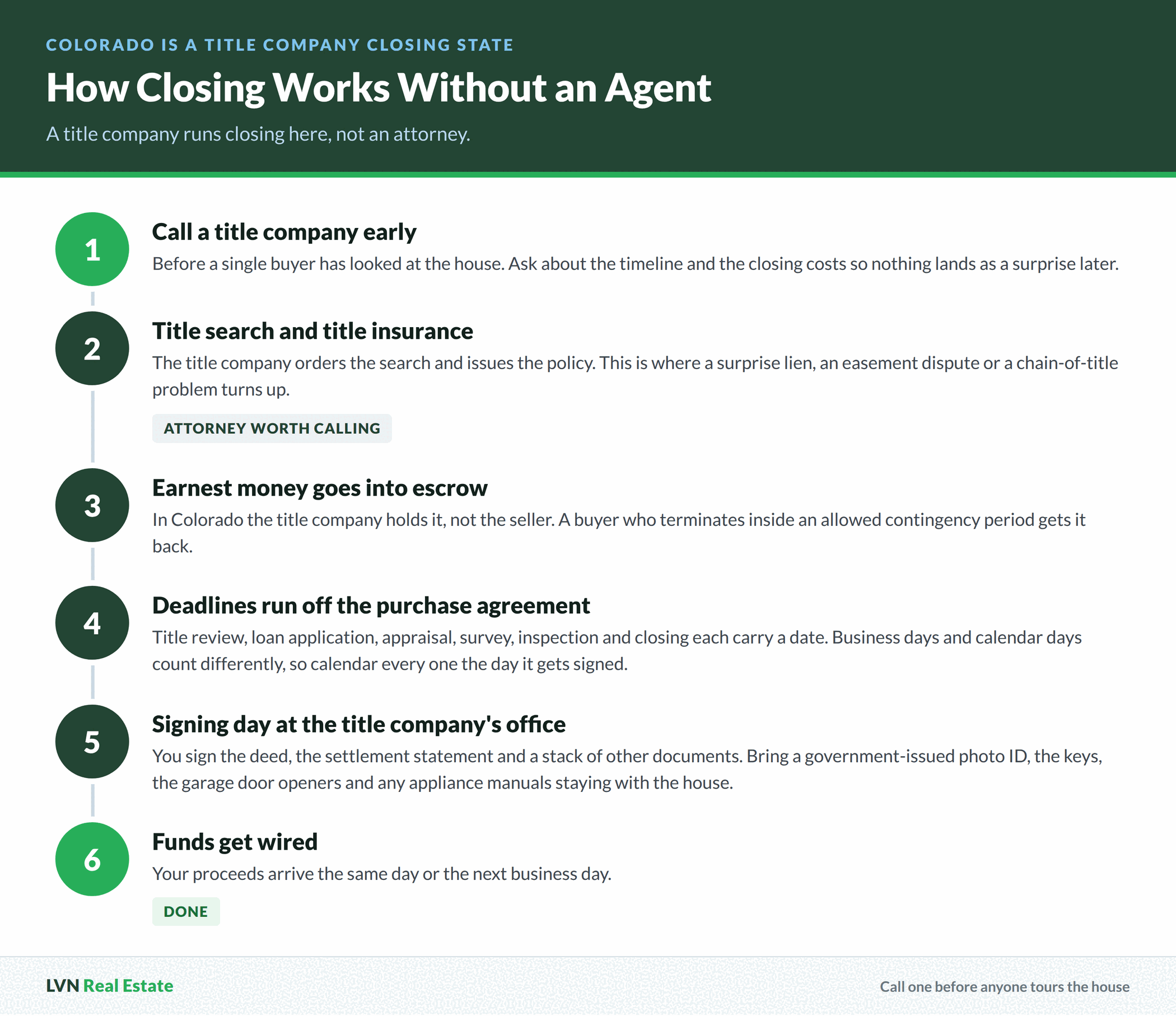
Colorado is a title company closing state. A title company runs closing, not an attorney. It orders a title search, issues title insurance, holds earnest money, prepares documents, and wires funds on closing day. Call one early, before anyone has looked at the house, and ask about the timeline and the closing costs.
Closing costs in Colorado average 2.49% of the final sale price. As a for sale by owner seller, yours cover title insurance, closing and title search fees, prorated property taxes, recording fees, and any concession you agreed to. You won’t pay a listing commission, the main financial reason sellers go this route. Marketing the house yourself runs $1,550 to $4,100. Ask for an estimated closing statement early, since that math is better seen sooner.
It all happens at the title company’s office. You’ll sign the deed, the settlement statement, and a stack of other documents. Bring a government-issued photo ID, the keys, the garage door openers, and any appliance manuals staying with the house. Your proceeds get wired the same day or the next business day.
When to Consider Hiring a Real Estate Attorney
A seller who finds a surprise lien three days before closing learns fast why legal counsel matters. Colorado doesn’t require a real estate attorney at closing, though plenty of situations make one worth the cost. Say the title search turns up a lien, an easement dispute, or a chain-of-title problem. A real estate attorney clears it faster than you can. If an addendum reads like a puzzle, an hour of review is cheap.
Transaction coordinators cost less and handle the grunt work. They manage deadlines, track documents, and talk to the title company and the buyer’s agent. They give no legal advice, and for a first-timer that’s money well spent.
Frequently Asked Questions About How to Sell a House by Owner in Colorado
Do I need a real estate agent to sell my house in Colorado?
No. Colorado law doesn’t require you to hire a real estate agent. You’ll handle your own paperwork, disclosures, and negotiations, and you’ll work with the title company at closing. Some buyers bring their own real estate agent. That agent represents them, not you.
How do I get my FSBO house on the MLS without an agent?
A for sale by owner listing reaches REcolorado through a flat fee MLS service. You pay a one-time fee, hand over your listing details and photos, and a licensed broker enters it. The MLS is a private database brokers maintain, and its listings feed Realtor.com and Zillow. That’s most of your online presence.
What closing costs should I expect when I sell my house by owner?
Expect the title company’s fees, owner’s title insurance, recording fees, prorated property taxes, and anything you’ve offered as a concession. You won’t pay a listing commission. Ask for a written estimate once you have a contract, so the closing costs hold no surprises.
Can a buyer’s agent still be involved in a for sale by owner transaction?
Yes, and it’s common. The buyer’s agent writes the offer with their client, negotiates terms, and helps coordinate the transaction. You’ll communicate directly with that agent throughout. Their commission is negotiable, and a reasonable concession keeps your house within reach of buyers who have agents.
Is Selling Your House by Owner in Colorado Right for You
For sale by owner works best if you’re organized and patient enough to treat it like a part-time job for six to ten weeks. You have to be available for showings, quick to answer, and comfortable reading a purchase agreement. A house in solid condition, priced accurately, in an active Colorado market gives you fundamentals worth trusting.
The tradeoffs are real. Limited exposure and weaker negotiation mean longer time on market and sometimes a lower price. Pricing, the inspection objection, and financing are where these sales break down, and you can plan for each one. My honest read: if you’ve never sold a house, budget for a transaction coordinator and an appraisal.
If you’d rather skip the whole thing, a cash buyer is worth a conversation. At LVN Real Estate we buy houses as-is across Colorado, which means no repairs, no showings, no purchase agreement negotiation, and no title company coordination on your end. We’ve been buying along the Front Range since 2013, and we’re BBB accredited. A cash offer conversation carries no obligation, and knowing the number gives you a baseline whether you sell your house to us or list it yourself.
Take your time with the paperwork. That’s what separates the sellers who sell a house by owner well from the ones who wish they hadn’t.
This article is for general informational purposes only and does not constitute legal advice. Consult a licensed Colorado real estate attorney for guidance specific to your situation.
Where LVN Real Estate Buys Houses From Owners Selling on Their Own
Plenty of Colorado owners finish the for sale by owner listing they started, and plenty decide partway through that they’d rather hand the whole thing off. Either way, we buy houses along the Front Range and out past it. That includes Denver, Aurora, Lakewood, Arvada, Thornton and Colorado Springs, plus the smaller towns in between. You don’t need a purchase agreement drafted, a title company lined up, or a real estate agent involved first. If you tried to sell a house by owner and the buyer walked after the inspection, that’s an ordinary week around here.
Talk Through What Selling Your House by Owner Would Take
Nothing has to happen today. If you want a number from a cash buyer before you sell your house on the open market, contact us and we’ll take a look at the house. There’s no obligation, and nobody keeps calling afterward. Our common questions page walks through how a cash offer gets built, who covers the closing costs in Colorado, and what closing day looks like without a real estate agent. Or fill out the short form below with the address, and we’ll come back with a figure you can weigh against running a for sale by owner sale yourself.