
Your mother’s home sits empty on a street she loved, and the mortgage comes due anyway. Someone has already asked when you can sell. You can. Selling a house in probate in Colorado is ordinary work, and you rarely have to wait for the case to close before going under contract. Legal authority comes first, though, and only a Colorado probate court hands that out.
Can You Sell a House in Probate in Colorado?
Yes, once the probate court’s paperwork is in your hand. Probate validates a will, appoints someone to run the estate, settles debts, and authorizes transfer. For real property, the probate process does one job nothing else can. It builds a clean chain of legal authority, and that chain is what lets a title company insure the transfer. Break the chain and the sale stops cold.
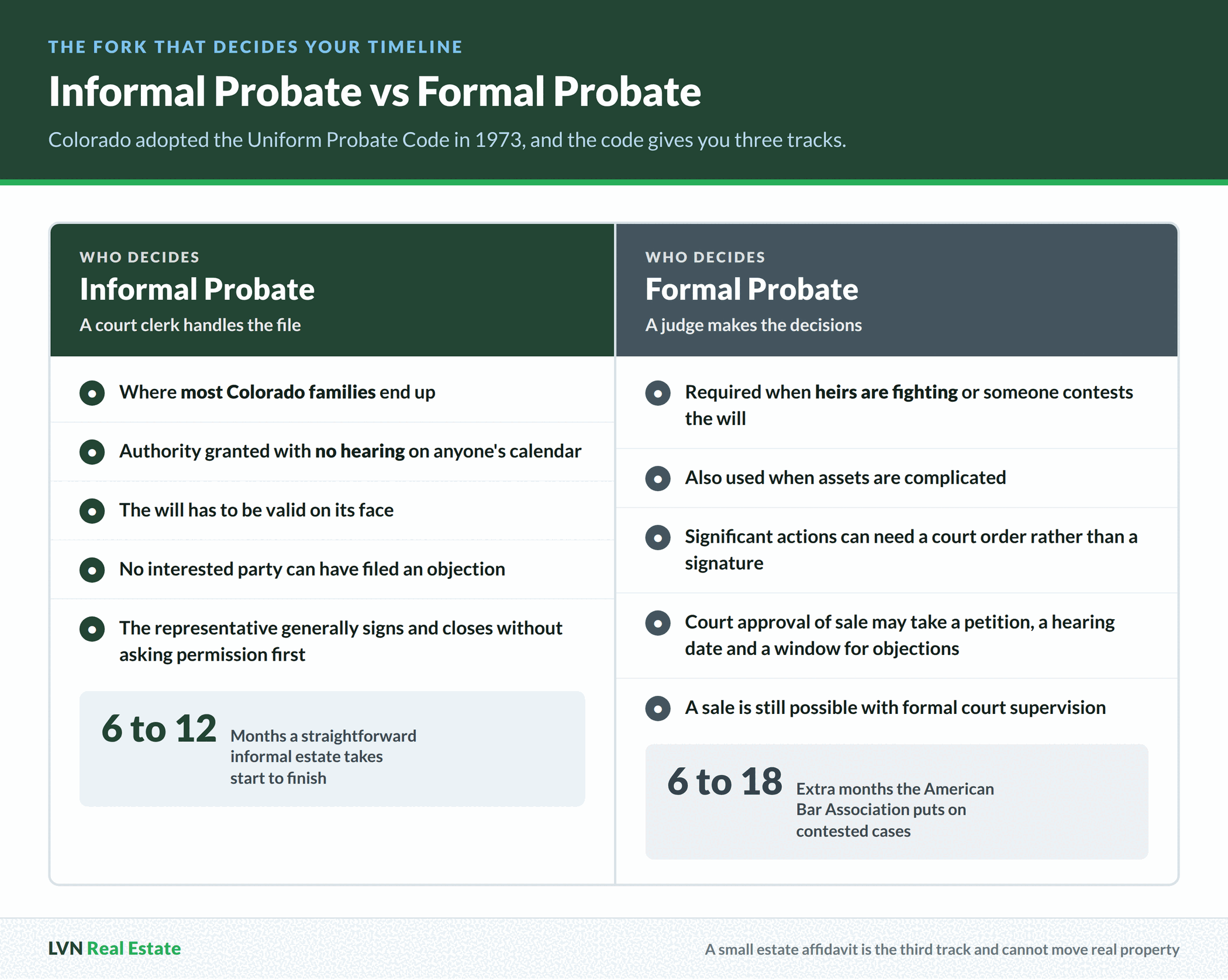
Colorado adopted the Uniform Probate Code in 1973, and that choice still shapes probate here. The code gives you three tracks. A small estate affidavit skips court entirely when an estate qualifies. An informal track handles most Colorado estates with no hearing. A formal track exists for contested matters, and it moves on a judge’s calendar.
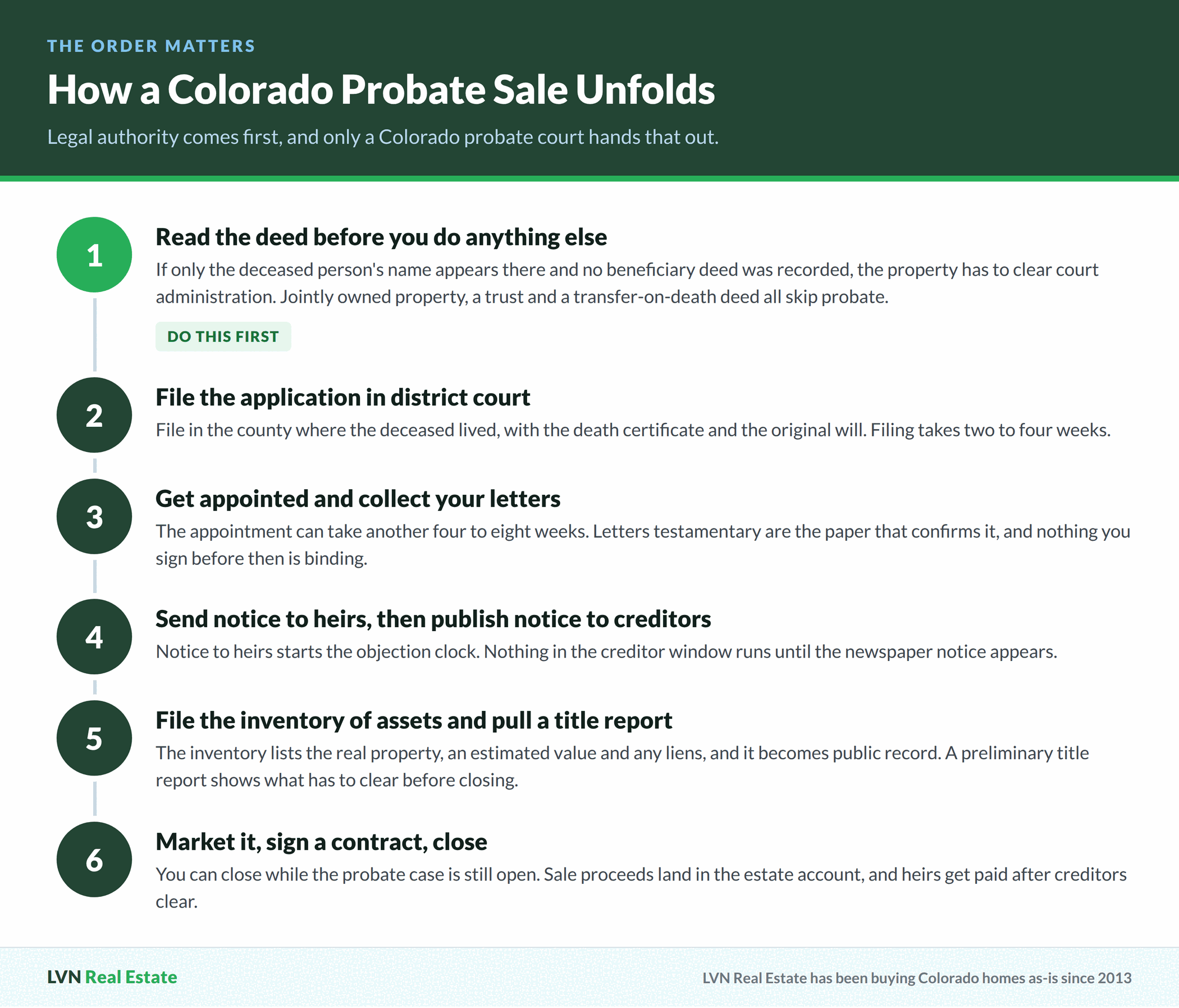
You will generally need probate when the deceased held real property in their own name, with no joint owner and no beneficiary named. Look at the deed first. If only the deceased person’s name appears there, and no beneficiary deed was recorded, that real property has to clear court administration first. Jointly owned property passes to the surviving owner. A trust does the same, and so does a transfer-on-death deed.
Which Colorado Probate Track Your Estate Lands On
Most Colorado families end up in informal probate, and it’s friendlier than the name suggests. A court clerk handles the file instead of a judge, which makes informal probate the fastest and cheapest route. The personal representative files an application with the district court. If the paperwork checks out, authority gets granted with no hearing on anyone’s calendar. That speed is worth real money while you’re paying utilities, insurance, and taxes on a vacant property.
Three conditions ride along with informal probate. The will has to be valid on its face, no interested party can have filed an objection, and the estate must not need ongoing supervision. Miss one and the clerk sends the file to a judge. That fork is why some Colorado estates finish in months while others sit on the formal track for a year.
Formal probate is required when heirs are fighting, when assets are complicated, or when someone contests the will. A judge makes the decisions, and significant actions can need a court order rather than a signature. The American Bar Association puts contested cases at 6 to 18 months beyond the standard probate process. A sale is still possible with formal court supervision.
A small estate affidavit is a genuine shortcut with hard limits. In Colorado, a successor can use one to collect personal property ten days after the death, with no court case opened at all. Total assets have to be worth $88,000 or less for a death in 2026, and that threshold adjusts every year for inflation. Check the current figure on the Colorado Judicial Branch self-help pages, or ask an attorney.
The limit bites as soon as a house is involved. A small estate affidavit reaches bank accounts and personal effects only. It carries no power to move real property, and Colorado offers no companion real-property affidavit, so any estate holding a home has to be probated. A small estate affidavit still earns its keep beside the probate process, clearing accounts and personal property, though the deed needs court authority behind the transfer.
The Personal Representative and Letters Testamentary
Every estate runs through one person. The personal representative is the one legally allowed to manage assets, pay debts, and sign a sale contract on the property. A will usually names that person outright. With no will, the probate court works down Colorado’s priority list of relatives. Filing takes two to four weeks, and the appointment can take another four to eight, so start early.
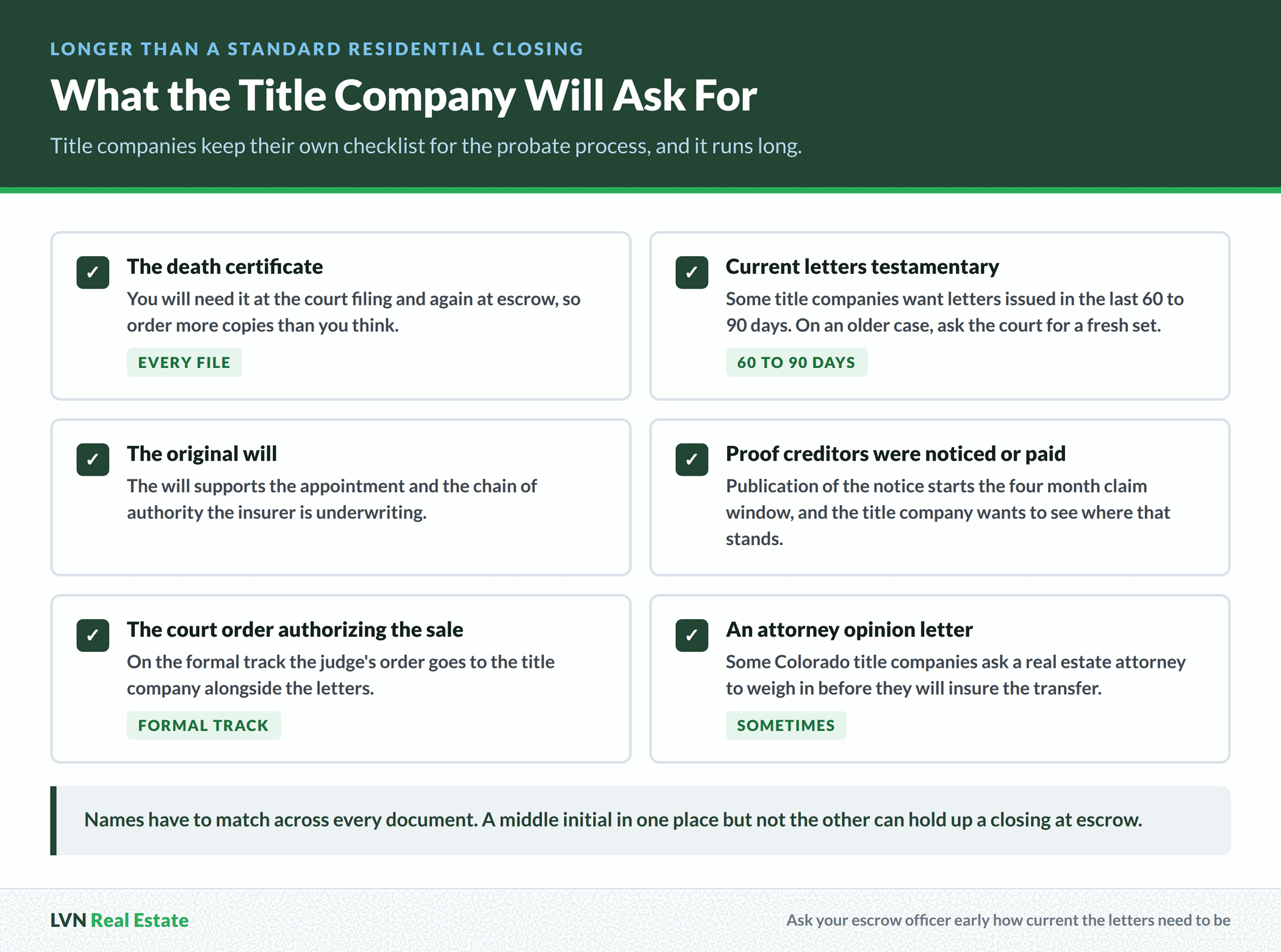
Letters testamentary are the paper that confirms the appointment. Treat them as the representative’s ID card. Banks, title companies, and the buyer’s attorney will all ask to see them. Before signing anything on the decedent’s real property, the personal representative has to hold letters testamentary or letters of administration. Without that document, nothing you sign is binding.
They don’t expire on a fixed date, though some title companies want letters issued within the last 60 to 90 days. If your probate case has been open a while, ask the court for a fresh set. One question is worth putting to your escrow officer early: how current do those letters need to be?
Signing authority is only half the job. A personal representative is a fiduciary, which changes what every choice about the property has to answer for. The sale price and the choice of buyer both have to serve the estate, not one heir’s preference. Selling cheap to a favored buyer is the classic breach. Creditors get paid before heirs see anything, so the personal representative has to identify them, send notice, and give each a fair chance to file a claim. Skip that and the personal liability is yours.
Opening the Probate Case and the Creditor Claim Period
You will file in the district court in the county where the deceased lived, and the Colorado Judicial Branch posts the forms, including the application and the proposed letters. Bring the death certificate and the original will. Filing fees change, so ask the clerk for today’s amount.
Once authority lands, notice to heirs goes out. Under Colorado probate law, that notice does real work beyond papering the file. It starts the objection clock. Publishing formal notice to creditors in a local newspaper is a separate requirement. Nothing in the creditor window runs until that notice appears.
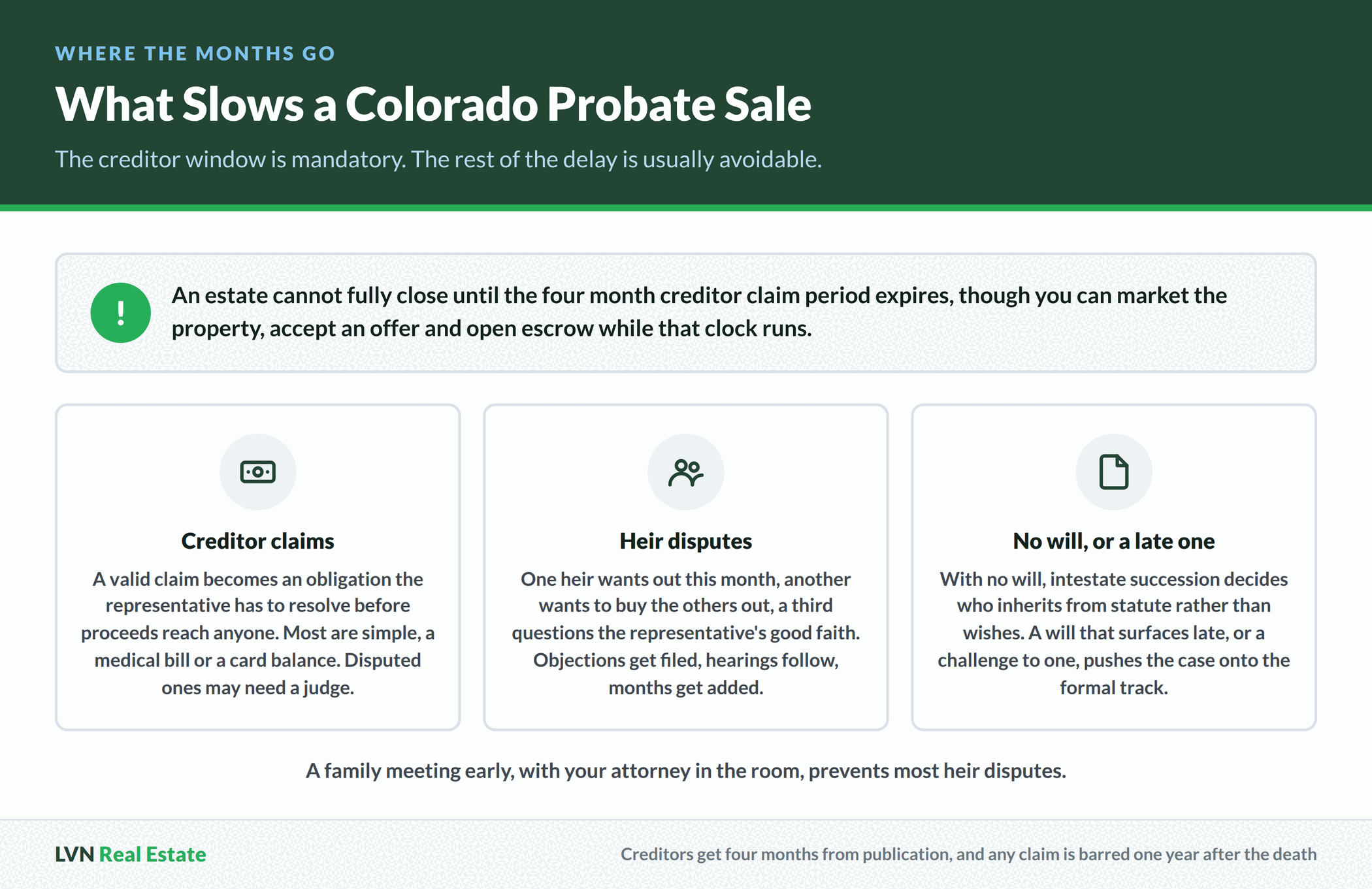
The Colorado Probate Code, in Title 15 of the Colorado Revised Statutes, gives creditors four months to bring a claim once notice is published. That creditor claim period is mandatory, not a courtesy. An estate can’t fully close until that window expires, which sets the floor under any Colorado probate sale. You can still market the property, accept an offer, and open escrow while the clock runs.
A second deadline sits behind it. Any claim not brought within a year of the death is barred, notice or no notice. That one-year mark is the cleanest point for marketable title, though plenty of probate sales close well before it. Get your attorney and your title officer on the same call.
Getting the Property Ready and Choosing How to Sell
Before the house hits the market, the personal representative completes a formal inventory of assets. The inventory lists the real property, the personal property, an estimated value, and any liens. Colorado probate court requires it on file, and it becomes public record. An appraisal or a comparative market analysis from an agent supports the valuation. Many representatives order both. Value on the date of death also sets the stepped-up basis, which decides how much capital gains tax, if any, heirs owe when they sell.
Pull a preliminary title report early, before you talk to buyers. It shows the liens, judgments, and encumbrances that have to clear before closing. An old mechanics lien or a judgment nobody knew about can push a closing back weeks, and some Colorado counties still keep older records on paper, which slows a title search down.
From there you have two paths. List with a real estate agent on the open market, or sell off-market to a cash buyer. Both are legitimate. A cash sale can close in as few as seven to fourteen days, with no repairs, no showings, and no commissions. Cash offers usually land below full retail value, though net proceeds often come out close once you subtract repairs, commissions, and carrying costs, so run both sets of numbers.
Court Approval of Sale and What Title Companies Require
Under informal probate the personal representative generally signs a contract and closes without asking permission first. That’s the practical advantage of the informal route. On the formal track the picture changes. Court approval of sale may take a petition, a hearing date, and a window for objections, and some cases require a judge to confirm the sale price at a formal hearing.
If the probate court approves, it issues an order authorizing the sale, and that order goes to the title company alongside the letters. The extra step costs time. It also buys the representative real protection against a later claim that the sale wasn’t properly authorized, the kind of complaint that can land on someone personally.
Title companies keep their own checklist for the probate process, and it runs longer than a standard residential closing. They will want the death certificate, current letters, the will, and proof that creditors were noticed or paid. On the formal track they’ll want the court order too. Some Colorado title companies also ask an attorney for an opinion letter. A middle initial in one place but not the other can hold up a closing at escrow.
You can close while the probate case is still open. Three things have to line up. The personal representative holds authority, the creditor picture satisfies the title company, and any required approvals are signed. Sale proceeds land in the estate account, not in anyone’s pocket. Heirs get paid after creditors clear, final accountings are filed, and the probate court approves distribution.
Costs, Taxes, and the Help You’ll Need
Selling real property in probate costs more than a standard transaction, and attorney fees are the largest line. Probate attorney fees usually run $3,000 to $7,000 for a straightforward estate, and they can pass $15,000 once disputes start. The number moves with the hourly rate, the county, and the complexity of the case. Ask for a written fee estimate before you hire anyone.
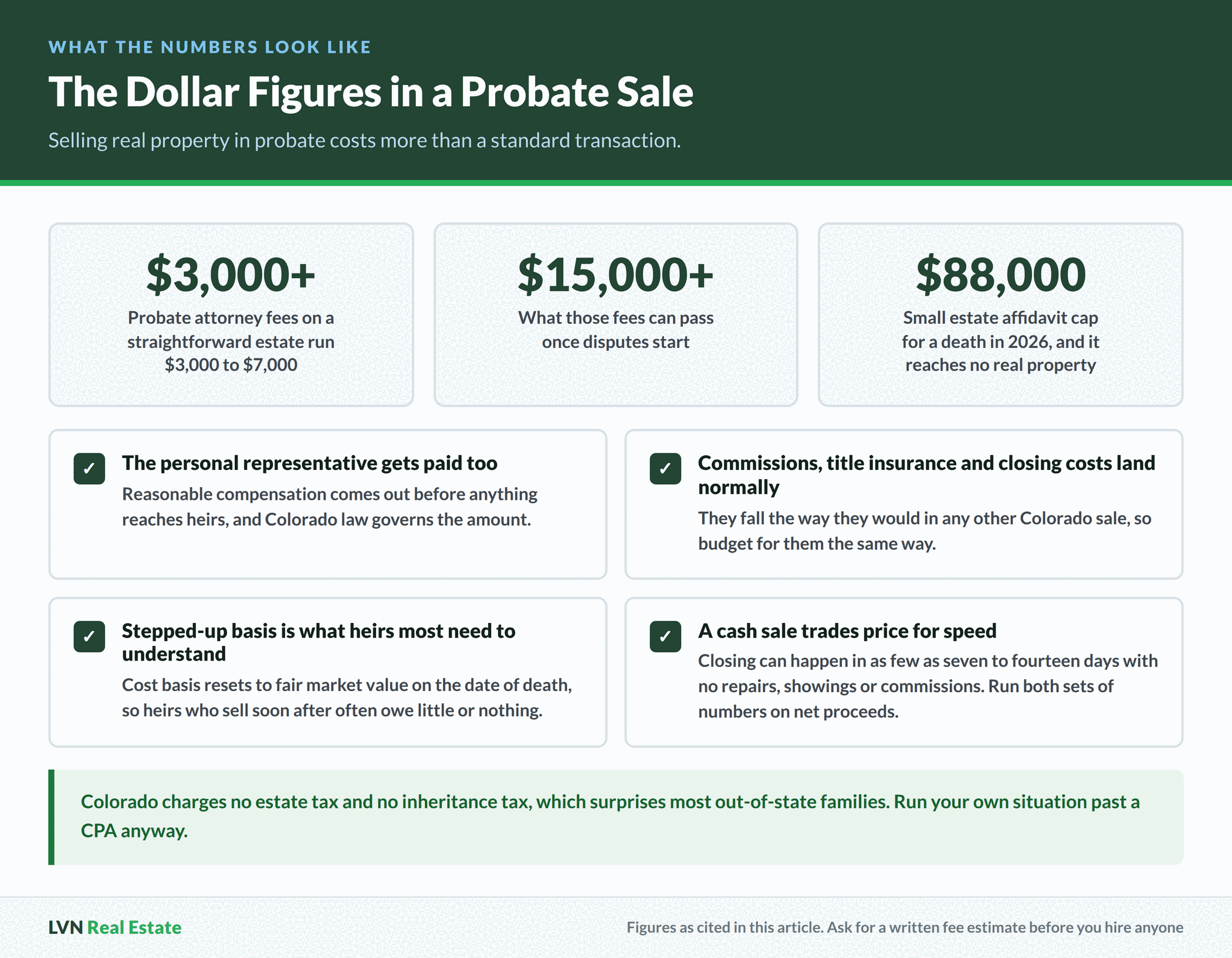
Your personal representative is entitled to reasonable compensation too, paid out before anything reaches heirs, and Colorado law governs the amount, which can run as a percentage of what the estate holds. Commissions, title insurance, and closing costs land the way they would in any other Colorado sale.
Heirs most need to understand stepped-up basis. Because cost basis resets to fair market value on the date of death, heirs who sell soon after often owe little or nothing in capital gains. Colorado charges no estate tax and no inheritance tax, which surprises most out-of-state families. Still, run your own situation past a CPA who handles probate sales.
A real estate attorney isn’t optional when real property is involved. They open the probate case, prepare the filings, manage creditor notice, and coordinate with the title company. Running a sale without one puts personal liability on the representative and real title risk on the buyer. The Colorado Bar Association’s lawyer referral service is a reasonable place to start.
What Slows a Colorado Probate Sale Down
Creditor claims are the most common source of delay. A valid claim becomes an obligation the representative has to resolve before sale proceeds reach anyone. Most claims are simple. A medical bill, a credit card balance, a utility arrearage, all paid from estate funds, not the representative’s personal money. Disputed claims are where the trouble starts, and a judge may have to rule on one.
Heir disputes come second, and they carry the most feeling. One heir wants out this month. Another wants to keep the house and buy the others out. A third questions whether the personal representative is acting in good faith. Those disagreements escalate into formal objections filed with the probate court, hearings follow, and months get added. A family meeting early, with your attorney in the room, prevents most of it.
With no will, Colorado’s intestate succession laws decide who inherits, and the priority list comes from statute, not from the decedent’s wishes, which creates real tension among relatives who expected otherwise. A will that surfaces late changes everything. So does a challenge to its validity. Either one pushes the case onto the formal track. Out-of-state wills, handwritten wills, and vague language all create title risk.
Frequently Asked Questions About Selling a House in Probate in Colorado
How long does the Colorado probate process take before a house can be sold?
Straightforward informal estates typically take 6 to 12 months to finish. Contested ones run longer. A house can often go under contract well before the probate process ends, though two things have to happen first. The representative needs letters testamentary, and the title company needs the creditor picture clear enough to insure.
Can a personal representative sell a house without every heir agreeing?
Usually yes under informal probate, as long as the fiduciary duty to get fair value is being met. Heirs still have a right to notice, and they can object to the probate court. Under formal probate, court approval adds another layer of protection. Ask your attorney exactly what authority those letters grant a representative.
What happens if the estate owes more than the property is worth?
That’s an insolvent estate, and Colorado probate law sets a priority order for paying creditors from the sale proceeds. The personal representative has to follow that order, and heirs may receive nothing if the debts eat the proceeds. Selling as-is for cash can help, since it avoids the repair costs and commissions that would shrink what’s left.
Do out-of-state heirs face extra steps in a Colorado probate sale?
They have the same legal rights and a harder logistical job. Signing documents and coordinating with Colorado professionals from two time zones away costs time. An out-of-state personal representative can still serve here, though they’ll need a Colorado attorney for the court filings. Remote online notarization is available now, which helps.
Next Steps for Personal Representatives and Heirs
Open the probate case early. Carrying costs on an empty property run whether or not anyone has legal authority to sell. Gather the death certificate, the original will, and a list of assets, personal property, and known debts. A full checklist of the required documents for selling an inherited house in Colorado saves you a second trip to vital records. Then call a Colorado probate attorney, before you talk to agents and before you entertain any informal offers.
Once your letters arrive, you can sign, open escrow, and talk about a real price instead of a hypothetical one. Then compare the two paths on net proceeds rather than headline price. An estate that closes clean is often worth more than one that closes high and slow.
LVN Real Estate has been buying Colorado homes as-is since 2013, and we’ve closed probate sales across the Front Range and in smaller counties beyond it. We know what letters testamentary look like, and we work with title companies that handle these transactions monthly. If selling as-is for cash might fit, we can walk the property, look at the title picture, and put a straightforward offer in front of you. Listing with an agent or holding the house are both reasonable choices, and we’ll say so. Whenever you want a second opinion, give us a call.
Where LVN Real Estate Buys Probate Houses in Colorado
Most of the probate property we look at sits in the Denver metro, though we buy across Colorado. If the estate holds a house in Denver, Aurora, Arvada, Lakewood, Thornton or Colorado Springs, we already know which district court handles the case and how long recording takes in that county. Our service area runs the length of the Front Range and reaches the smaller counties past it, so an out-of-state heir isn’t left coordinating with someone three hours from the property.
Talk It Through Before You Pick a Path
You don’t have to decide anything today, and you don’t need your letters in hand to have the conversation. If you want a straight read on what the house would bring in a cash sale, and how that compares with listing it, contact us and we’ll take a look. Nobody chases you afterward. If you’d rather read first, our common questions page covers how an offer gets built and what happens once you accept. Or fill out the short form below and we’ll come back to you with a number you can hold up against the other path.