
Your brother is on the deed. He moved out three years ago. You want his name off the title before you refinance, and someone told you a quit claim deed handles that in an afternoon. Partly true. It does move his interest to you. It won’t touch the mortgage, it carries no warranty, and one formatting slip sends the county clerk and recorder’s office right back to you. The Colorado quit claim deed form does one job well and several jobs not at all.
What Is a Quit Claim Deed in Colorado?
A quit claim deed transfers whatever ownership interest the signer (the grantor) holds right now to the person receiving it (the grantee). Nothing more. It makes no promise that the title is clear, that no liens sit hidden in the chain, or that the grantor owns any part of what they’re signing away. The state treats it as a valid transfer instrument, and people reach for it constantly, because it’s fast when both parties trust each other.
That phrase “whatever interest” carries the weight. If your grantor owns the property free and clear, you get all of it. Owns half, you get half. When a judgment lien attached to their interest last year, the lien rides along to you. With zero warranties, the new owner holds any historical trouble. That isn’t a flaw. It’s the design.
In most legal writing the term is one word, quitclaim, with no space. County offices and forms across the state use quit claim deed and quitclaim deed interchangeably, so neither gets your filing rejected. The instrument handles two jobs: moving property between people who trust each other, and cleaning up defects in a title.
How a Quitclaim Compares With Other Colorado Deed Types
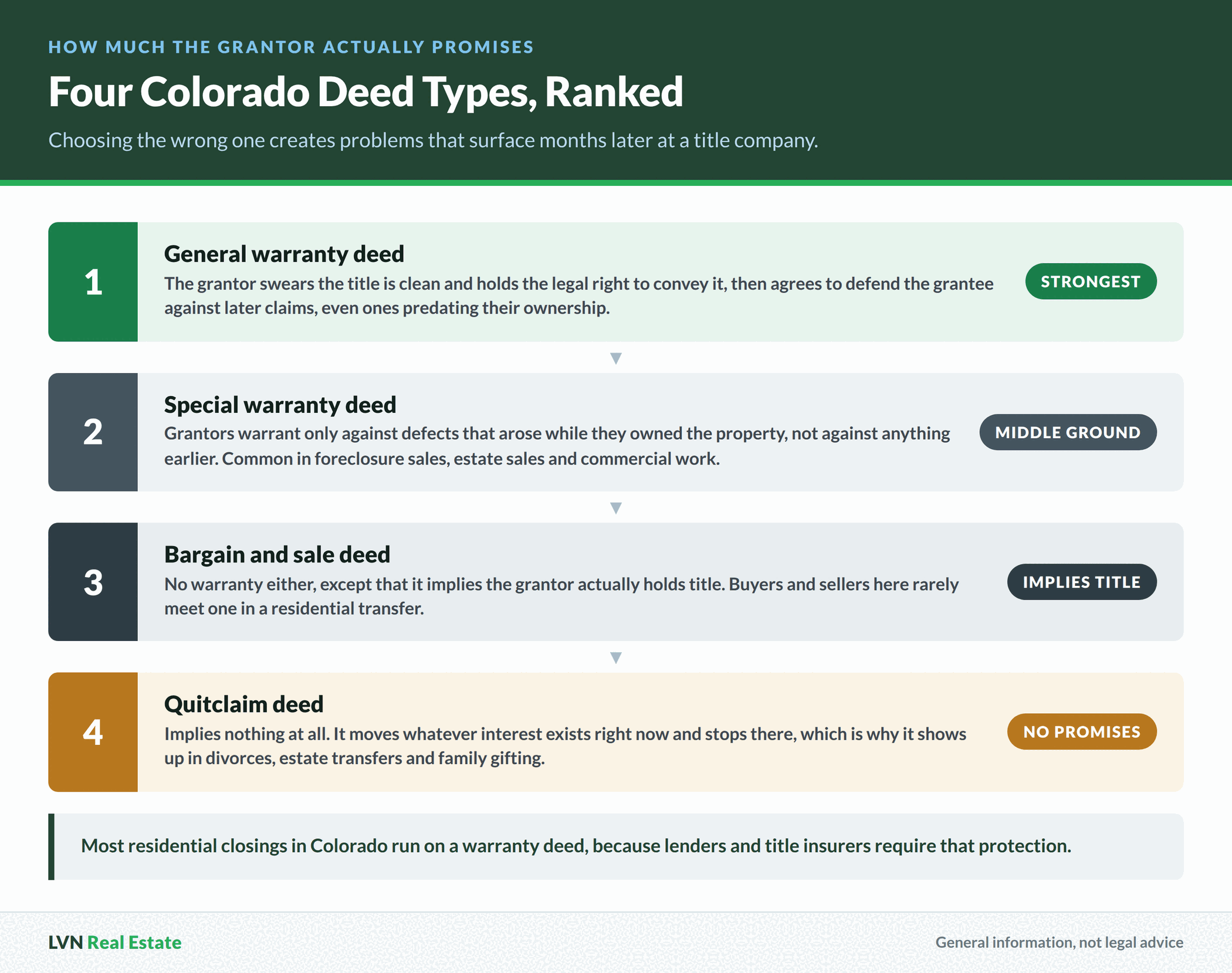
Colorado recognizes several deed types, and choosing the wrong one creates problems that surface months later at a title company. The differences come down to how much the grantor promises about what they’re handing over. That promise carries weight when something goes sideways.
A general warranty deed carries the strongest promises in Colorado real estate. The grantor swears the title is clean and holds the legal right to convey it. They also agree to defend the grantee against later claims, even ones predating their ownership. Most residential closings in Colorado run on a warranty deed, because lenders and title insurers require that protection.
Special warranty deed language narrows the promise. Grantors warrant only against defects that arose while they owned the property, not against anything earlier. You’ll see it in foreclosure sales, estate sales, and commercial work where the seller knows little about the property’s full history. Call it the middle ground.
A bargain and sale deed conveys with no warranty either, except that it implies the grantor actually holds title. A quitclaim implies nothing. It moves whatever exists and stops there. Buyers and sellers here rarely meet a bargain and sale conveyance in a residential transfer. They reach for the other document when no warranty is needed, which is why it shows up in divorces, estate transfers, and family gifting.
When Colorado Property Owners Use a Quitclaim Deed
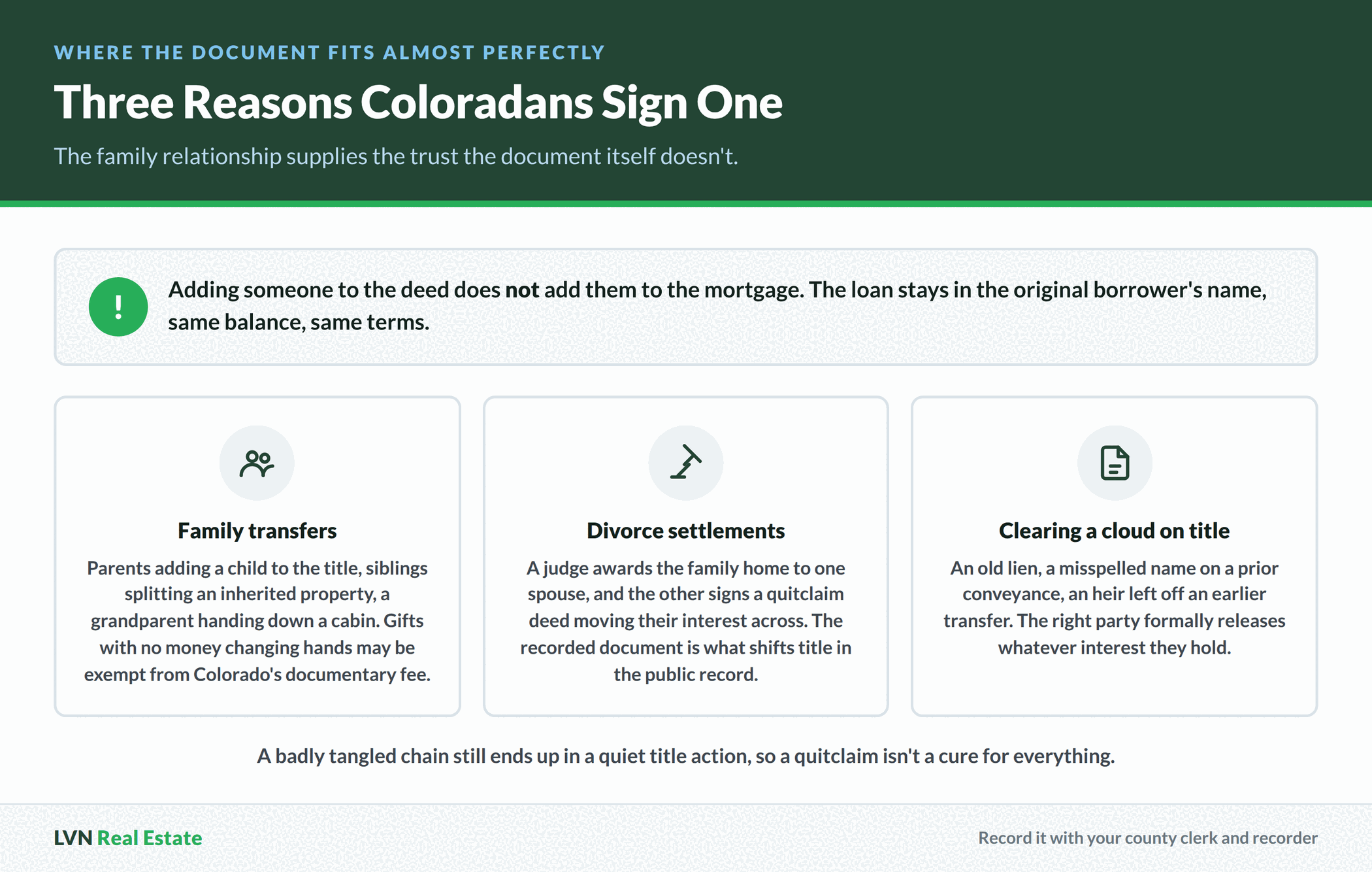
Three scenarios suit the document almost perfectly, and Colorado families run into all three.
Parents adding a child to the title, siblings splitting an inherited property, a grandparent handing down a cabin: those transfers tend to run on a quitclaim deed. The family relationship supplies the trust the document itself doesn’t. Gifts with no money changing hands may be exempt from Colorado’s documentary fee. You still have to record it with the county clerk and recorder.
One thing families miss: adding someone to the deed doesn’t add them to the mortgage. The loan stays in the original borrower’s name, same balance, same terms. Only your lender can change that.
Divorce is the second trigger, and it’s the one Colorado courts see most. A judge awards the family home to one spouse, and the other signs a quitclaim deed moving their interest across. The recorded document is what shifts title in the public record.
Then there’s a cloud on title. A cloud is anything in the chain that creates doubt about ownership: an old lien, a misspelled name on a prior conveyance, an heir left off an earlier transfer. The right party formally releases whatever interest they hold, which clears some of it up. Title companies use it routinely during a title commitment review. A badly tangled chain still ends up in a quiet title action.
What a Colorado Quit Claim Deed Form Includes
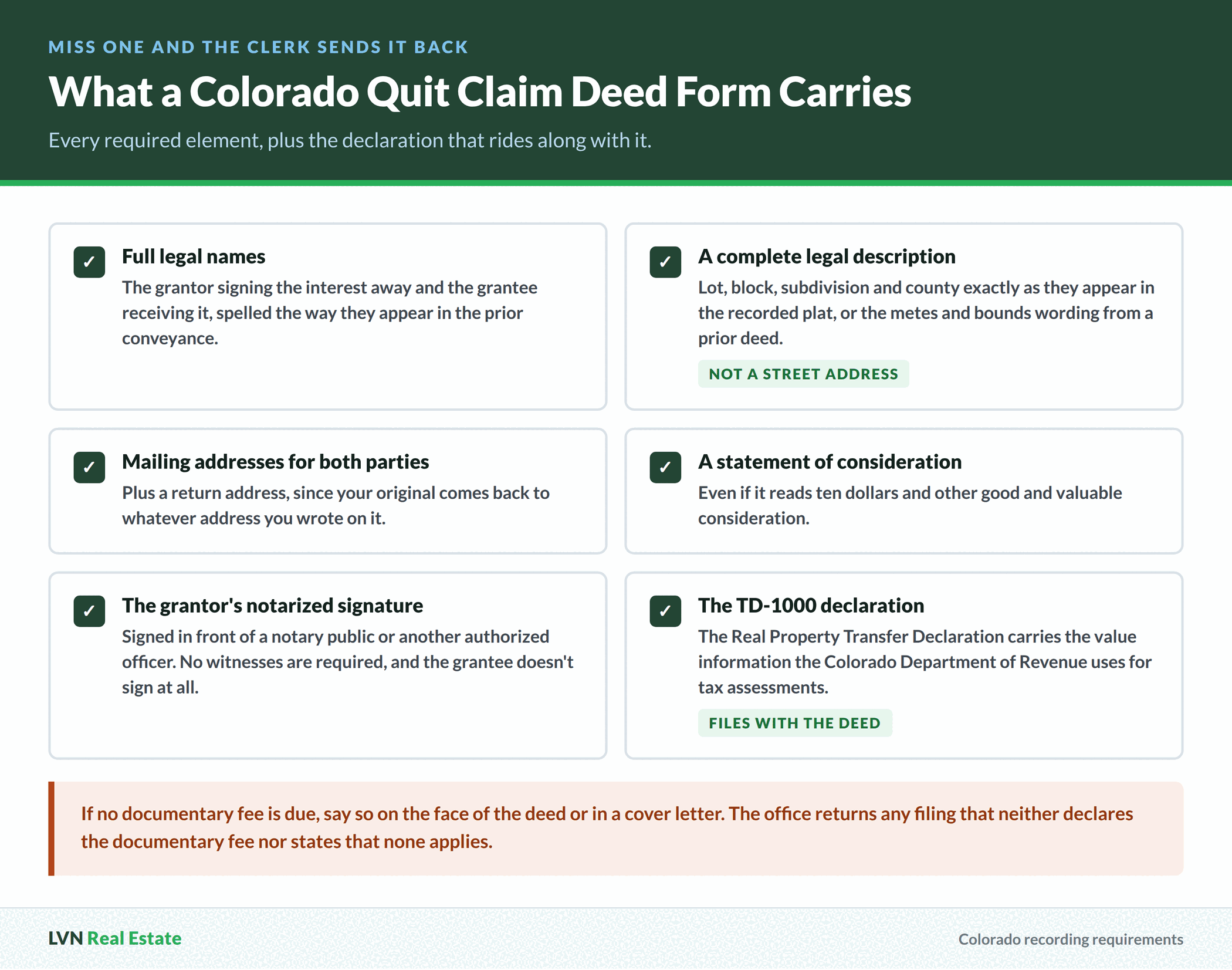
Every valid Colorado quit claim deed form must carry certain required elements. Miss one and the clerk either rejects it or records it in a shape that creates trouble later.
You need full legal names for the grantor and grantee, plus a complete legal description of the property. Mailing addresses for both parties go on it. So does a statement of consideration, even if it reads “ten dollars and other good and valuable consideration.” The grantor’s notarized signature and a return address finish the form.
A Real Property Transfer Declaration, the TD-1000, rides along with it. That form carries the value information the Colorado Department of Revenue uses for tax assessments. If no documentary fee is due, say so on the face of the deed or in a cover letter. The office returns any filing that neither declares the documentary fee nor states that none applies.
Legal descriptions trip people up most. A street address isn’t one. You need the lot, block, subdivision, and county exactly as they appear in the recorded plat, or the metes and bounds wording from a prior deed. Pull it off that one, or from the county assessor’s parcel page.
How to Complete and Record a Quitclaim Deed in Colorado
Start with an accurate quit claim deed form written for Colorado. Generic versions from other states sometimes leave out required language. Colorado requires quitclaim-specific conveyance wording rather than the word convey, which belongs in warranty deeds. The grantor signs in front of a notary public or another authorized officer. No witnesses are required, and the grantee doesn’t sign at all.
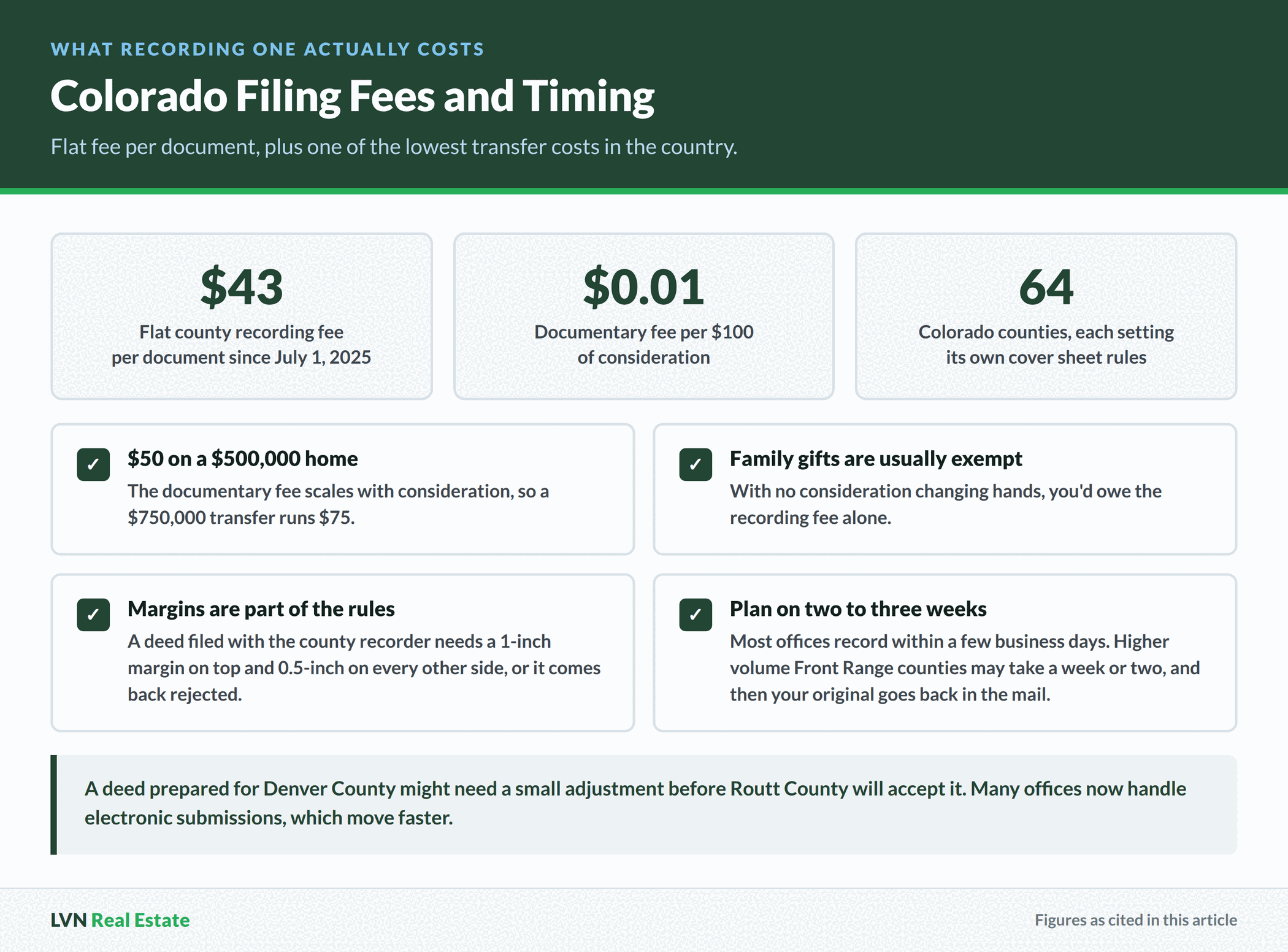
Watch the formatting too. A deed filed with the county recorder needs a 1-inch margin on top and 0.5-inch on every other side. Miss the specs and it comes back rejected, which delays everything. Do it right the first time and the clerk records it without a call.
File with the county clerk and recorder where the property sits. Colorado has 64 counties, and each county office sets its own cover sheet rules. A deed prepared for Denver County might need a small adjustment before Routt County will accept it. Most take filings in person and many now handle electronic submissions, so confirm before you drive out there. Your original comes back to the address you wrote on it, and the county assessor updates the tax records.
As of July 1, 2025, Colorado counties charge a flat recording fee per document. That fee is $43, whatever the length. Colorado also imposes a documentary fee of $0.01 per $100 of consideration, one of the lowest transfer costs in the country. On a $500,000 home, that comes to $50. A $750,000 transfer runs $75. Family gifts with no consideration are usually exempt, so you’d owe the recording fee alone.
Title Insurance and the Chain of Title
Title insurance protects against defects in the chain of ownership that nobody knew about when the transfer happened. Receive property by quitclaim deed and you accept whatever interest the grantor had, hidden problems included. The policy covers you when an old lien or an unknown heir turns up later, and unknown heirs do.
Underwriters get nervous about a property transferred recently by quitclaim rather than by warranty deed. They want the full history first. If you plan to sell within a few years, talk to a title company before you record. A sloppy transfer now stalls your closing later, when the title commitment review finds a gap in the chain of title.
Every recorded deed stays part of a property’s permanent public record. The chain is the sequence of ownership transfers, and a quitclaim filed with your county clerk and recorder becomes a permanent link. A missing legal description, or a grantor name that doesn’t match the prior owner, creates a cloud on title that lenders will flag. Clean ownership history is worth more than most people think, and we’ve watched small problems surface at the worst moment on Front Range properties.
The Due on Sale Clause and Your Mortgage
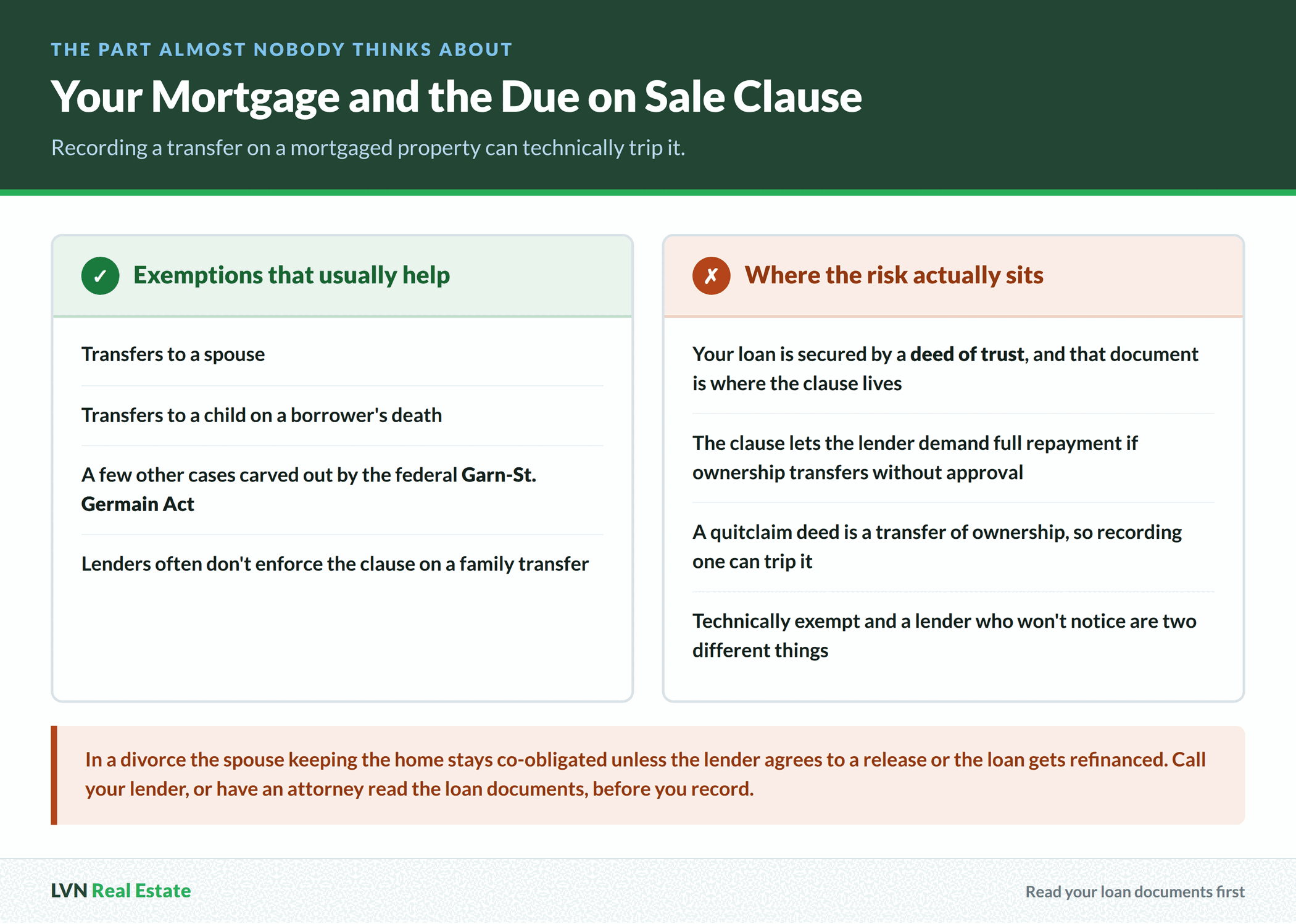
Almost nobody thinks about this one until it’s too late. Your loan is secured by a deed of trust, and that document is where the due on sale clause lives. The clause lets the lender demand full repayment if ownership transfers without approval. A quitclaim deed is a transfer of ownership, so recording one on a mortgaged property can technically trip the clause.
Lenders don’t always enforce it on a family transfer. Federal law helps. The Garn-St. Germain Act carves out exemptions for transfers to a spouse, transfers to a child on a borrower’s death, and a few others. Technically exempt and a lender who won’t notice are two different things. Call yours, or have an attorney read the loan documents, before you record.
Divorce raises the same question. If one spouse quitclaims their interest to the other, the mortgage doesn’t follow along. The spouse keeping the home remains co-obligated unless the lender agrees to a release or the loan gets refinanced. A due on sale clause gives your lender a seat in that conversation.
Divorce Decrees: What Colorado Courts Require
A divorce decree awarding the family home to one spouse is a court order, not a deed. It tells the world who’s supposed to own the property. It doesn’t change the public record. Colorado courts expect the parties to follow through by signing and recording a quitclaim deed. Skip that step and both names stay on the title, and lenders catch it the moment the receiving spouse tries to refinance.
Sign as close to the divorce finalization as you can manage. Delay creates risk. A judgment lien could attach to the departing spouse’s interest, or that spouse could die, stacking a probate matter on top of a divorce. Your decree gives you the right. The recorded deed makes it real. An attorney who handles family law and real estate can often prepare the paperwork as part of the settlement.
Colorado courts don’t demand a specific instrument for dividing marital property. The quitclaim deed is the standard choice anyway, because neither party is making warranties to the other. Both spouses already know the property’s history. Your document needs a signature, a notary, and a filing with the county clerk and recorder in the county where the property sits.
When a Quitclaim Isn’t Enough
Selling a Colorado property to an unrelated buyer calls for something stronger. Buyers want a warranty deed because it gives them legal rights when a problem surfaces after closing. A title insurance underwriter will normally require one before issuing a lender’s policy. Try to sell with a quitclaim and the buyer’s lender will likely reject it.
Removing a name from the title also does nothing to the mortgage. If you want a departing co-owner off the hook financially, a Colorado refinance in the remaining owner’s name is the reliable path, and that means qualifying on your own income and credit.
Colorado doesn’t legally require an attorney here, though it does require a declaration of value form with most transfers, along with specific formatting. Plenty of owners hand the job to a real estate attorney or a title company anyway, to avoid a recording rejection. A few hundred dollars up front weighs well against months of delay and legal fees from a flawed chain. An attorney also catches a grantor name that changed with a marriage. The transfers that cause trouble almost always skipped that step.
Frequently Asked Questions About Quit Claim Deeds in Colorado
Does a quitclaim deed remove someone from the mortgage?
No. It transfers title only. Your mortgage is a separate contract between borrower and lender, and recording a conveyance changes nothing about that obligation. Whoever signed the note stays on the loan until the lender releases them through an assumption agreement, or until somebody refinances.
Can a quitclaim deed be reversed in Colorado?
A recorded deed is part of the permanent public record. It can’t simply be undone. If both sides agree the transfer was a mistake, the grantee signs a new deed sending the interest back. When one won’t agree, the only remedy is a court action to void it, which means proving fraud or duress. Prevention beats reversal every time.
Do I need title insurance when receiving a quitclaim?
Colorado doesn’t legally require it. Receiving property this way means accepting the title exactly as it stands, with no warranty from the grantor. It’s the safety net for a hidden lien or a gap that surfaces years later. For a family transfer where you know the full history, the risk may feel manageable. Anything more complicated, and the premium earns its keep.
How long does it take to record a quit claim deed in Colorado?
Most county clerk and recorder offices record a deed within a few business days of submission. Higher volume Front Range counties, Denver and Jefferson among them, may take a week or two when they’re busy. Electronic submissions through approved e-recording services move faster. Your original then goes back in the mail, so plan on two to three weeks.
Protect Your Title Transfer From Costly Mistakes
A Colorado quitclaim is one of the simplest instruments in real estate, and that simplicity is its risk too. It moves title fast, it costs little to record, and it suits family transfers and divorce settlements. It also carries no warranty, it leaves your mortgage where it was, and the due on sale clause in your loan documents doesn’t care how routine the transfer feels. Lenders have heard every version of “it’s just family.”
The gap between what people think a quitclaim does and what it actually does is where the costly mistakes live. Look at the usual suspects: a name that doesn’t match the prior grantor, a missing TD-1000, a legal description pulled from a tax bill. Any one of those stalls a future closing or creates a title insurance problem that takes months to untangle. A noncompliant deed may bounce back from the clerk, or record and still fail to move the real estate as intended.
Get the quit claim deed form right. Record it promptly. And if there’s any complexity at all, get help. A mortgage in the picture, a divorce decree to execute, a family situation with several heirs: spend the few hundred dollars on a Colorado real estate attorney.
If you own Colorado property and you’re weighing a title transfer, we’re glad to talk through how it might affect a future sale. No pressure and nothing to sign. Just a straight answer from people who’ve worked through these situations since 2013.
Where LVN Real Estate Buys Houses With a Title Question Open
A quitclaim deed sitting in the chain of title doesn’t stop us from buying. We buy houses in Denver, Aurora, Lakewood, Arvada, Boulder and Colorado Springs, and those questions come with the territory. A missing signature from a former spouse, an heir nobody accounted for, a quit claim deed form that never made it to the county clerk and recorder: our team has worked through each of those on Colorado property. You don’t have to clear the record before you talk to us, and you don’t have to pay a real estate attorney first to find out what the house is worth in a cash sale.
Talk Through a Colorado Title Transfer Before You Sell
Nothing here has to happen today. If you’re weighing a quitclaim deed and wondering how it lands on a future sale, contact us and we’ll walk through it with you. There’s no obligation, and nobody keeps calling afterward. Our common questions page covers how a cash offer gets put together and what closing looks like once a homeowner accepts. You can also fill out the short form below, and we’ll come back to you with a number for your Colorado property, title history and all.