
If you went looking for a transfer on death deed form Colorado supposedly uses, you hit a vocabulary gap. State statutes don’t use that phrase. Colorado law calls the document a beneficiary deed, and most other states call it a transfer on death deed. One instrument, two names. That saves you from hunting for paperwork that doesn’t exist under the label you typed. If you’re the beneficiary on one and the owner has died, the filing steps sit about halfway down.
What Is a Transfer on Death Deed in Colorado?
A transfer on death deed is a written instrument that moves title to real estate to a beneficiary the owner names, effective when the owner dies. Colorado’s statutes call that same instrument a beneficiary deed. Attorneys, title companies and county clerk offices use looser vocabulary, so TOD instrument, beneficiary deed and transfer on death document all name one piece of paper.
In 2004 the Colorado Legislature authorized TOD deeds for real estate here, an early move. As of 2024, roughly 30 states plus the District of Columbia allow some version. Two decades of case law and title standards have grown up around it, so underwriters here rarely stumble. The form runs short, and what beneficiaries face after the owner dies is where people get tripped up.
How a Colorado Beneficiary Deed Works While the Owner Is Alive
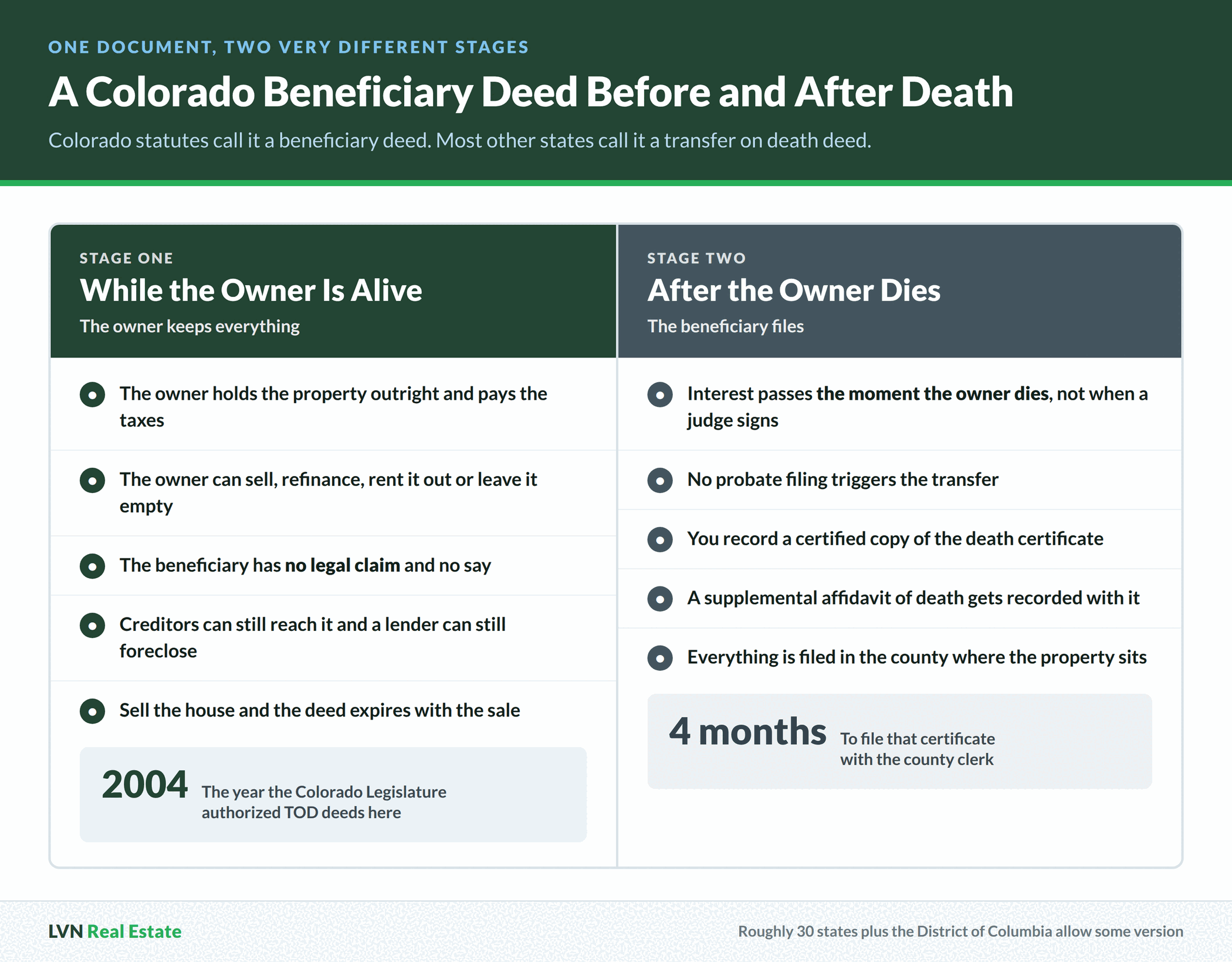
A beneficiary deed looks like any other deed you’d use to move Colorado real estate. Timing is the difference, since it does nothing until the owner dies. Until then the owner holds the property outright, pays the taxes, and can sell, refinance, rent it out or leave it empty. The beneficiary has no legal claim while the owner lives, and no say over the property.
Because of that timing, the document shields nothing during that lifetime. Creditors can still reach the property. A lender can still foreclose. A beneficiary can’t stop either one. Sell the house and there’s nothing left for the deed to convey, so it expires with the sale.
Owners change their minds, and the statute lets them, though revoking takes paperwork. The owner has to execute, acknowledge and record either a revocation or a newer beneficiary deed overriding the old one. A verbal statement won’t do it, and handwritten notes in a drawer are no better. One more thing worth sitting with: a recorded Colorado beneficiary deed outranks a will covering the same property. A beneficiary named ten years ago can still inherit when a newer will says otherwise.
Why Recording With the County Clerk and Recorder Matters
Recording is everything here, and the statute spells that out. It lives in Title 15 of the Colorado Revised Statutes, in the part covering transfer of real property effective on death. An owner transfers an interest in real property effective on death by executing a deed that says conveys on death or transfers on death. Recording follows, with the clerk and recorder in the county where the property sits, and it has to happen while the grantor is alive.
Notarized and recorded, both. Someone who signs the paperwork and never takes it to the county clerk and recorder has created nothing. That transfer on death deed form is legally worthless. The property falls back into the estate and probably ends up in probate. It happens most when someone drew up the document themselves and treated signing as the finish.
How to Claim the Property After the Owner Dies
The deed activates at death. Interest in the property passes to the beneficiary the moment the owner dies, not on the day a judge signs an order. No probate filing triggers the transfer. Title doesn’t wait for a court, so you can move without the months probate usually adds.
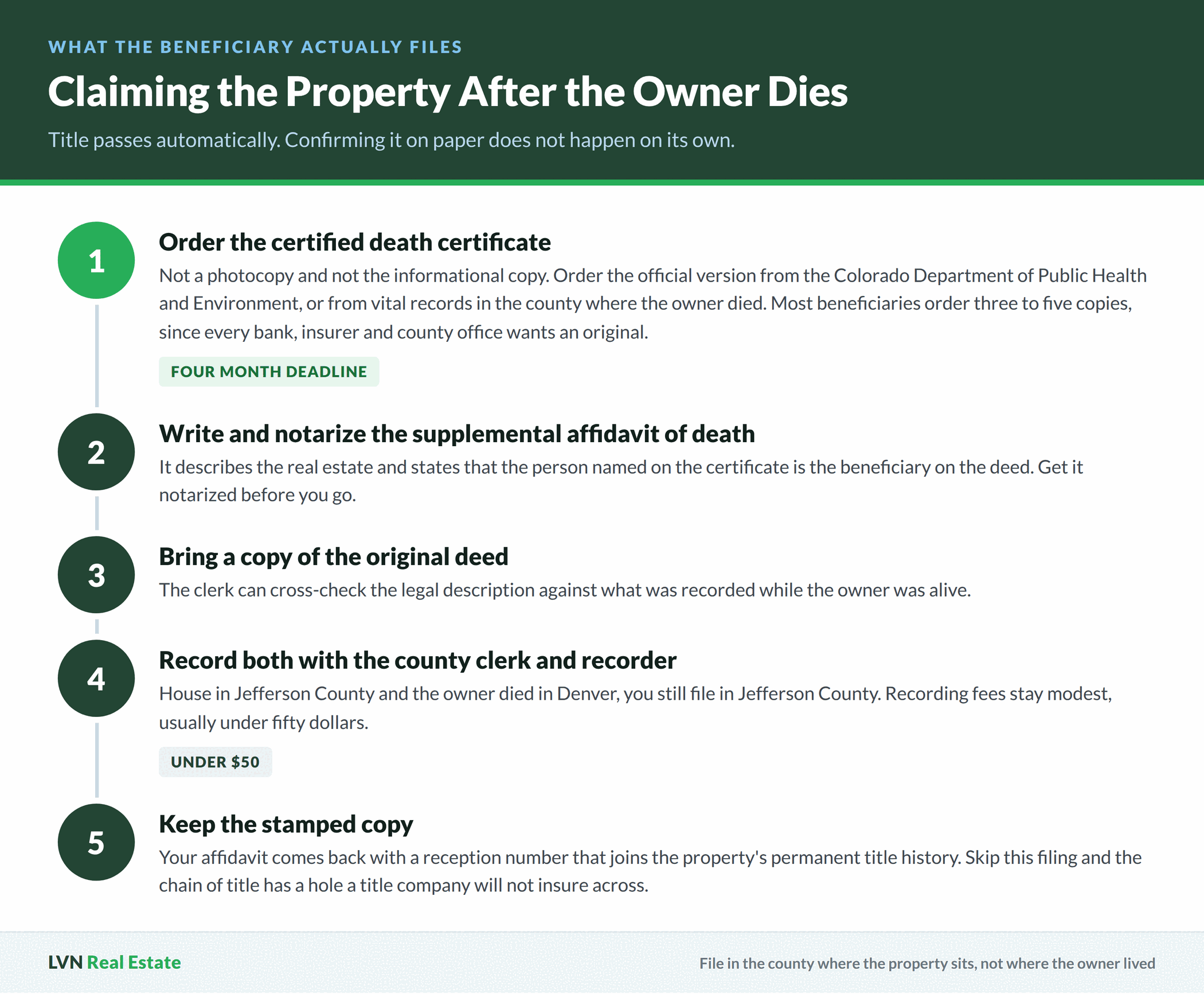
Automatic doesn’t mean paperwork free. A TOD beneficiary confirms the transfer the same way a surviving joint tenant does. You record a certified copy of the owner’s death certificate along with a supplemental affidavit of death, filed with the land records in the county where the property sits. Not the state. The county. Your affidavit describes the real estate and states that the person on the certificate is the beneficiary on the deed.
Skip that filing and the chain of title has a hole in it. No title company will insure a later sale across that hole, which is how a beneficiary finds the problem years later, at closing.
A certified death certificate isn’t a photocopy, and it isn’t the informational copy. Order the official version from the Colorado Department of Public Health and Environment, or from vital records in the county where the owner died. A beneficiary gets four months to file that certificate with the county clerk. Four months closes fast while you’re arranging a funeral. Most beneficiaries order three to five certified copies, since every bank, insurer and county office wants an original.
File in the county where the property sits, not where the owner lived or died. House in Jefferson County, owner died in Denver, you file in Jefferson County. Get the affidavit notarized first, and bring a copy of the original deed so the clerk can cross-check the description. Recording fees stay modest, usually under fifty dollars. Your affidavit comes back stamped with a reception number that joins the property’s permanent title history. Keep that copy handy.
Does a Transfer on Death Deed Avoid Probate?
Yes, and that’s the main reason people use one. Real estate transfers straight to the beneficiary named, with no probate proceeding in between. Nobody hires an attorney to open a file, and nobody pays court filing fees. In Colorado, even a tidy probate runs six months to a year, and a contested one drags on far longer. Beneficiaries get formal title sooner, which matters when you want to sell, refinance or move in.
Skipping probate doesn’t mean skipping every obligation. The deed moves the house and nothing else. If the owner left a bank balance, a car or unpaid bills, someone may still open a probate case, and creditors file claims there.
Creditor Claims and Medicaid Estate Recovery
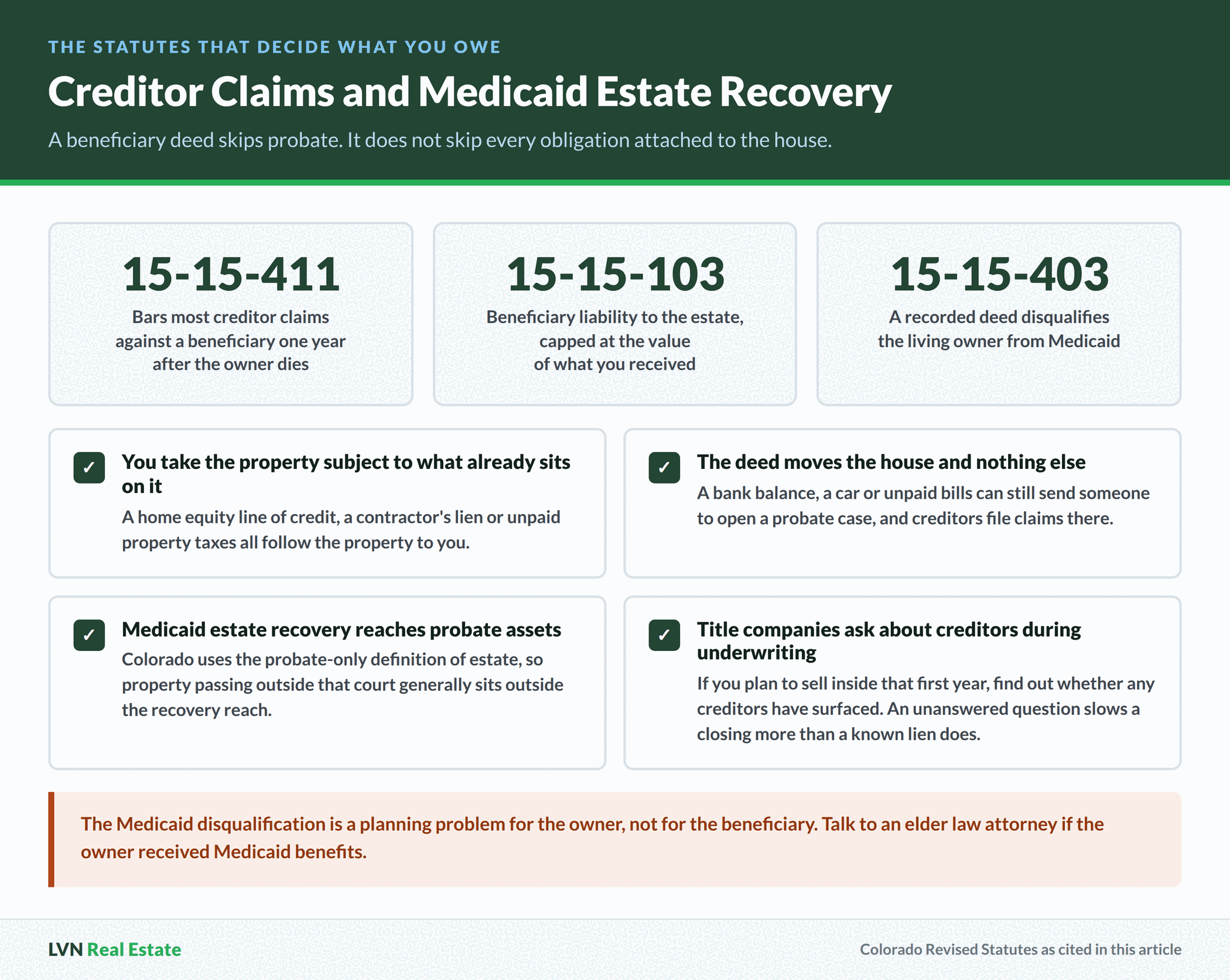
TOD deeds don’t shield beneficiaries from creditors or liens. You take the property subject to whatever mortgages and encumbrances already sit on it. A home equity line of credit, a contractor’s lien, unpaid property taxes: all of it follows the property to you.
Colorado law does put creditors on a clock. C.R.S. 15-15-411 bars most creditor claims against a beneficiary one year after the owner dies. If you plan to sell inside that year, find out whether any creditors have surfaced yet. A title company asks during underwriting, and an unanswered question slows a closing more than a known lien does.
C.R.S. 15-15-103 goes further. A beneficiary who takes real estate through a nonprobate transfer can be liable to the estate for allowed creditor claims and family allowances. That liability only bites when the estate runs short, capped at the value of what you received. The property sets the ceiling.
Medicaid estate recovery catches families off guard. Colorado uses the probate-only definition of estate, so the state reaches assets moving through that court. Property passing outside it generally sits outside the recovery reach, often the biggest dollar difference this instrument makes.
There’s a catch on the front end. C.R.S. 15-15-403 turns a recorded beneficiary deed into a problem while the owner is still living. If one is in effect, the applicant is disqualified from Medicaid, since the program treats the home as a countable resource, not an exempt primary residence. That’s a planning headache for the owner, not for the beneficiary. Medicaid debts left behind still shrink what beneficiaries inherit. Talk to an elder law attorney if the owner received Medicaid benefits. The Colorado Gerontological Society publishes a plain-English rundown of the Estate Recovery Act if you want to read further.
Title Insurance and the Transfer on Death Deed Form
Title companies aren’t spooked by transfers to beneficiaries. What they want is a documented chain of title before insuring a property sale. The transfer on death deed form recorded before the owner died, the recorded affidavit and the certified death certificate make up that chain.
ALTA 2021 policy forms help. A conveyance from the named insured to a transferee by a transfer effective on the death of an Insured as authorized by law leaves that transferee covered under the existing policy. Nobody escapes the underwriter’s review, though. A title search pulls the full history and hunts for gaps, liens or competing claims. One letter of difference between the name on the death certificate and the name on the deed gets flagged. The Colorado Bar Association’s real estate title standards address beneficiary deed transfers directly.
Order a preliminary title commitment early, before you accept an offer or sign a listing agreement. Have a Colorado attorney or a title company read the original document alongside everything recorded since. That review costs far less than a closing that falls apart.
What Type of Deed You Use When You Sell
Once your ownership is confirmed and title is clear, a new deed conveys the property to a buyer. The instrument that brought the property to you was a one-time thing.
A general warranty deed gives a buyer the broadest protection. You warrant that title is clean and that you’ll defend against claims traceable to owners decades back. A special warranty deed narrows that promise to your own stretch. A quitclaim deed conveys whatever interest you hold and warrants nothing.
Most buyers, and every lender behind them, expect a special warranty deed at minimum. A quitclaim deed on inherited property raises eyebrows at title companies, fairly or not. You’ve owned the property since the moment of death, so covering your own stretch is usually the right call. Ask a Colorado attorney to confirm before the listing goes up.

Colorado also asks sellers to fill out a Seller Property Disclosure form. A beneficiary often never lived in the house and can’t speak to the furnace, the roof or the water heater. That form has a no representation option for items you honestly don’t know, and using it beats guessing. Misrepresentation creates liability after closing even when it wasn’t intentional. If you’ve had the place inspected, hand the report to your buyer.
When One Deed Names Several Beneficiaries
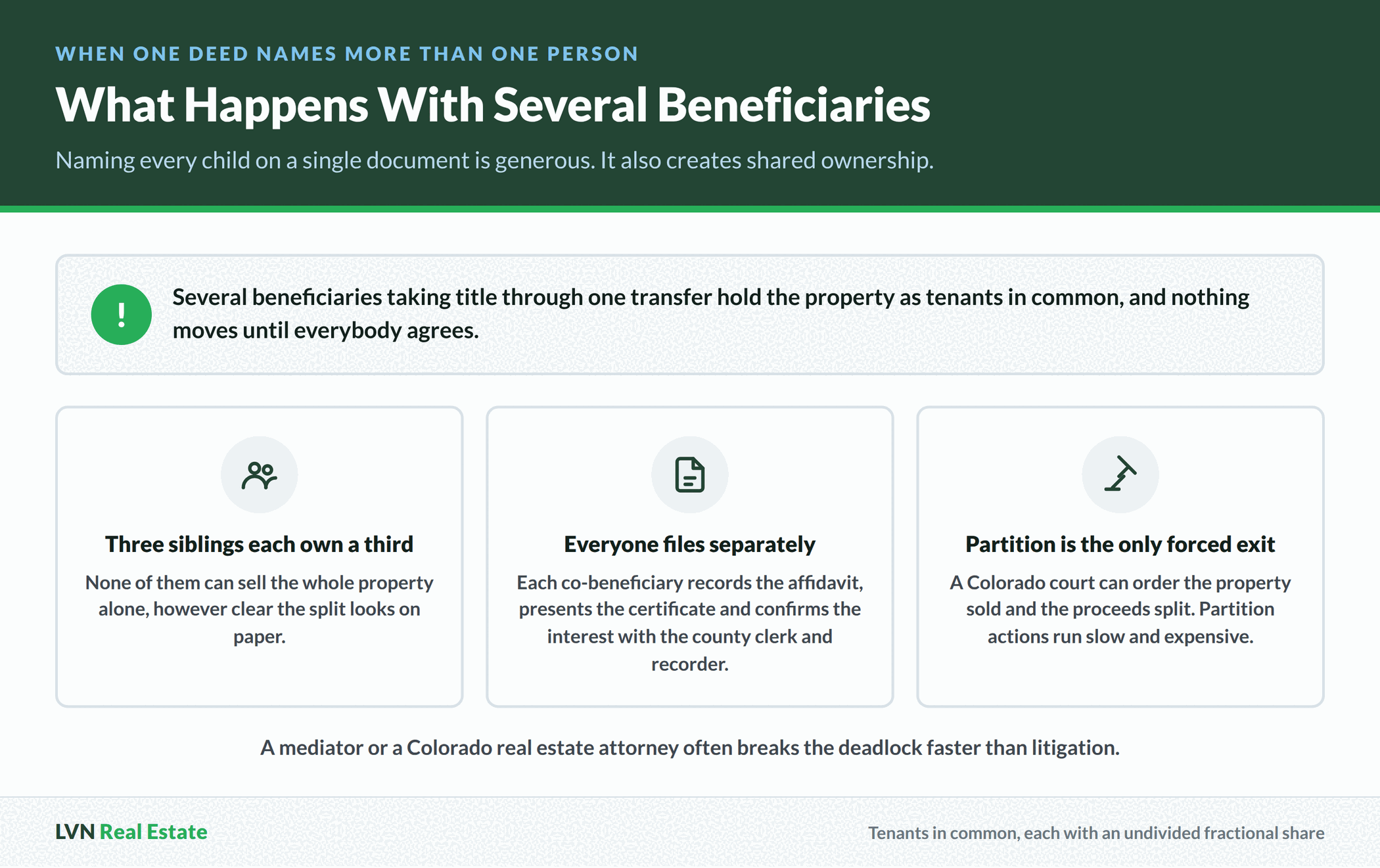
Nothing stops an owner from naming more than one beneficiary. Parents do it constantly, listing every child on a single document. The gesture is generous. What it creates is shared ownership of one property, and beneficiaries move nothing until everybody agrees.
Real property includes the partial interests held by joint owners, so several beneficiaries taking title through one transfer hold it as tenants in common, each with an undivided fractional share. Three siblings each own a third, and none can sell the whole property alone. Co-beneficiaries each walk the same steps separately: file the affidavit, present the certificate, confirm the interest with the county clerk and recorder. One sibling across the country who answers email slowly becomes everyone’s problem.
Disagreement is where the real problem shows up. Two siblings want to sell, one wants to keep the house, and nobody can force a sale without a court. A partition lawsuit is the remedy, and a Colorado court can order the property sold and proceeds split. Partition actions run slow and expensive, and they leave marks that outlast the money. Better to negotiate before anyone files. A mediator or a Colorado real estate attorney often breaks the deadlock faster than litigation. Sometimes a cash buyer who closes quickly is the one option all three siblings agree on.
Frequently Asked Questions
Does a Colorado beneficiary deed override a will?
Yes, for real property. The most recent recorded document controls who gets the real estate, whatever a will says about that property. A newer will doesn’t undo it. Wills still handle personal property and bank accounts, and they carry no power over a properly recorded Colorado beneficiary deed. People assume a will is the last word on everything they own. Here, it isn’t.
What if the owner never recorded the transfer on death deed form?
An unrecorded transfer on death deed form isn’t valid in Colorado, and no will can rescue one that never reached the clerk. An owner who signed and filed nothing left the property to pass through the estate as though it never existed. That means probate, the exact thing everyone was trying to avoid. The property goes to whoever the will names, or to heirs under Colorado intestate succession law when there’s no will.
Can a beneficiary sell the property right away?
Technically yes, once the affidavit is recorded and the certificate is on file. In practice most title companies want the full documentation package first. Some buyers and their lenders prefer to wait out the one-year window on creditor claims, which pushes a financed sale past the anniversary of the owner’s death. A beneficiary who sells for cash usually moves faster, since no lender is underwriting the buyer and no appraisal gets scheduled.
What if one of several beneficiaries has died?
A beneficiary who dies before the owner usually leaves a lapsed share, unless an alternate was named. Surviving beneficiaries don’t automatically absorb it. The document has to say so. Exact wording in the original deed decides this, so have an attorney read it and explain how Colorado law treats a lapsed share. The answer sits in the paperwork, not in the family’s understanding.
Next Steps if You Inherited a House Through a Colorado Beneficiary Deed
Start with the paperwork. Order the certified death certificate, record your affidavit with the county clerk and recorder, and pull a preliminary title report on the property. Those steps tell you what you’re actually holding, and they cost little next to the decisions that follow.
From there your options are ordinary. Listing with a Colorado real estate agent gets you the widest buyer pool and the strongest price, if the house shows well and you can wait. Renting makes sense if you want long-term income and you’re ready to be a landlord from another state. Selling as-is for cash fits a different case: the property needs work, several beneficiaries want a quick resolution, or you’ve no appetite for a listing on top of settling an estate.
We’re LVN Real Estate, a veteran-owned cash home buyer based in Denver. We’ve been buying houses across the Front Range and the rest of Colorado since 2013, and we’re BBB accredited. We buy as-is, so no repairs, no showings and no waiting on a lender’s appraisal. If a house came to you through a Colorado beneficiary deed and you want a no-obligation cash offer, we’re glad to look and give you a number. No pressure to accept. It sits next to listing with an agent and keeping the property, and you decide.
This article is general information only and is not legal advice. Colorado beneficiary deed law runs on specific statutes and recording deadlines. Consult a licensed Colorado attorney about your own situation.
Where LVN Real Estate Buys Inherited Houses Across Colorado
Most of the houses that reach us through a beneficiary deed sit in the Denver metro, though we buy across Colorado. If the property came to you in Denver, Aurora, Arvada, Golden, Centennial or Boulder, we already know how that county clerk and recorder handles an affidavit of death and how long recording takes there. Our service area runs the length of the Front Range and reaches the mountain towns and the Western Slope.
Talk Through What the House Is Worth Before You Decide
You don’t have to decide anything today. If you want a straight read on what the property might bring in a cash sale, and how that compares with listing it, contact us and we’ll take a look. There’s no obligation and nobody chasing you afterward. If you’d rather read first, our common questions page walks through how an offer gets built and what happens once you accept. Or fill out the short form below and we’ll come back to you with a number. A Colorado transfer on death deed did its job the day it was recorded, and what you do with the house from here is your call.