A buyer’s inspector pulled up a corner of kitchen linoleum in a 1958 Englewood ranch and found three more layers underneath, with the bottom one turning out to be the original. Eleven days later that seller’s contract fell apart, not because of what was in the floor, but because nobody had a plan for it. I’ve bought houses across the Front Range for years now, and the same quiet question comes up over and over: can you legally sell a house with asbestos in Colorado, or are you stuck? You can sell. Most of the money sellers lose here comes from guessing.
What Is Asbestos and Why Does It Matter in Colorado Homes?
Most of the panic around asbestos is out of proportion to the actual risk sitting in your house right now.
I’m not waving it off. Asbestos is a family of naturally occurring fibrous minerals that got used for decades in fire-resistant and insulating products, and breathing high levels of it can cause diseases including lung cancer and malignant mesothelioma. Cheap and excellent at handling heat, the mineral asbestos was loved by builders. So it ended up everywhere in mid-century Colorado housing stock.
Asbestos turns up in predictable spots. Popcorn ceilings sprayed through the 1960s and 70s. Nine-inch vinyl floor tiles and the black mastic under them. Pipe wrap on boilers in Capitol Hill and Baker. Roofing shingles, siding panels, furnace duct tape, window glazing.
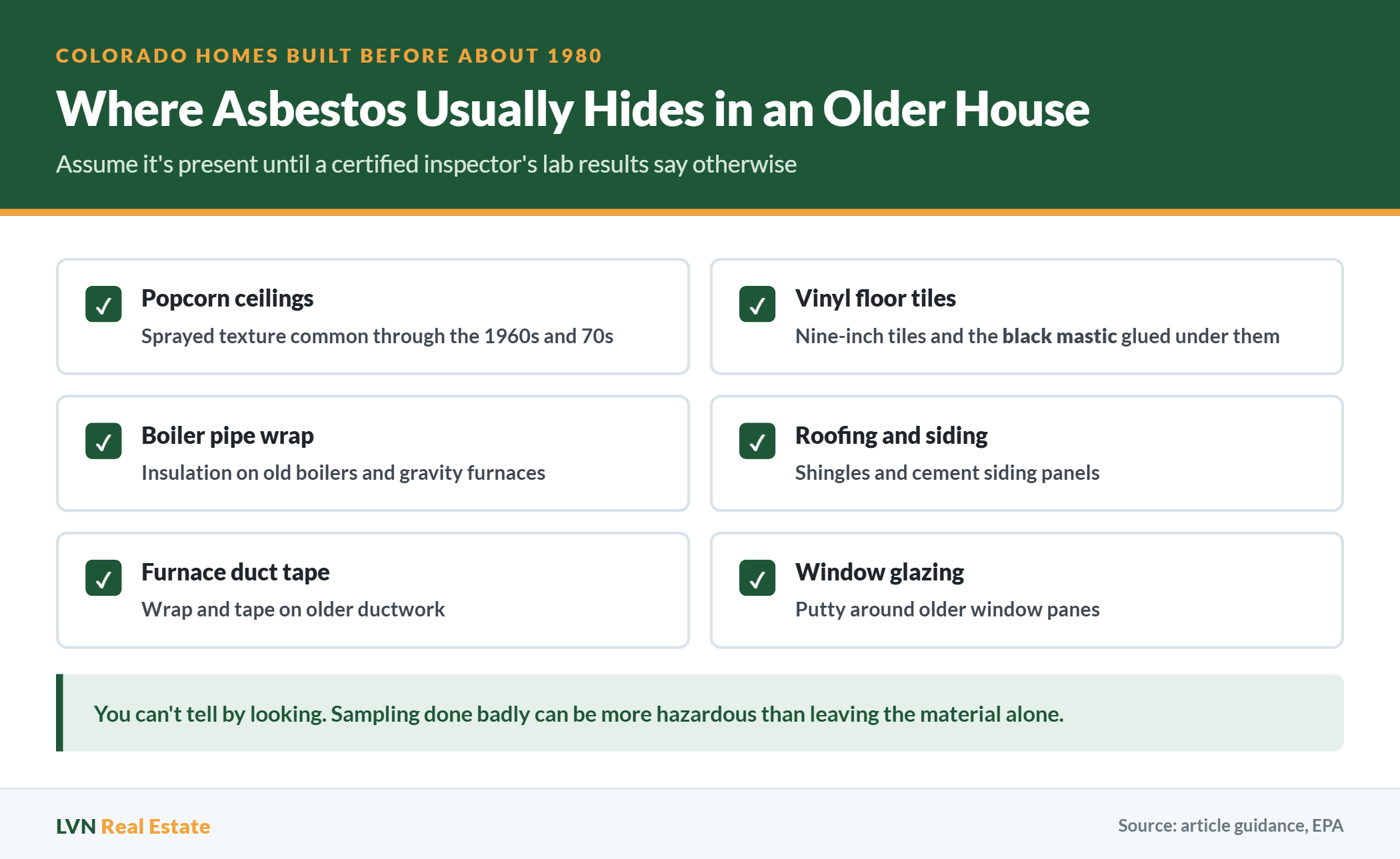
Colorado’s older neighborhoods are full of it. Park Hill bungalows, the brick ranches in Wheat Ridge, Old Colorado City cottages, the post-war tracts around Lakewood. If your Colorado property went up before about 1980, assume some asbestos is present until testing says otherwise, and I’ve rarely seen that assumption proven wrong.
A few years back I bought a house in Littleton from two adult children whose mother had moved into assisted living. One of them had taken a job transfer and had five weeks to be out of the state. We found asbestos pipe insulation wrapped around the old gravity furnace on a Tuesday walkthrough, plus a garage stacked floor to ceiling with paint cans. They didn’t have five weeks to abate anything, and they didn’t need to.
In a Colorado sale, asbestos matters for a reason beyond the mineral itself. It’s how buyers, lenders, and inspectors react to the word. Sellers lose real dollars to that reaction, and it’s manageable once you understand the mechanics.
How Dangerous Is Asbestos Exposure in Older Houses?
“If it’s that dangerous, how is anybody living in these houses?” Fair question, and the answer is the one piece of this that gets buried under scary marketing.
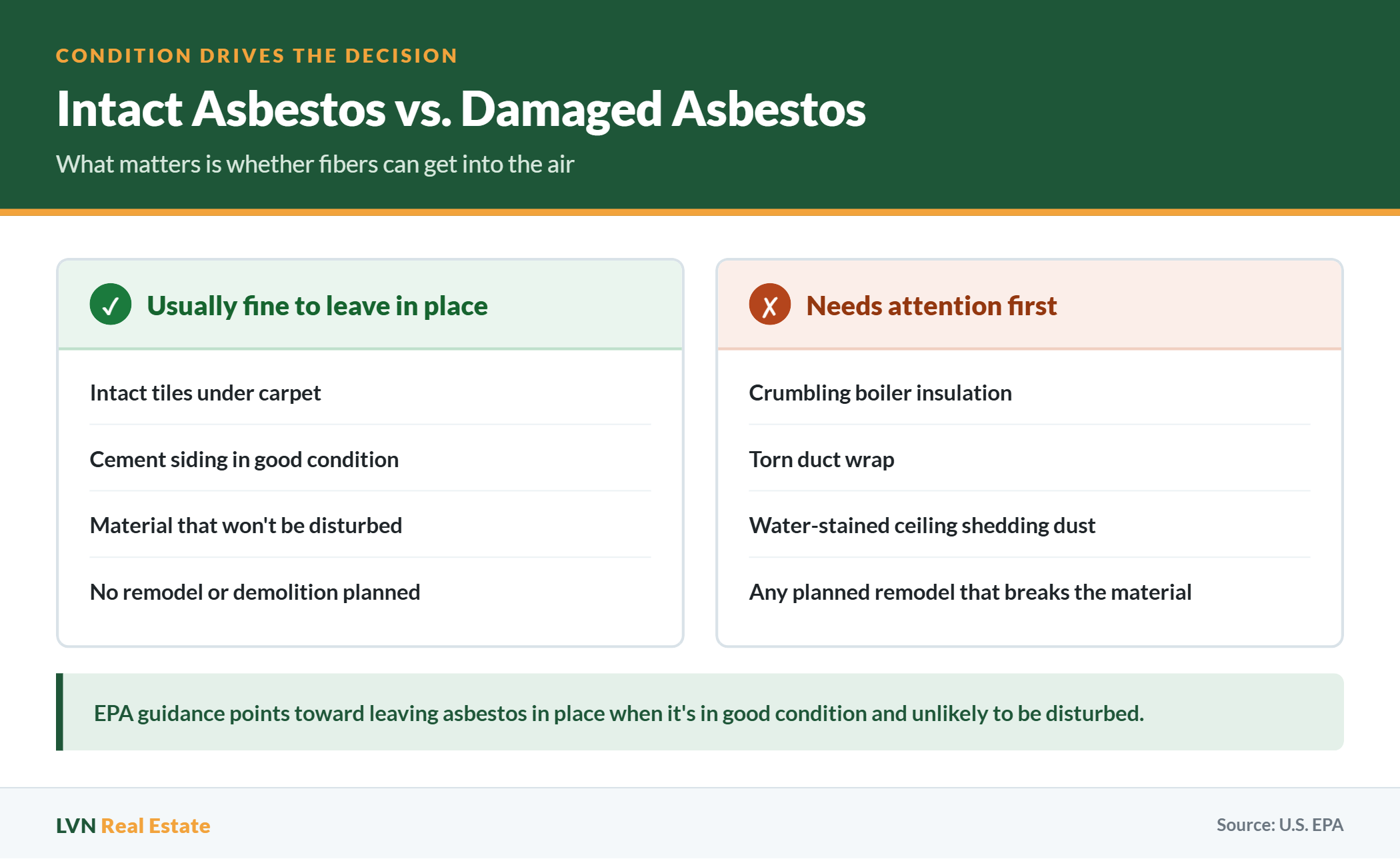
Intact material doesn’t release fibers. Asbestos-containing materials generally don’t pose a health risk as long as they stay intact and in good condition. Problems start when something breaks the material: a remodel, a leak, a demo hammer, decades of crumbling.
When fibers do get airborne, the health risks are real. Disturbed products release tiny asbestos fibers into the air, those fibers can lodge in the lungs and stay there, and accumulated fibers cause inflammation and scarring that lead to serious health problems over time. The EPA lists three major outcomes: lung cancer, mesothelioma (a rare cancer in the thin lining of the lung, chest, abdomen, and heart), and asbestosis, a progressive long-term lung disease.
Latency is the cruel part. Disease shows up decades after exposure, which is why the 1970s plumber and the 1960s boiler mechanic are the people who got sick, not the family who lived above intact tiles.
Here’s where I’ll disagree with half the contractors who will knock on your door: removal is not automatically the safe choice. EPA guidance points toward leaving asbestos in place when it’s in good condition and unlikely to be disturbed, because removal costs money and creates temporary exposure risk during the work itself. You can read the agency’s homeowner overview on the EPA’s asbestos page.
A crumbling mess is a different story. Crumbling boiler insulation in a Pueblo basement, torn duct wrap, a water-stained ceiling shedding dust: that asbestos needs attention before anyone lives with it. Condition drives the decision, not the presence of asbestos on a lab report.
How Do You Know If Your Colorado Home Has Asbestos?
Plan on spending somewhere between $400 and $1,200. That’s the typical range for a CDPHE-certified asbestos inspector on a Front Range single-family home, including bulk sampling and lab analysis. Cheap, relative to what a failed inspection contingency costs you.
You cannot eyeball this. Unless material is labeled, looking at it tells you nothing, and sampling done badly can be more hazardous than leaving the material alone, so the cutting corners instinct backfires here. I’ve watched sellers take a utility knife to a popcorn ceiling to “get a sample” and contaminate a room they then had to pay someone to clean.
One rule surprises people in Colorado. The state does not exempt newer homes; buildings of any age must be inspected for asbestos before building materials get disturbed, because CDPHE didn’t adopt a cutoff year the way some states did. Modern imported flooring and drywall have tested positive.
The person collecting the samples has to hold the right credential. A compliant inspection in Colorado has to be performed by a CDPHE-Certified Asbestos Building Inspector. CDPHE publishes a searchable list of licensed abatement contractors, project designers, inspectors, and air monitoring specialists through its Air Pollution Control Division, which also shows whether a license is current. Start at the state’s asbestos information page rather than a search engine ad.
Should you test before listing? If you’re going the traditional route with an agent, usually yes. Knowing beats finding out on day forty when a buyer’s inspector hands you a report and a renegotiation demand. If you’re selling as-is to an investor, testing is often money you don’t need to spend, since the buyer typically handles the asbestos question on their own dime.
Can You Sell a House with Asbestos in Colorado?
“Is this even legal?”
Yes. No Colorado law requires you to remove it before transferring a property. Not one. Houses with asbestos siding, tiles, and pipe wrap change hands across Colorado every single week.
What the law requires is honesty, not remediation. You can sell a Colorado home with asbestos still in the walls as long as you disclose what you know.
The market is the harder constraint. Colorado has softened, and sellers with condition issues feel it first. Single-family sales dropped 19% in October 2026, with the statewide median price easing 0.7% to $575,000, according to the Colorado Association of REALTORS. Single-family homes averaged 68 days on market statewide. You can see the full Colorado market report here.
Two months of showings with asbestos disclosed on a listing is a long two months. Financing adds friction too: FHA and VA appraisers flag deteriorated materials, and some lenders will require correction before closing. Cash buyers rarely care.
So your options sort into three lanes. Abate first and list clean, list as-is with full disclosure and price for it, or sell directly to a buyer who prices the asbestos into their offer and closes anyway. We buy Colorado properties in that third lane regularly at LVN Real Estate, so the seller never has to front abatement costs out of pocket.
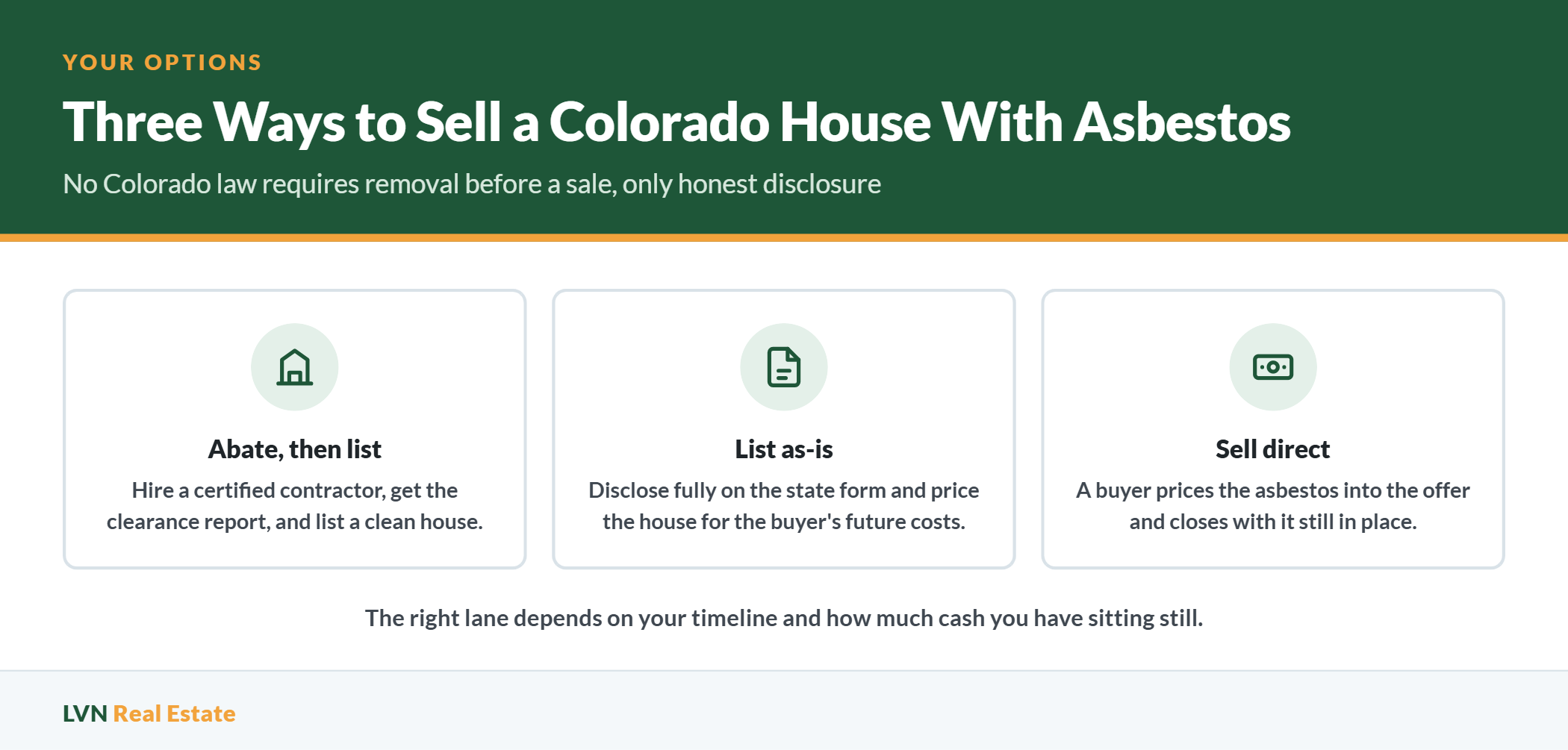
None of those three is wrong. The right one depends on your timeline and how much cash you have sitting still.
Do You Have to Disclose Asbestos When Selling a House in Colorado?
A seller in Aurora checked “no” on hazardous materials, then handed the buyer a 1994 abatement invoice at closing because it was in her file folder. The sale survived, barely, and only because she caught it herself.
Colorado uses a state-approved form, and asbestos is named on it directly. The Seller’s Property Disclosure (Residential) has an Environmental Conditions section asking whether hazardous materials, including asbestos, have ever existed on any part of the property. That phrase “ever existing” does a lot of work. Past asbestos counts, not just current.
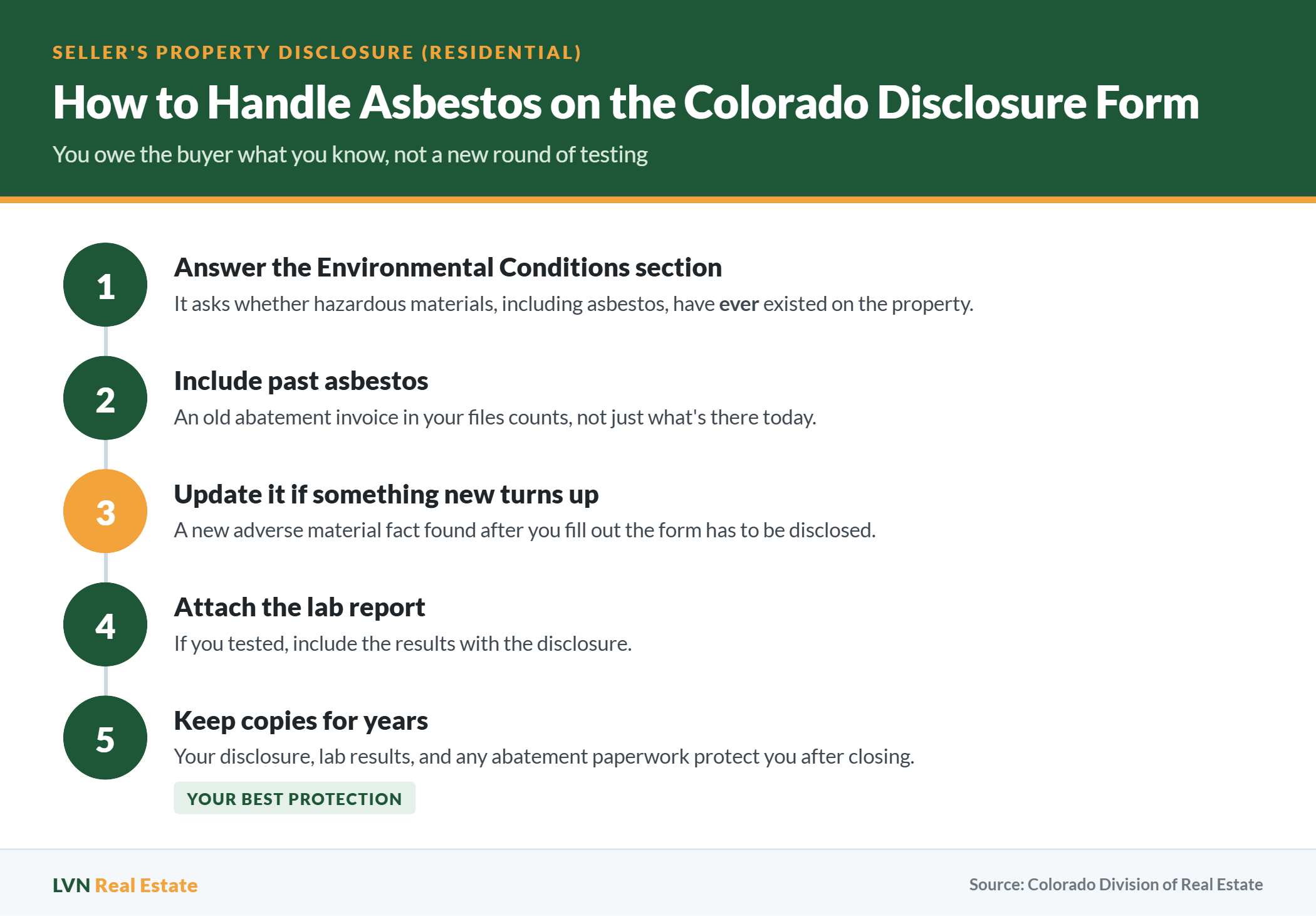
If you discover a new adverse material fact after completing the disclosure, you’re required to disclose it. Found something during packing? It goes on the form. You can review the current Colorado form on the Division of Real Estate’s site.
What you owe a buyer is what you know. No Colorado rule forces you to go test for asbestos just to fill out a form. Once you know, though, silence stops being an option.
Does disclosing asbestos kill sales? Less often than sellers fear. Buyers in Colorado expect a 1962 house to have 1962 materials in it. What blows up a sale is the gap between what the seller said and what the inspector found.
I’ve bought plenty of houses where the disclosure listed asbestos plainly, and it changed nothing about my offer. Omissions are what create lawsuits and post-closing letters from attorneys. Write it down. Attach the lab report if you have one. Keep a copy.
What Does the Asbestos Abatement Process Involve?
A landlord in Greeley wanted to flip a duplex and figured he’d scrape the popcorn ceilings himself over a weekend. He stopped after one room when he learned about Colorado’s permit thresholds.
Those thresholds are the first thing to understand about asbestos abatement in Colorado. Under CDPHE Regulation 8, disturbing more than 32 square feet of surface material, 50 linear feet on pipes, or a 55-gallon drum’s volume means testing and state-certified abatement are legally required. So a small job can trigger big obligations fast. Thirty-two square feet is roughly one sheet of plywood. Most ceiling jobs blow past it immediately.
Above those trigger levels, the process has a shape. A ten-day notification goes to the state, and a state-certified General Abatement Contractor has to perform the removal. CDPHE charges permit fees by duration for single-family dwellings: $60 for a notice, $180 for a 30-day permit, $300 for 90 days, and $420 for a full year.
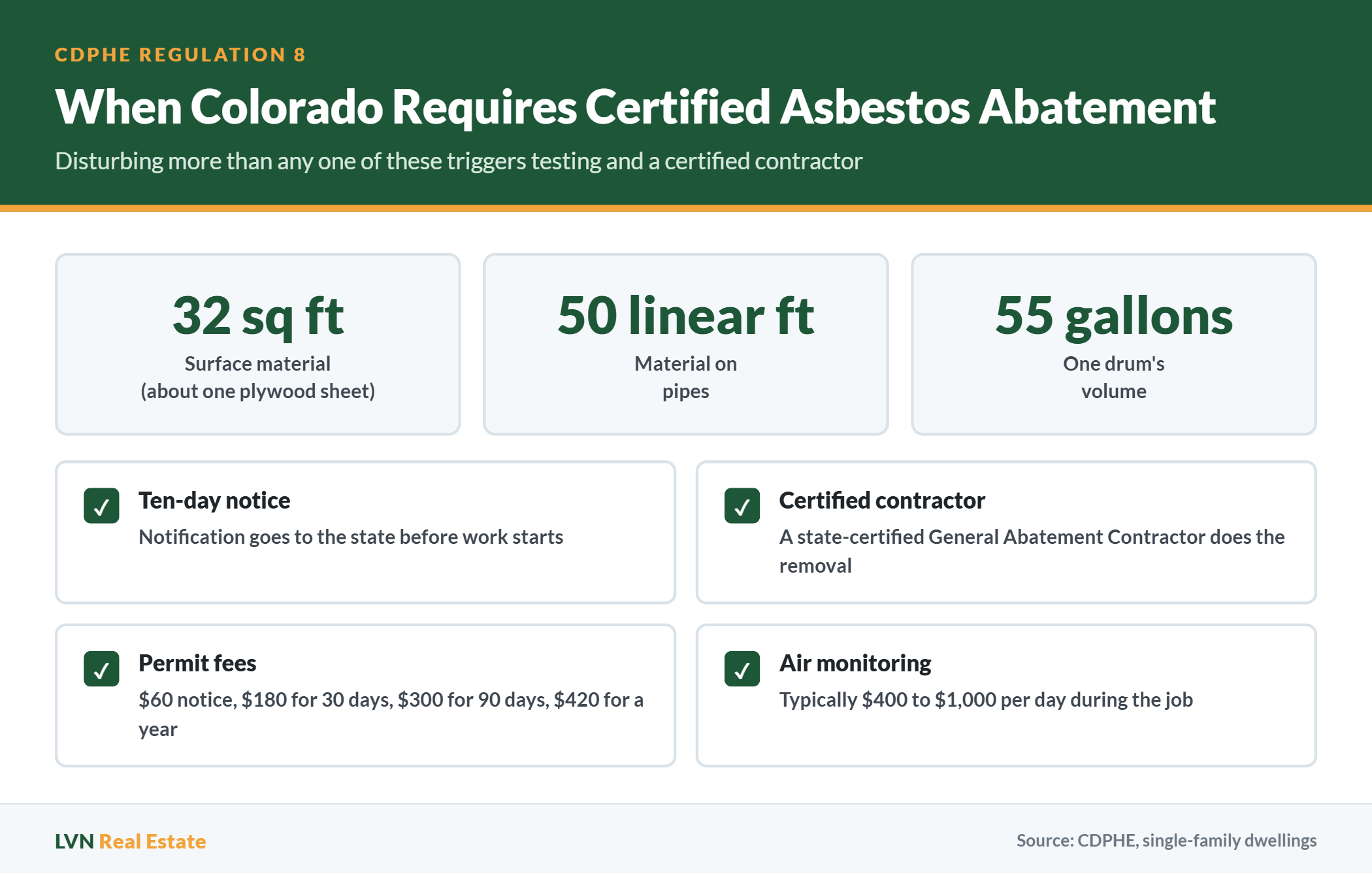
The physical work is contained, wetted, bagged, and air-monitored. Plastic sheeting goes up, negative air machines run, workers suit up, and waste goes to a facility permitted to take asbestos. Air monitoring during abatement typically runs $400 to $1,000 per day depending on how many samples get pulled.
Timelines in Colorado depend on contractor backlog more than on the work itself. Spring and summer book out. Winter abatement moves faster, though Colorado’s freeze-thaw swings complicate containment in unheated spaces.
Budget for the rebuild, not just the asbestos removal. Pulling asbestos floor tiles leaves you with a subfloor and no finished surface, and that second invoice is the one sellers forget when they run the numbers.
Should You Hire a Professional for Asbestos Removal?
Which brings up the question every DIY-minded Colorado homeowner asks next.
Colorado carves out narrow room for owner-occupants, and the carve-out is narrower than it sounds. An owner-occupant of a single-family residence that’s their primary home may ask CDPHE that the dwelling not be treated as an “area of public access” for a specific abatement project. They must do this by filing the Division’s opt-out form before work starts. By default, Colorado law includes single-family homes in that category, so most residential abatement follows the same strict protections as commercial sites.
That opt-out is not permission to do whatever you want. CDPHE still expects safe handling and proper disposal. And if the property isn’t where you live, which describes most inherited and rental situations I encounter, the carve-out doesn’t apply to you at all.
My position: hire the certified contractor. The cost difference between doing asbestos removal legally and doing it badly is small compared to the liability you carry into a Colorado closing with no permit, no air clearance, and no paperwork.
Buyers’ agents ask for documentation now. A clearance report is an asset at the closing table; a story about a weekend with a shop vac is a liability.
A seller in Montrose called me after getting a contractor bid for asbestos abatement on her kitchen floor and backsplash. The estimate came back higher than the entire kitchen was worth, cabinets included, and she’d been sitting on it for a month, paying a mortgage on a house she’d already moved out of. We bought the house with the asbestos exactly where it was, and she stopped bleeding carrying costs that Friday.
When the abatement quote exceeds what the finished space adds to value, removal stops being an improvement and becomes a donation. Selling as-is to a buyer who handles asbestos routinely isn’t surrender, it’s just arithmetic. That’s the conversation we have at LVN Real Estate with Colorado sellers all the time, and a good investor will show you both sets of numbers rather than just the one that favors them.
Frequently Asked Questions
Can a Homeowner Legally Remove Asbestos Themselves in Colorado?
Only in limited circumstances, and only if you live in the home as your primary residence. Small projects that stay under the state’s trigger levels described earlier fall outside the certification requirement, but anything larger means hiring a certified General Abatement Contractor. Landlords, heirs selling an inherited property, and investors don’t get the owner-occupant carve-out at all, so asbestos work on those Colorado properties goes to a licensed pro every time.
Will Insurance Companies Cover a House with Asbestos Siding?
Generally yes, and asbestos cement siding is one of the less troublesome versions to insure in Colorado. It’s non-friable, weather-tough, and it holds up well against hail, which matters along the Front Range. Some carriers ask questions about condition or price the policy a little differently, so shop two or three companies rather than accepting the first quote. Where insurers get nervous is damaged or deteriorating asbestos material, not intact siding panels.
Does Asbestos Reduce What a Colorado Home Is Worth?
It affects price mostly through buyer pool and financing, not through some fixed appraisal deduction. A Colorado home with intact asbestos tiles under carpet rarely appraises lower; a home with crumbling pipe insulation and an FHA buyer can lose the sale entirely. Expect offers to come in reflecting the cost of future removal plus a cushion for uncertainty. Cash buyers and investors discount it least, because they’ve priced asbestos jobs before and know what the work actually runs.
Can I Sell a Colorado House As-is Without Testing for Asbestos?
You can. Colorado doesn’t require pre-sale testing, only that you disclose what you already know on the state form. Selling as-is to a direct buyer usually means skipping the inspection entirely, since that buyer takes on the asbestos question themselves. If you’re listing on the MLS instead, testing ahead of time gives you control over the conversation rather than reacting to someone else’s report mid-contract.
What Happens If Asbestos Turns Up After Closing in Colorado?
If you disclosed honestly and didn’t know about it, you’re generally in reasonable shape, because the Colorado disclosure form asks what the seller knows, not what exists. Trouble comes from concealment: covering damaged material, pulling a report out of the file, or answering “no” when you had reason to answer otherwise. Keep copies of your disclosure, any lab results, and any abatement paperwork for years after the sale.
Do Colorado Buyers Walk Away Over Asbestos?
Some do, and they’re usually first-time buyers using financing with strict property condition standards. Plenty of others shrug, especially in Denver and Colorado Springs neighborhoods where mid-century houses are the norm and asbestos shows up on half the inspection reports. Pricing honestly and disclosing early filters out the buyers who were going to leave anyway, which saves you weeks you’d otherwise spend back on the market.
If you’re sitting on a Colorado house with asbestos and you’re not sure whether to abate it, list it, or just be done with it, I’m happy to walk through the math with you. Sometimes the right answer is hiring the abatement crew and listing clean, and I’ll tell you that if it’s true. Other times the numbers say sell it as it stands. Either way, you’re welcome to reach out and talk it through. No pressure, no obligation, and no one will push you toward a decision that isn’t yours.
What Denver’s Fall Market Means for Older Homes
Denver metro home sales fell 21.39% year over year in September, the slowest September since 2008, according to ColoradoBiz’s report on Denver Metro Association of Realtors data. Fewer buyers means a house with asbestos on the disclosure has a smaller pool to win over. Older homes in Denver, Aurora and Lakewood tend to feel that first.
That doesn’t mean you have to wait for spring. It means the math between abating, listing as-is and selling direct matters more right now.
Talk Through Your Asbestos Numbers With Us
Every house with asbestos comes with its own numbers. Some sellers do best abating and listing clean, and others come out ahead selling the house as it stands. If you’d like a second set of eyes, reach out to LVN Real Estate and we’ll go over both options with you. You can also fill out the short form below to get a no-obligation cash offer on your Colorado house.