

A landlord in Park Hill called me last spring with a problem that had nothing to do with his house. His tenant had eleven months left on a lease, his job had moved to Phoenix, and every agent he’d talked to told him the same thing: wait. Denver landlords lose real money on that advice, and it’s usually wrong. Selling a tenant occupied property in Denver is legal, common, and frequently the smarter financial move, as long as you understand how Colorado law treats that lease once the deed changes hands.
Why Sell a Tenant Occupied Property in Denver, CO?
Some years back I bought a bungalow in Barnum from a young couple who were three months behind on the mortgage with an auction date already circled on the calendar. Their tenant was paying rent on time, but the rent didn’t cover the payment, and the garage was still full of the husband’s woodworking tools when we closed on a Thursday.
The rental stopped penciling out, and the lease is the only thing standing between the owner and a clean exit.
Denver numbers explain part of it. In October 2026, the median sale price across the six core Denver metro counties held at $585,000, essentially unchanged from a year earlier, while October closings dropped from 3,450 to 2,754, a 20% decline.
Costs keep climbing, and that pushes the rest of these decisions. Insurance premiums on older Denver bungalows have climbed hard after a decade of hailstorms. Property taxes in the City and County of Denver keep adjusting. A furnace that dies in January on a Capitol Hill fourplex can erase a year of profit.
Then there’s the licensing side. The Healthy Residential Rentals for All ordinance passed May 3, 2021. Under it, anyone offering or operating a residential rental property in the City and County of Denver must hold a Residential Rental Property license. The requirement for single-unit rentals took effect January 1, 2024. An inspection and paperwork are required before you can legally rent. Some owners look at the renewal cycle and decide they’re done being landlords.
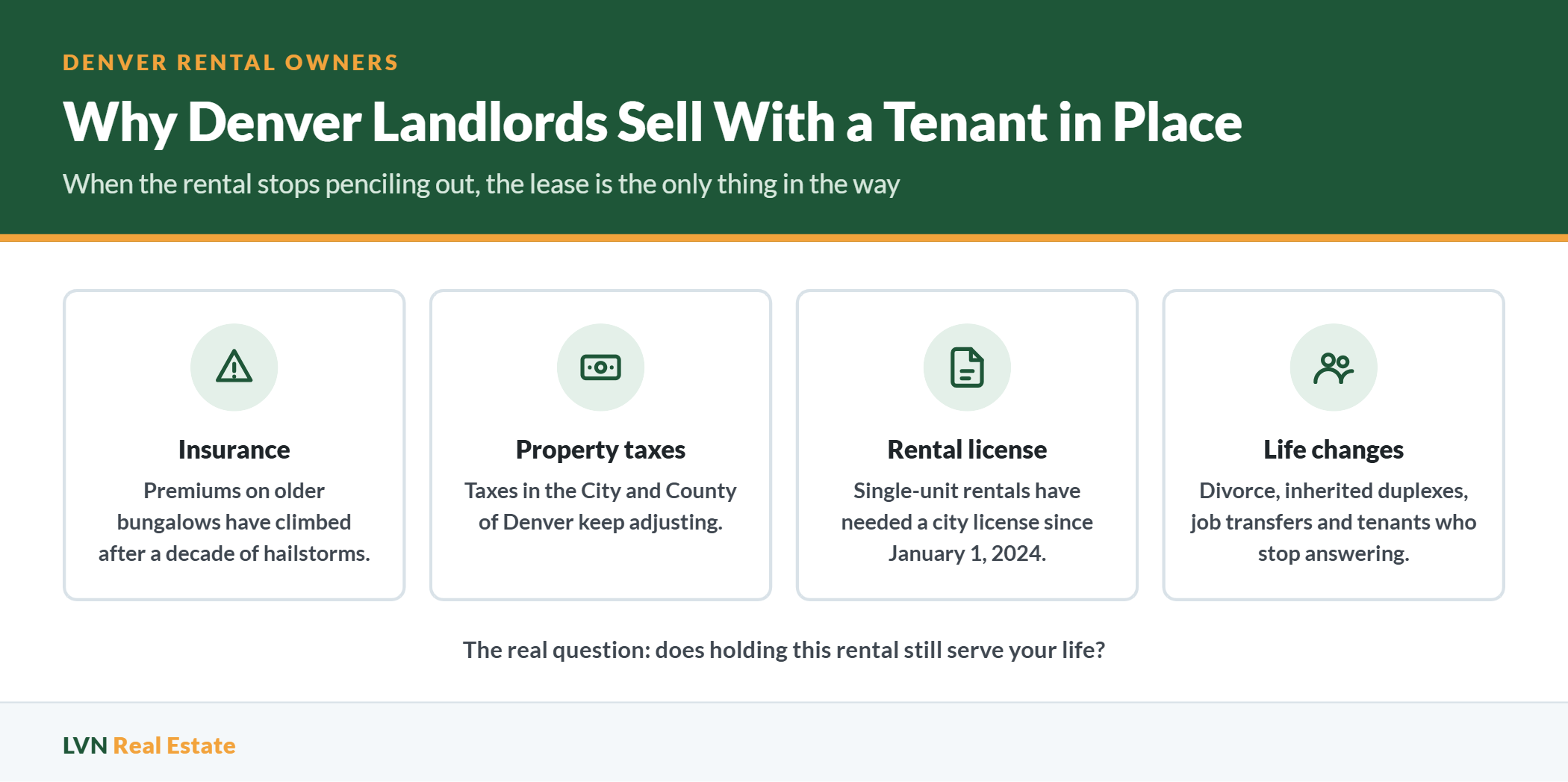
Divorce, inherited duplexes in Berkeley, a job transfer to Boulder, a tenant who stopped answering texts: the reasons vary. But the math behind selling a tenant occupied property in Denver usually comes down to one question you have to ask yourself. Does holding this asset still serve your life?
Can You Sell a Rental Property in Denver, CO with Tenants Living in It?
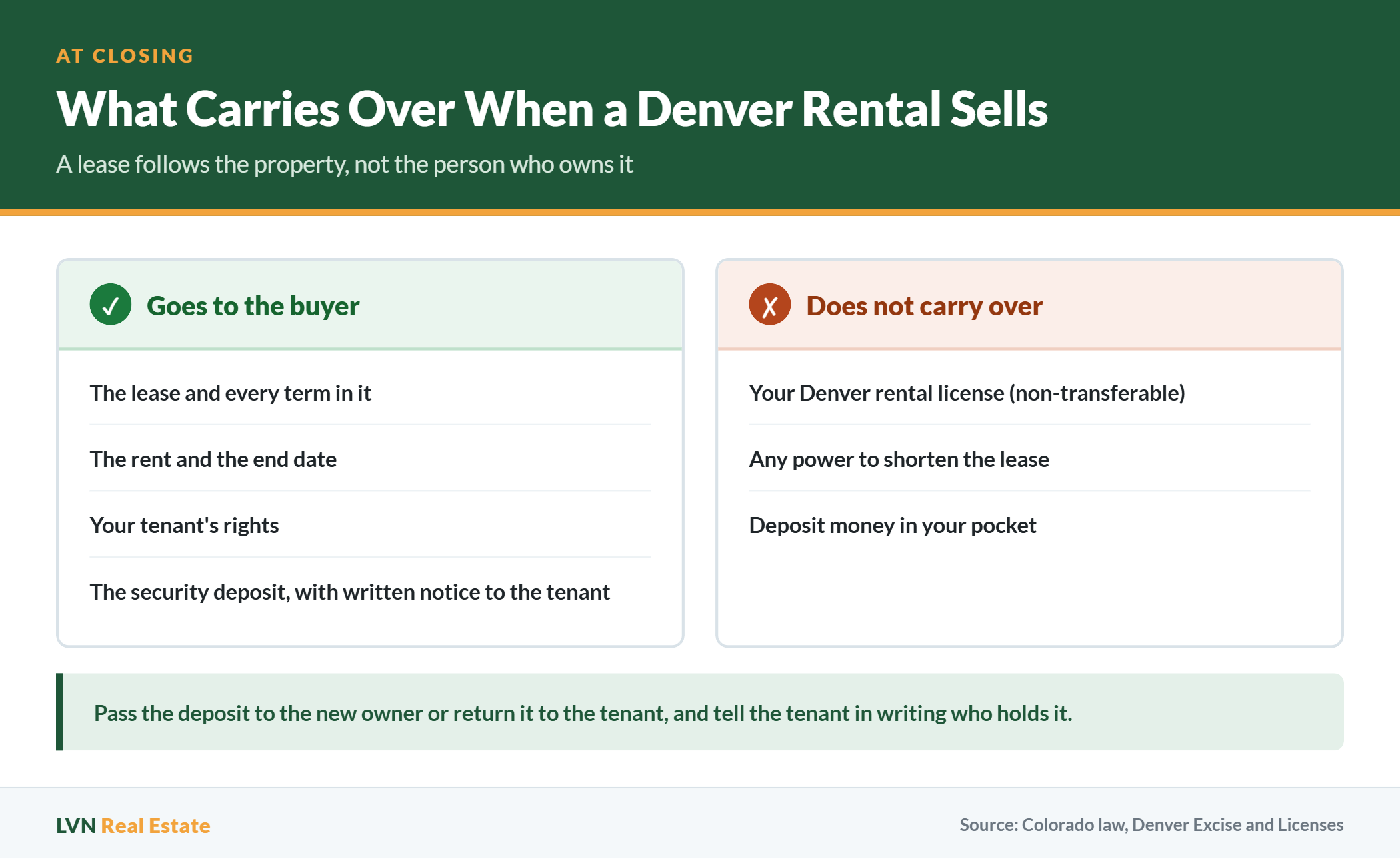
A lease follows the property, not the person who owns it. When you sell a tenant occupied property in Denver, the buyer steps into your shoes as landlord, and your tenant keeps every right they had the day before closing. Nothing about the sale shortens their term.
Colorado requires that the security deposit be handled properly at the transfer, not quietly absorbed into your proceeds. The former owner must either pass the remaining deposit (minus lawful deductions) to the new owner or return it to the tenant. This must be done along with written notice telling the tenant how it was handled and who holds it now.
Your Denver rental license doesn’t ride along either. Residential rental licenses in Denver are non-transferable, and they’re valid for four years unless ownership changes. Your buyer handles their own licensing with the Department of Excise and Licenses.
Showings are where the friction shows up. Your lease agreement governs notice for entry, and if it’s silent, you’re relying on goodwill.
Most mortgage buyers shopping Denver want to move in, so a tenant with nine months left disqualifies the tenant occupied property for them entirely. That shrinks your buyer pool to investors and the occasional patient owner-occupant.
It’s worth getting organized before anything else. Pull the signed lease, the deposit ledger, rent payment history, and any written correspondence into one folder before you list. Buyers underwriting a tenant occupied property in Denver will ask for all of it, and sellers who can’t produce documents lose leverage fast.
Should You Wait for the Lease to End Before Selling Your Denver Rental?
Waiting out a long lease is usually the most expensive form of patience in real estate.
Run the numbers before you accept that advice. If you’re carrying a mortgage, insurance, taxes, and maintenance for eight more months on a Denver rental, that holding cost comes straight off your net.
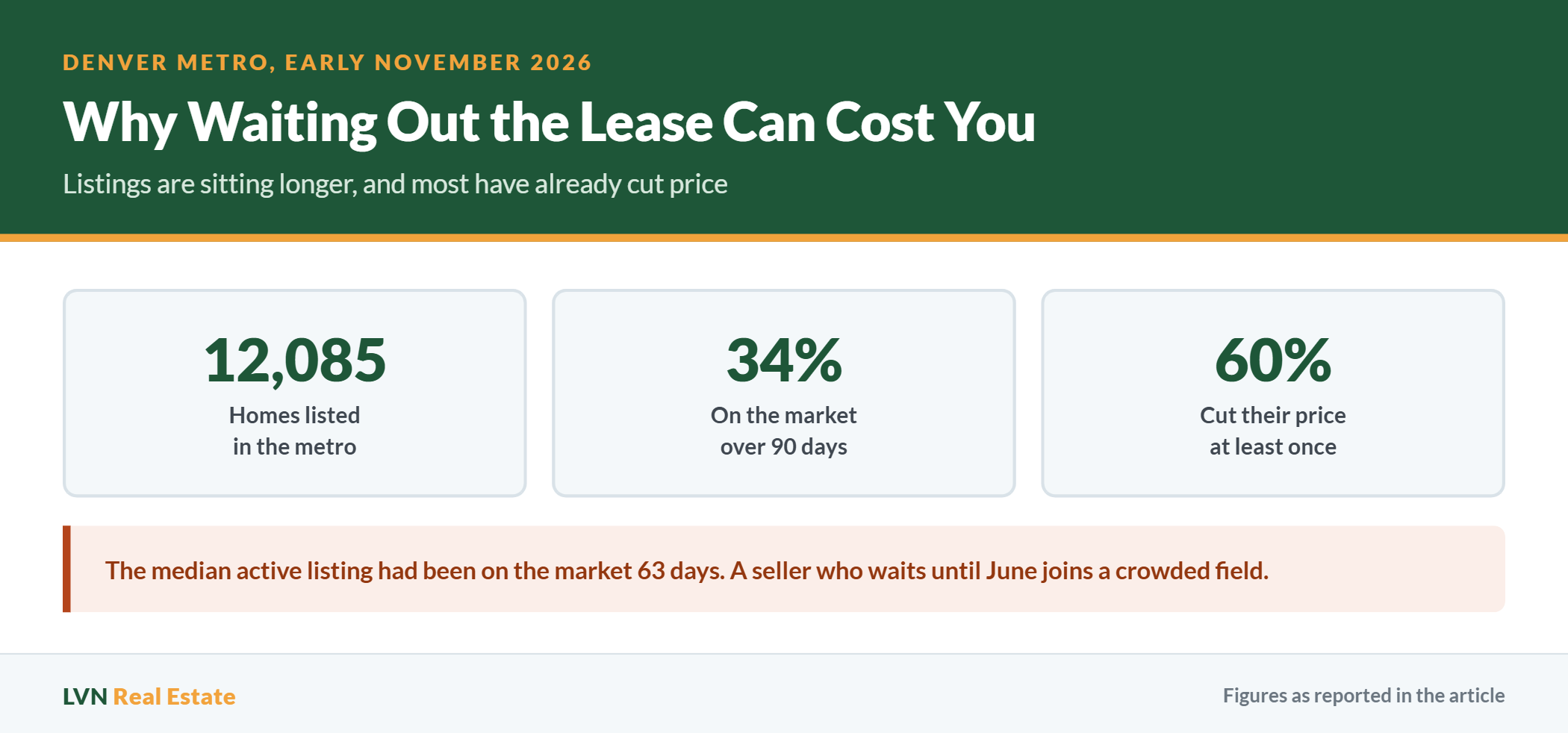
Current conditions argue against stalling. Of the 12,085 Denver metro homes listed in early November 2026, 34% had been on the market more than 90 days. 60% had already cut their price at least once, with the median active listing sitting 63 days. I’ve watched this pattern play out before, and a seller who waits until June to list is joining a crowded field, not escaping one.
A vacant house carries its own risk. Empty houses in Denver get hit by frozen pipes in February and copper theft in neighborhoods in transition.
Still, a legitimate case for waiting exists. When your lease ends in sixty days anyway, and your Highlands property would sell to an owner-occupant at a premium, patience pays. Attached homes are a different story: condo and townhome median time in the MLS rose from 41 to 48 days between October 2025 and October 2026, so an Uptown condo might sit regardless.
Ask yourself what the delay actually buys. If the answer is “a slightly better price I’m not certain about,” that’s a bet, not a plan. We work with Denver owners on both tracks at LVN Real Estate, and running the hold-versus-sell comparison in writing beats guessing.
My general rule: if the lease has more than four months left and your reason for selling is financial pressure, don’t wait. Don’t wait for a tenant occupied property in Denver to empty out on its own.
Is Selling Your Tenant Occupied Property in Denver, CO to an Investor a Good Idea?
“Will I get lowballed because someone’s living there?”
Fair question. The answer rests on who’s buying: an owner-occupant sees an obstacle, while an investor sees income already in place, verified by rent receipts, with no lease-up period and no vacancy gap.
Denver investors pay for performing tenants. A unit in Athmar Park renting at market with twelve months of clean payment history is worth more to a buyer building a portfolio than the same unit sitting empty.
What you give up is the retail premium. Investors price for repairs and risk, so you’ll typically land under what a scrubbed, staged, vacant house fetches on the MLS.
Listing a tenant occupied property in Denver means coordinating showings around someone else’s schedule, then waiting through financing, which adds its own delay on top of everything else. The Colorado Association of REALTORS reported 67 days on market for seven-county metro condos and townhomes in its September 2026 report. Cash closings run weeks, not months.
Subtract the agent commission, the repairs a lender will demand, two or three months of carrying costs, and a price reduction. Then compare.
Local matters here too, and it’s something I’ve seen trip up out-of-state buyers more than once. A buyer who knows the difference between Sloan’s Lake and Sun Valley underwrites your Denver property accurately instead of padding their offer with unknowns. The team at LVN Real Estate focuses on Denver neighborhoods specifically, which shortens the diligence back-and-forth considerably.
What Is Cash for Keys and How Does It Work for Occupied Rentals?
Paying someone to leave a house you own sounds backwards. It isn’t. It’s almost always cheaper than the alternative, which is a court docket, an attorney, lost rent, and a tenant with no reason left to treat your property gently.
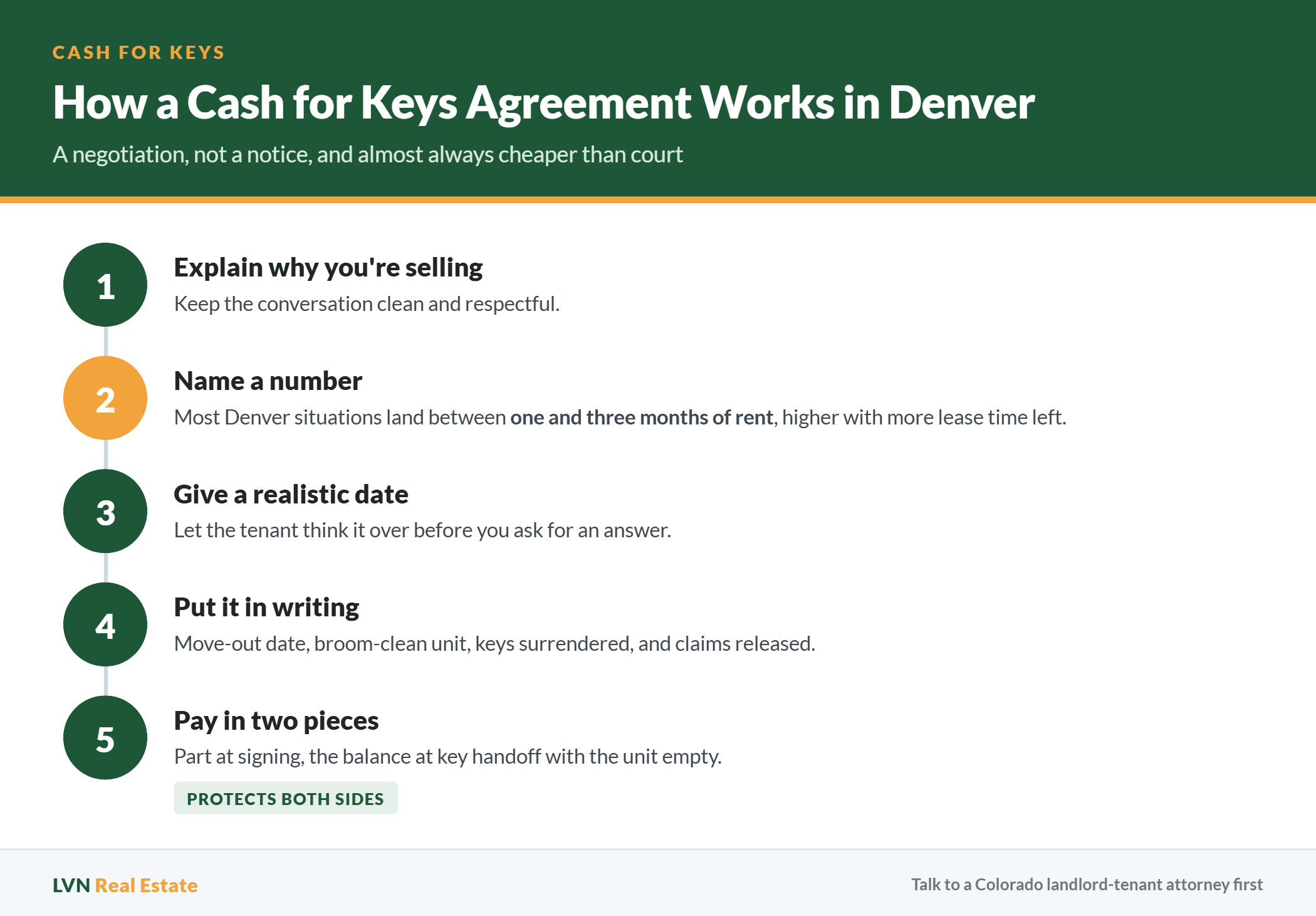
Cash for keys is a written agreement. You offer money. The tenant agrees to vacate by a set date, leave the unit broom-clean, surrender the keys, and release any claims.
Put it in writing every single time. A verbal agreement with a Denver tenant gives you nothing to enforce when move-out day arrives and the moving truck never shows.
You must time your sale carefully for a tenant occupied property in Denver with a fixed-term lease. You can’t unilaterally shorten that term, so cash for keys is a negotiation, not a notice.
The conversation goes better than landlords expect. Plenty of Denver renters are already thinking about moving, and a check that covers a deposit on a new place in Lakewood solves their problem and yours simultaneously.
Keep it clean and respectful. Explain why you’re selling, name a number, give a realistic date, and let them think it over.
Some buyers handle this step themselves after closing. When I buy a tenant occupied property, I’d often rather manage the tenant relationship directly than have a stressed-out seller negotiating under a deadline. Ask any buyer whether they’ll take the property with the tenant in place before you spend a dollar on relocation.
How Much Should You Offer a Tenant to Move Out in Denver, CO?
One month’s rent gets thrown around as the standard figure, and it works fine for a month-to-month tenant in a modest Denver rental who was already house-hunting. But that number stops working the moment your tenant has a below-market lease and eight months of security left.
Think about it from their side of the kitchen table. Someone paying $1,500 for a Villa Park two-bedroom who’d pay $1,950 for the equivalent today is losing $450 a month by leaving.
Start the offer with their actual costs. First month plus deposit at a new place, moving expenses, and something for the disruption. In most Denver situations that lands somewhere between one and three months of rent, with longer remaining lease terms pushing toward the high end.
Compare that against the cost of doing nothing. Carrying a non-performing Denver property while an eviction winds through county court can burn through more than the relocation payment several times over, so you’re still stuck owning the house at the end.
Two things raise the number: a tight rental submarket and a tenant with roots. Families with kids in a specific Denver Public Schools boundary have genuine reasons to resist moving, and a Washington Park tenant with a backyard and a garage knows what they’ve got.
Structure the payment in two pieces when you can: a portion at signing, the balance at key handoff with the unit empty. Protects both sides. Keep in mind that a tenant occupied property in Denver sold to an investor may not require any relocation payment at all, which makes this whole calculation optional.
What Happens If Your Denver Tenant Won’t Cooperate with a Sale?
Get this wrong and you’ll lose a buyer, a contract, and three months, all over a showing that never happened.
Uncooperative tenants are real: some refuse entry, leave the place filthy before photos, or tell every buyer who walks through about the basement that floods.
Start with the lease agreement and read the entry provisions carefully. If written notice is specified, follow it exactly, in writing, every time.
When goodwill fails, you have three honest paths. Negotiate cash for keys. Sell a tenant occupied property in Denver as-is to an investor who doesn’t need showings. Or let the lease run its course.
Lease termination follows a strict schedule in Colorado. Under the state judicial branch’s guidance on the Notice to Terminate Tenancy (JDF 99 B), the notice period runs anywhere from 1 to 91 days depending on the rental agreement. A lease term of a year or longer gets the full 91 days. That form is for repeat or serious lease violations, not for clearing a rental before a sale. The notice must be in the tenant’s primary language. The forms and instructions live on the Colorado Judicial Branch self-help page.
Colorado also limits the reasons a landlord may end a tenancy without fault. A Notice of No-Fault Eviction (JDF 99 C) applies to situations including selling the home, and that notice period must be at least 90 days. Before you serve anything on a Denver tenant, talk to a Colorado landlord-tenant attorney about which form fits your facts.
Document everything. Dates, texts, emails, delivery method. If this ends up in Denver County Court, your records are the case.
What Mistakes Should You Avoid When Selling a Tenant Occupied Property in Denver, CO?
That documentation habit is exactly where most of the avoidable errors start. Sellers who keep nothing, promise things verbally, and improvise their way through closing are the ones who end up in trouble.
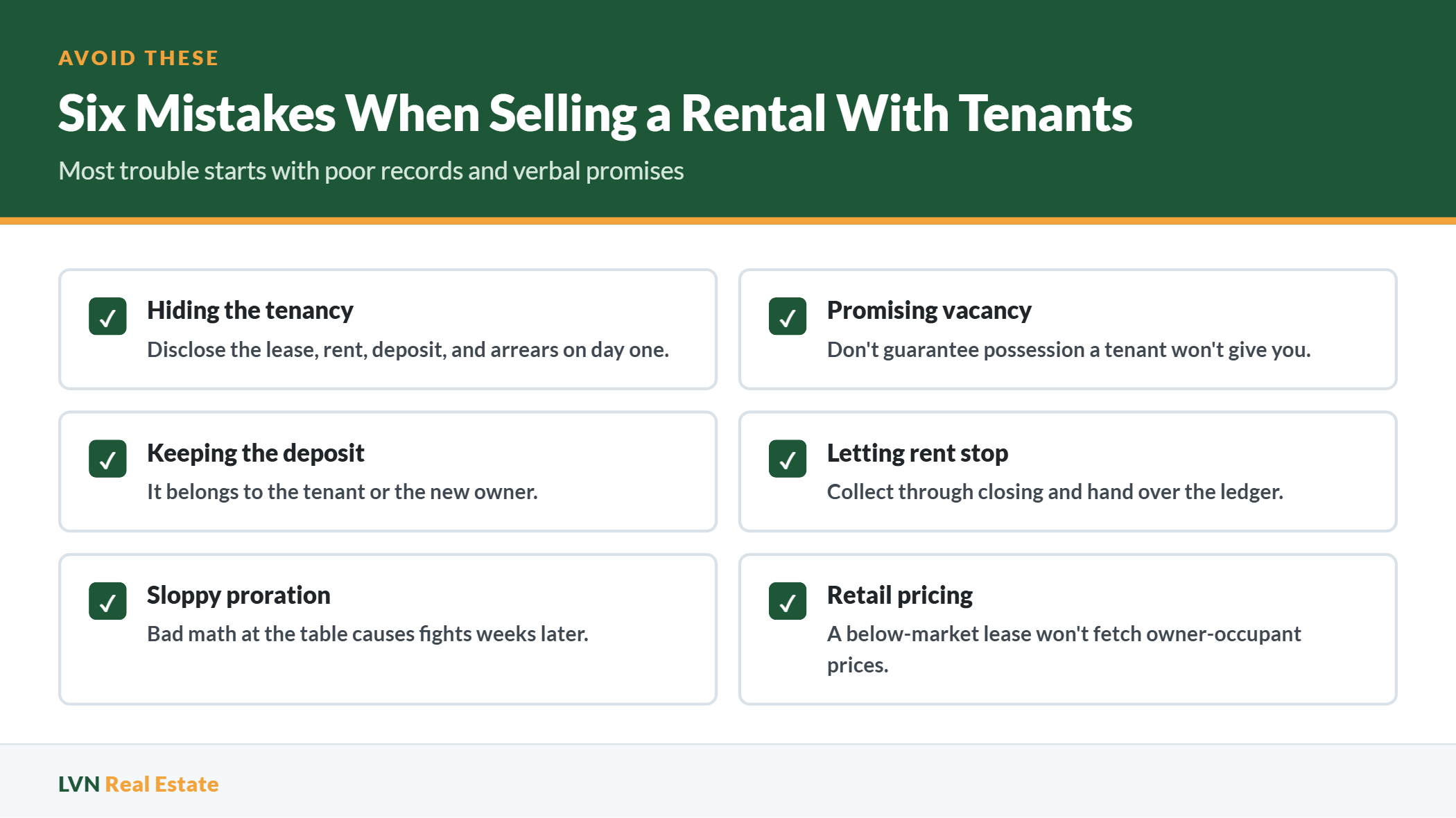
The biggest mistake is hiding the tenancy from your buyer. Disclose the lease, the rent, the deposit, and the arrears on day one.
Second: promising a vacant property you can’t deliver. I’ve seen Denver sellers sign a contract guaranteeing possession at closing, even though a tenant with four months left had no intention of leaving. That seller now owes a buyer a house he can’t hand over.
Pocketing the deposit is another one. It belongs to the tenant or the new owner, never to you, and the written notice requirement isn’t optional.
Don’t let the rent stop either. Collect through closing, prorate correctly at the table, and give your closing agent the ledger. Sloppy proration on a tenant occupied property in Denver creates arguments weeks after everyone has moved on.
Pricing errors round out the list. A Denver rental with a lease well under market won’t fetch owner-occupant pricing, and pretending otherwise just means sitting on the MLS. In September 2026, 32.1% of Denver listings carried a price cut, the second-highest share among the fifty largest U.S. metros.
An heir reached out to me about a Westwood rental she’d inherited while her divorce was being finalized. She was blunt: she wanted the asset turned into one clean number her attorney could work with. The tenant stayed put, the detached garage still had the previous owner’s canning jars lining the shelves, and we closed without a single showing. That’s often the right answer when the tenant occupied property is one line item in a bigger negotiation.
If you want a sanity check on your situation before committing, LVN Real Estate will walk through the lease and the math with you.
Frequently Asked Questions
What Rights Do Tenants Have in Denver County When the Property Is Sold?
Your tenant keeps everything the lease gave them, and ownership changing doesn’t alter the terms, the rent, or the end date. Colorado law also protects their security deposit through the transfer, and they’re entitled to written notice telling them who holds it going forward. Denver tenants additionally have rights tied to the city’s rental licensing ordinance and minimum housing standards, which the Denver Department of Excise and Licenses enforces.
How Does the Eviction Process Work for a Denver Rental?
Eviction in Denver starts with the correct written notice, served the correct way, using Colorado’s state-issued forms, and the required notice period depends on the length and type of the tenancy. Only after that period passes can you file an eviction complaint and summons with Denver County Court. Selling the tenant occupied property is not by itself grounds to remove a tenant on short notice, so talk with a Colorado attorney before serving anything.
Do I Have to Tell My Tenant I’m Selling the House?
Legally your obligation centers on the deposit notice and any entry provisions in the rental agreement, but telling them early is the better play. Tenants who hear about a sale from a stranger with a lockbox key tend to become difficult, and tenants who hear it from you often cooperate with showings. A short, direct conversation protects the relationship and your timeline.
Can My Buyer Raise the Rent or Evict My Tenant After Closing?
Not during a fixed-term lease. The new owner inherits the rental agreement exactly as written and can only change rent or terms once that term expires, following the notice rules Colorado requires. Month-to-month arrangements give a buyer more flexibility, though the statutory notice periods still apply.
Is It Harder to Get Financing on a Tenant Occupied Property?
It depends on the buyer. Investors using portfolio or commercial financing often prefer an occupied unit because the rental income supports their underwriting. Owner-occupant buyers using conventional or FHA loans generally need possession at closing, so an active lease usually rules them out entirely.
If you’re sitting on a rental here and you’re not sure whether to wait, negotiate with your tenant, or just sell it as it stands, I’m happy to talk it through. No pressure, no obligation, and no one will push you toward an offer you don’t want.
What Denver’s Fall Prices Mean for Rental Owners
The median price across the 11-county Denver metro slipped to $575,000 in September, down from $594,000 in August, according to the Denver Gazette’s coverage of the Denver Metro Association of Realtors report. Detached homes dipped too. For a landlord, a softer retail market makes a buyer who values the rent roll more useful than usual.
That holds for owners in Denver and for landlords across Colorado weighing a sale before the lease runs out.
Talk Through Your Rental With Us
Every lease and every tenant is a little different. If you’d like help comparing a sale with the tenant in place against waiting for move-out, contact LVN Real Estate and we’ll go over the numbers with you. You can also fill out the short form below to get a no-obligation cash offer on your Denver rental.