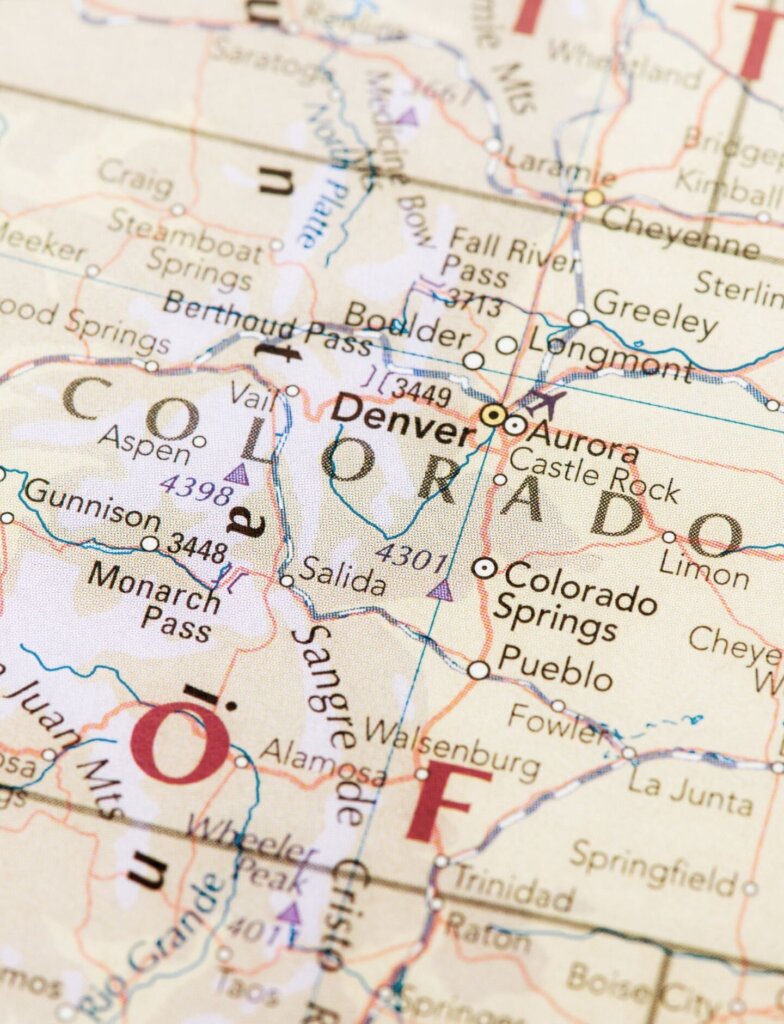

Most Denver sellers learn they’ve got a problem under the floor from an inspection report. Maybe your agent crawled down there. Maybe a buyer’s inspector did, and now you’re holding a report full of photos you’d rather not have seen. Crawl space water is one of those discoveries that rearranges your whole plan for selling, and I’ve had that exact conversation more times than I can count.
Why Does Denver Have Crawl Space Water Problems?
A ranch home near Sloan’s Lake stayed dry for eleven years, which says nothing about what’s coming next. One weekend in May, the sprinkler zone along the north wall stuck on, and by Monday water was standing under the kitchen.
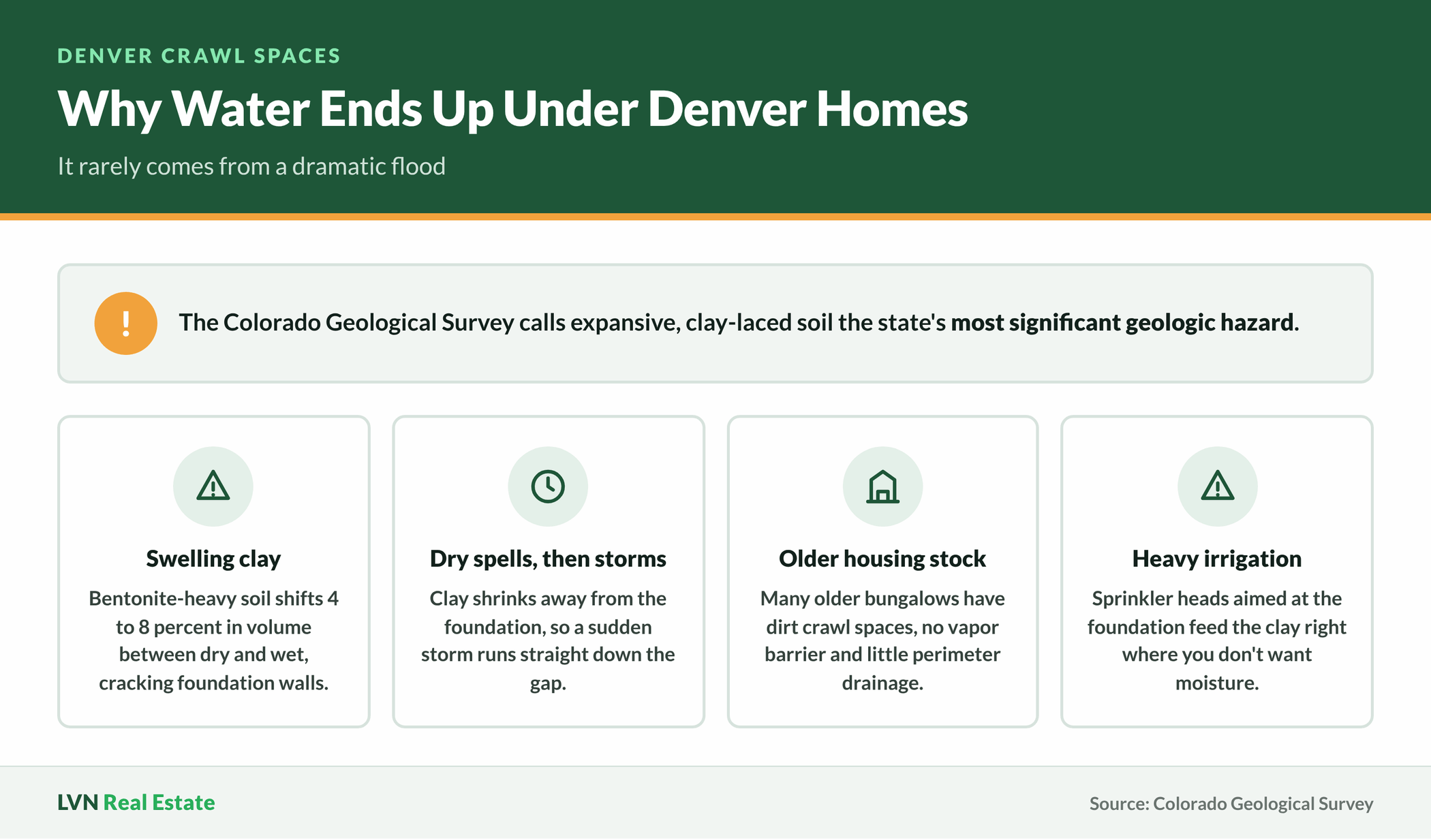
Crawl space water in Denver homes seldom starts with a dramatic flood. It starts with the soil doing what Denver soil always does.
The Colorado Geological Survey calls expansive or swelling soil, meaning soil laced with layers of clay, the state’s most significant geologic hazard. Much of the metro sits on the Pierre Shale and the Denver Formation, and both are full of bentonite clay. Bentonite can soak up several times its dry volume in water. Denver’s residential soil typically shifts 4 to 8 percent in volume between dry and saturated conditions. That movement cracks foundation walls, and the cracks let water in.
When Denver goes bone dry for weeks, the clay shrinks and pulls away from the foundation. A July thunderstorm then drops an inch in twenty minutes, and the water runs straight down that gap instead of soaking in slowly. The Survey also lists ponding near a foundation as a contributor to expansive-soil damage.
Older housing stock makes it worse. Bungalows in Baker, Platt Park, and Berkeley went up before anyone thought hard about perimeter drainage. Plenty of those homes have a partial basement with a dirt crawl space tucked off to one side, no vapor barrier, and foundation walls of rubble stone or early concrete.
Irrigation habits add to it. Denver homeowners water heavily because the dry climate demands it, and sprinkler heads aimed at the foundation feed the clay exactly where you don’t want moisture.
A couple of years ago I worked with an heir in Montbello who had never lived in Colorado. She’d listed her father’s house twice with agents and watched both listings expire without an offer. Only after that did she learn the crawl space had been taking on water every spring. Hydrostatic pressure had been working on that foundation for years while nobody checked.
What Are the Warning Signs of Crawl Space Water Damage?
“How would I even know if I never go down there?”
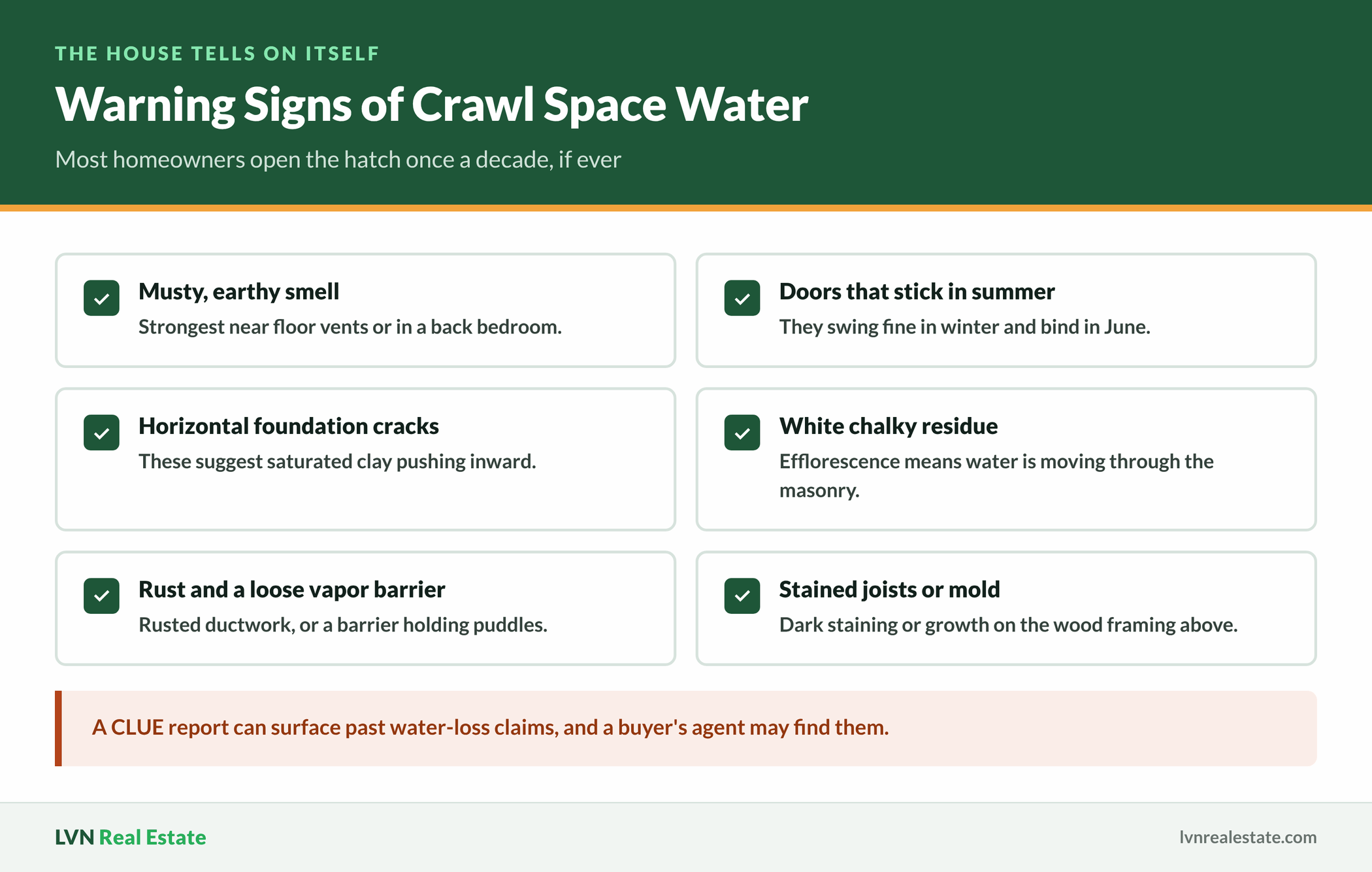
That’s fair. Most Denver homeowners open that hatch maybe once a decade. Still, the house gives itself away if you know what to look for.
A musty, earthy smell that’s strongest near floor vents or in a back bedroom usually means moisture is evaporating up through the subfloor. That odor tends to show up long before anyone spots standing liquid, and I’ve walked into plenty of homes where the smell was the only clue.
Doors that stick in June but swing fine in February are riding the same moisture cycle.
Walk around and look at your foundation walls from outside. Horizontal cracks worry me more than vertical ones, since horizontal cracking points to saturated clay pushing inward, and that kind of damage gets expensive fast. White chalky residue (efflorescence) on interior foundation walls tells you water has moved through the masonry and left minerals behind.
Pull your insurance records while you’re at it. Carriers keep claim histories tied to a property address, and a CLUE report on a home often turns up water-loss claims nobody disclosed. If a past owner filed one, a buyer’s agent may find it.
Then check the crawl space itself for rusted ductwork, a vapor barrier that’s pulled loose and holding puddles, dark stains on the undersides of floor joists, or visible mold growth on wood framing. Rodents tend to show up more too, because a damp crawl space makes good shelter.
Can Crawl Space Water Cause Health Problems in Your Home?
In a home with a dirt crawl space, roughly a third of the air you breathe passed through that crawl space first. Warm air rises and leaks out through the upper floors, which pulls replacement air in from the lowest point of the house. That’s called the stack effect. It means a damp crawl space isn’t sealed off from you at all. It’s part of your air supply.
Mold spores ride that current into the bedrooms. Families with asthma, allergies, or nagging respiratory irritation sometimes spend months on air filters and duct cleaning while the real source sits right underneath them.
Moisture brings other company. Dust mites thrive above 50 percent relative humidity, and wood-boring insects like softened joists. Radon, which the Front Range has plenty of, moves more easily through bare dirt than through a sealed barrier.
Does any of this change what you legally have to say? Yes, and it’s where sellers trip up. Colorado’s residential Seller’s Property Disclosure form has specific lines for water intrusion in the basement, crawl space, or elsewhere on the property, and for repairs made to control it. The current form is on the Colorado Division of Real Estate’s site. It asks for your current actual knowledge, and Colorado also requires disclosure of adverse material defects even when the form doesn’t list them.
Hiding it is the single worst financial decision available to you. Disclose it, price for it, and sleep well.
Should You Get an Inspection Before Listing a House with Crawl Space Water?
“Why would I pay someone to find more problems I’ll have to disclose?”
Because the math points the other way. You already know it’s there. Once you know, you’re disclosing it either way. The part you don’t know is the scope, and scope decides whether you’re facing a weekend fix or a structural project.
Picture a buyer’s inspector writing “evidence of extensive moisture intrusion, recommend specialist evaluation.” Suddenly the buyer’s imagination is setting your price. I’ve watched sellers give up far more in concessions than the repair would have cost, just because nobody had a real estimate in hand.
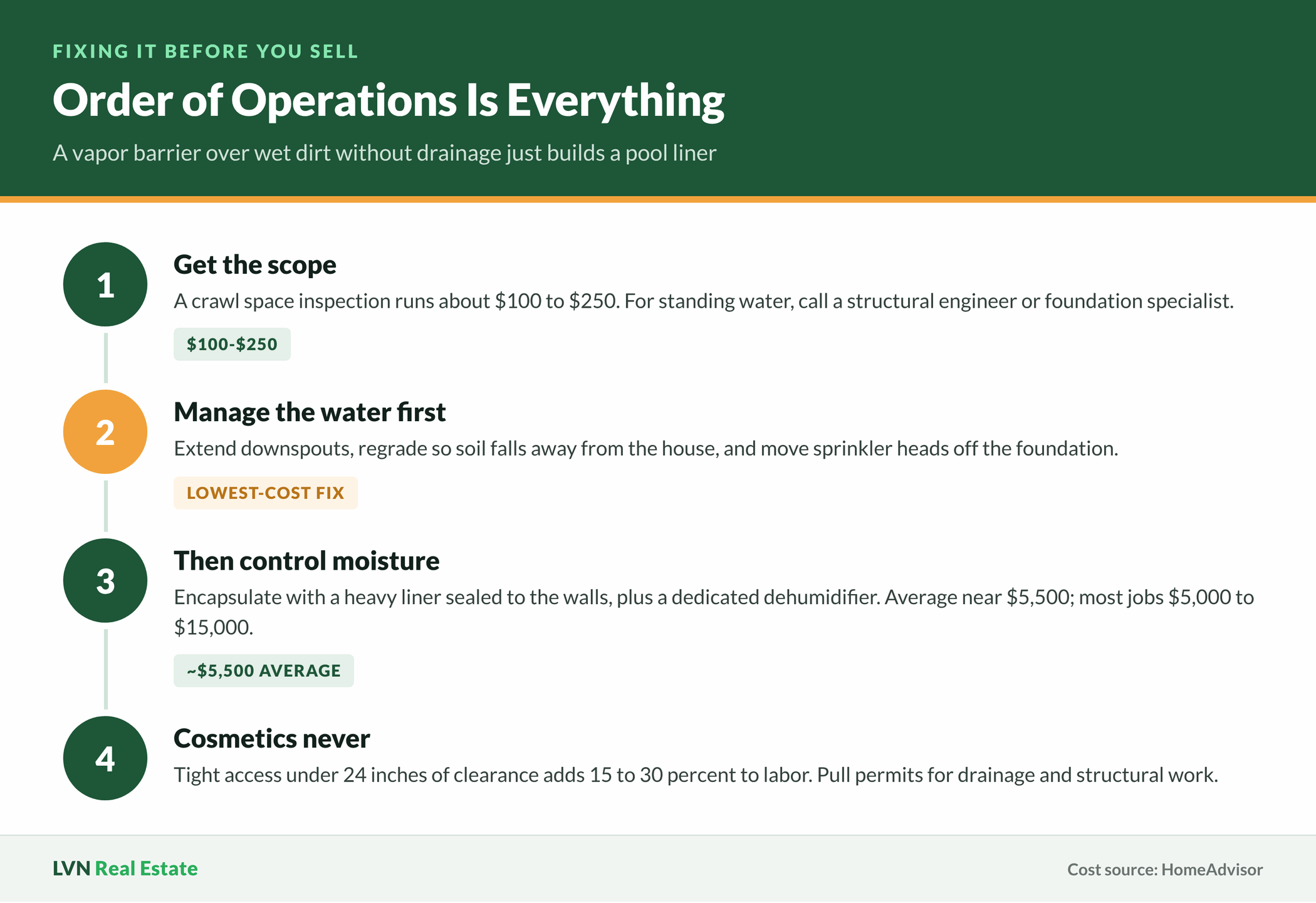
Scope matters because the fixes split in very different directions. A crawl space inspection runs somewhere around $100 to $250, which is cheap insurance against a five-figure guess.
Who should do it? For standing water, I’d skip the general home inspector and call a structural engineer or foundation specialist who works on Denver clay all the time. A generalist will confirm there’s water. An engineer tells you whether the foundation walls have shifted, whether the joists are compromised, and what a Denver buyer’s lender might object to.
You don’t have to give buyers the engineer’s full report, though you do have to disclose the conditions it uncovers.
Timing the inspection matters too. Denver’s wettest stretch runs from late April into early summer, so a May inspection shows you worst-case conditions. A February visit to the same crawl space might find dry dirt and tell you nothing useful.
How Do You Fix Crawl Space Water Before Selling in Denver?
Lay a vapor barrier over wet dirt without fixing the drainage and you’ve built a swimming pool liner. The water keeps coming.
The order you do things in is everything. Water management comes first, moisture control second, cosmetics never.
Extend the downspouts well away from the walls. Regrade so the soil slopes away from the house across the first several feet. Move sprinkler heads off the foundation. In older Denver neighborhoods like Congress Park or Washington Park, where houses sit close together on tight lots, regrading can mean hauling in fill and rebuilding a flower bed. It’s still the cheapest fix available, and I’ve seen sellers dodge thousands in foundation work with this step alone.
Encapsulation comes next, with a heavy mil liner sealed to the foundation walls and a dedicated dehumidifier.
Prices vary a lot from job to job. HomeAdvisor puts the average encapsulation near $5,500, with most professional projects landing around $5,000 to $15,000, and you can check their cost breakdown yourself. Tight access under 24 inches of clearance adds 15 to 30 percent to labor, and that hits a lot of Denver bungalows hard.
If drainage work and a barrier fix the problem for a few thousand dollars, go ahead. If an engineer says the foundation needs piers, think hard before starting a project you may not get to finish.
Denver buyers find half-finished foundation work scarier than problems nobody’s touched.
Can You Sell a Denver House as Is with Crawl Space Water?
A landlord in Globeville called me about a duplex he’d owned since the nineties. One unit had a tenant, the other had crawl space water, and he had no interest in managing contractors from his new place in Arizona.
Yes, you can sell as is. Colorado doesn’t make you repair anything before closing. It does require a completed Seller’s Property Disclosure, and selling as is never erases that obligation.
How does that play out in Denver right now? Buyers have leverage they didn’t have three years ago. Of roughly 12,085 homes listed across Denver Metro in early November 2026, 34 percent had been sitting more than 90 days, and 60 percent had already cut their price at least once. In that market, a retail buyer can just move on to the next house instead of taking on your crawl space water.
Financing is what really shrinks your buyer pool. Conventional lenders often get nervous about standing water and visible structural movement, and FHA and VA appraisers can flag it outright. That leaves cash buyers, renovation-loan buyers, and investors as the practical market for an as-is Denver home with crawl space water.
Cash buyers close fast, skip the appraisal, and don’t come back for a repair credit after inspection, because the repair is already priced into the offer.
Get an engineer’s estimate first and let that document anchor the conversation. Local firms like LVN Real Estate handle these Denver situations all the time and can walk you through what the numbers look like in your neighborhood.
Price it honestly, disclose everything, and as is works just fine.

Will Buyers Still Make an Offer on a House with Crawl Space Water?
Your house is going to sell. That part isn’t in question.
Denver’s market right now rewards sellers who price for actual condition. Metro Denver’s median close price in October 2026 came in at $595,000, a touch above $590,000 a year earlier, so values are holding even as sales slow. Detached homes that closed in October 2026 spent a median of 26 days in the MLS, four days faster than the year before. Clean, correctly priced listings can still move quickly.
A house with crawl space water won’t move within a few weeks on the open market. Plan for longer, or plan on a different kind of buyer.
The likely pool includes owner-occupant buyers with renovation financing who want the discount and will do the work themselves. Local investors who fix and resell show up too. Landlords building a rental portfolio round out the list, since they care more about cash flow than a pretty crawl space.
Sellers lose money in a predictable way: listing at a dry-house price, sitting for sixty days, cutting twice, and finally taking less than the first honest offer would have paid. In Denver, a stale listing signals desperation whether or not that’s your situation.
Bring the engineer’s report, the contractor bids, and photos of the gutter extensions you’ve already put in. A buyer who can see the ceiling on repair costs will bid closer to full value than a buyer picturing a collapsed foundation.
The season helps a little too. New listings dropped almost 17 percent month over month heading into November 2026, which thins out the competition. With fewer dry comparable homes nearby, your property gets a fairer look.
Attached homes are struggling more. Their median fell 3.25 percent year over year to $375,000 in October 2026, and time in the MLS climbed from 41 to 48 days. If you own a detached Denver house, even one with crawl space water, you’re in the stronger half of this market.

Who Do You Call About Crawl Space Water in Denver, CO?
So that’s the fork in the road: fix it, or sell to somebody who will.
If you’re fixing, start with a licensed structural engineer rather than a waterproofing salesman. Denver has several firms that specialize in expansive clay and will write a scope you can hand to three contractors for competing bids. Check contractor licensing through Denver’s permitting and licensing office before anyone touches your foundation, and insist on permits for drainage and structural work. Unpermitted foundation repairs come out later and kill sales.
Call your insurance carrier as well. Most policies exclude groundwater seepage but cover sudden plumbing failures, so the cause decides whether you have a claim at all. Ask before you repair anything, because carriers usually want to inspect first.
If you’re leaning toward selling, talk to at least one agent and at least one direct buyer before you decide, since each will frame your options differently. Agents give you retail reach. Direct buyers give you certainty and speed. The right choice depends on your timeline, how much contractor management you can stomach, and how much cash you can put into a house you’re leaving.
A man called me one Wednesday afternoon from his place in Harvey Park. He’d gotten a bid on his crawl space water and foundation, and it came in higher than his kitchen remodel a decade earlier. That estimate sat in his garage next to a boat he hadn’t used in years. He was trying to decide whether to drain his savings for a house he wanted to leave anyway. We bought it as is, he kept his savings, and he moved closer to his daughter in Fort Collins that spring.
Frequently Asked Questions
Should You Encapsulate a Crawl Space Before Selling in Denver?
Only once the drainage is handled. Plenty of well-built Denver homes sit on crawl spaces, and a sealed one with a good vapor barrier and working drainage performs just fine. A liner over a crawl space that still floods every spring won’t fool a buyer’s inspector. If gutters, grading, and sprinkler changes keep the space dry, encapsulation can help your listing. If the water keeps coming, spend that money on an engineer’s scope instead.
What Will It Cost Me to Fix Crawl Space Water in My Denver Home?
It comes down to what’s causing the water. Regrading your yard and extending downspouts might cost a few hundred dollars and solve the whole thing. A full interior drain system with a sump pump, sealed liner, and dehumidifier runs several thousand dollars, and foundation repair sits well above that. Get an engineer’s scope before you accept any contractor’s number.
Do I Have to Tell Buyers About Crawl Space Water If I Already Fixed It?
Yes. Colorado’s disclosure form asks about past water intrusion and repairs made to control it, so a fixed problem still goes on the form. That’s actually good news. Documented repairs with receipts reassure Denver buyers far more than a blank form on an old house ever will.
Will a Lender Approve a Denver Home with Water in the Crawl Space?
Often not, at least for government-backed loans. An appraiser who spots standing water or structural movement can require repairs before closing, which leaves your buyer stuck. Conventional lenders vary with severity. That’s a big reason cash and renovation-loan buyers dominate this corner of the Denver market.
How Long Will It Take to Sell a Denver House with Crawl Space Water?
On the open market, expect it to take noticeably longer than a typical detached listing, because your buyer pool is smaller and financing adds friction. Selling directly to a local buyer usually shortens that to a couple of weeks, since there’s no appraisal, no inspection objection, and no repair negotiation.
Looking at a wet crawl space and trying to decide whether to fix it or move on? We’re glad to look at it with you and give you straight numbers either way. No pressure, no obligation, and no hard feelings if you decide to list it instead.
Selling a House with Crawl Space Problems Around Denver
Expansive clay sits under much of the metro, so wet crawl spaces aren’t only a Denver problem. Metro Denver had about 4.4 months of housing supply in October 2026, according to the Colorado Association of REALTORS. Buyers have choices, and standing water gives them a reason to keep looking. LVN Real Estate buys houses with water problems as they sit, and we buy homes across Colorado.
That includes Aurora homeowners dealing with the same swelling soil and older foundations.
Talk Through Your Options Before You Pay for Repairs
You don’t have to pick a path today. Get the engineer’s scope, then ask LVN Real Estate for a cash offer on the house as it sits. Compare that number with what fixing and listing would leave you. When you’re ready, reach out to our team or use the form below. No pressure and no obligation.