
You closed on your Colorado home, pocketed a real profit, and then your accountant called. Now you’re hearing about capital gains, depreciation recapture, and Schedule D, and the good feeling drains off fast. Short version: you’ll probably owe capital gains tax on that profit. Colorado sellers pay a federal bill and a state bill on the same sale. Those two layers stack, and knowing how they stack keeps filing season from blindsiding you.
What Capital Gains Tax Means for a Colorado Seller
Capital gains tax lands on the profit when you sell an asset for more than you paid. The gain shows up the moment your sale price clears your adjusted basis. For most Colorado owners that asset is a house or a rental property, and years of Front Range appreciation can make the number large. Nobody at the IRS cares how long you saved for the down payment. The weekends you spent patching drywall don’t count either. All that matters is the gap between your sale price and the basis the IRS recognizes.
Colorado taxes capital gains as ordinary income. The state conforms to the federal definition of a capital gain, then applies its own flat rate. So one return doesn’t finish the job. You file federally, carry the numbers onto your state return, and a second bill waits there. Sort both layers out before you list and you get to plan instead of react.
How the Colorado Capital Gains Tax Rate Works
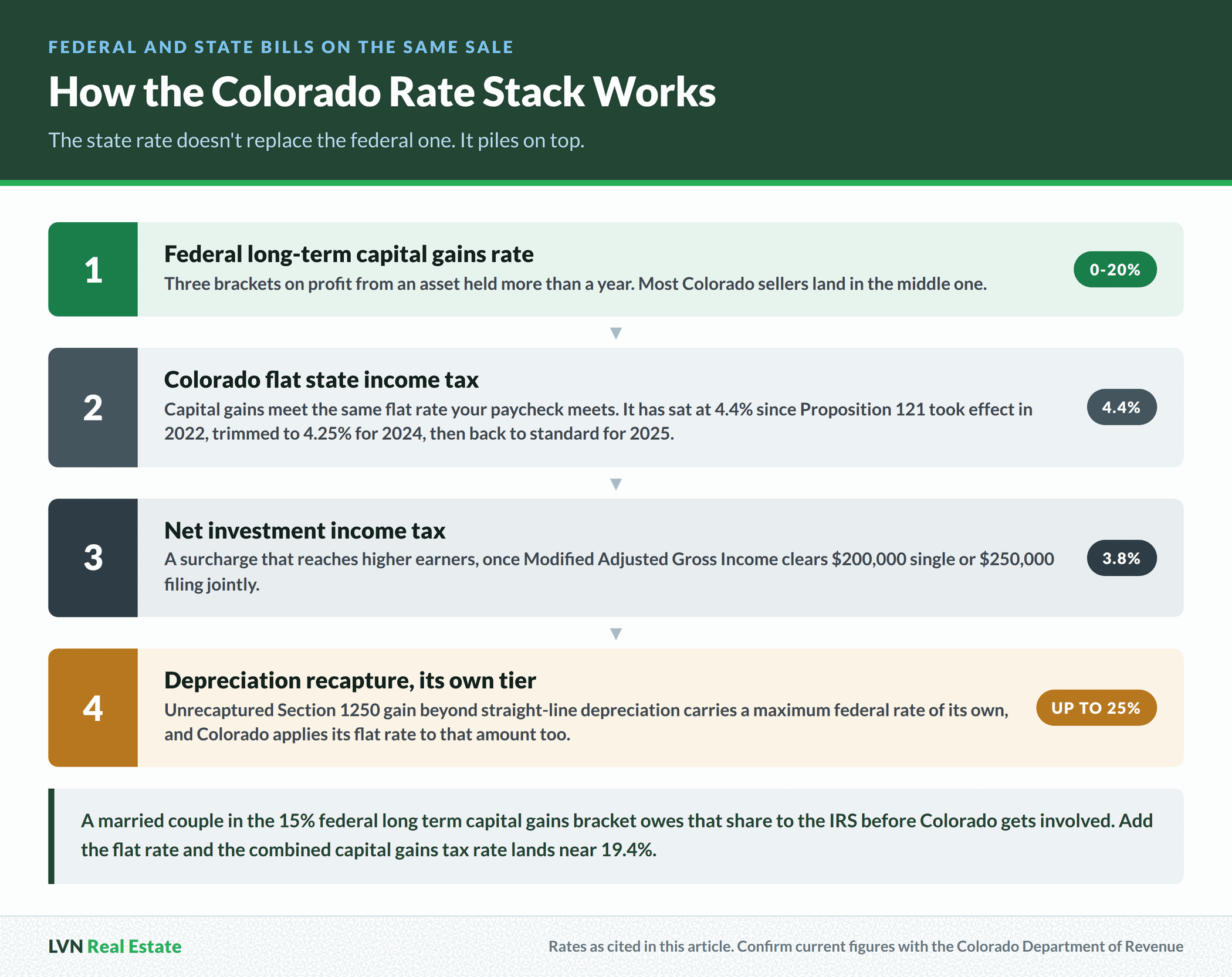
Capital gains meet the Colorado flat state income tax, the same rate your paycheck meets. That rate has sat at 4.4% since Proposition 121 took effect in 2022, and a temporary adjustment can nudge it lower. Lawmakers trimmed it to 4.25% for 2024, then the standard rate came back for 2025. That TABOR-driven dip was real. Don’t budget as though it repeats. Check current Colorado Department of Revenue guidance before you lean on any figure.
A flat rate spares you the bracket math. Long-term holders get no state-level break, so the federal reward for patience never reaches your state bill. Colorado charges the same either way.
This next part catches sellers off guard. The state’s rate doesn’t replace the federal one, and it piles on top. A married couple in the 15% federal long term capital gains bracket owes that share to the IRS before Colorado gets involved. Add the flat rate and the combined capital gains tax rate lands near 19.4%. Layer in the net investment income tax that reaches higher earners, and a Colorado seller can watch the combined rate pass a quarter of the gain.
Short-Term Versus Long-Term Federal Rates
Holding period matters enormously at the federal level, even though Colorado shrugs either way. Short-term capital gains tax applies to profit on an asset you held a year or less. Those gains count as regular income and meet the ordinary income brackets: 10%, 12%, 22%, 24%, 32%, 35% or 37%. A seller in a big income year can land at 32% or higher, with the Colorado rate stacked behind it.
Flip a house, or sell a property you’ve held under 12 months, and you’re squarely in short-term territory. The hit there can be brutal. A property sold in month eleven costs far more tax than the identical property sold in month thirteen. That’s arithmetic, not a scare tactic. Push your closing past the one-year mark and the savings can run to tens of thousands of dollars.
Patience pays federally through three brackets: 0%, 15%, and 20%. For tax year 2025, the 0% rate reaches up to $48,350 for single filers and married filing separately. It runs to $64,750 for head of household, and to $96,700 for married filing jointly. Income under those thresholds can mean nothing owed federally on long term capital gains. Colorado’s flat rate still applies, since the state has no zero bracket to match.
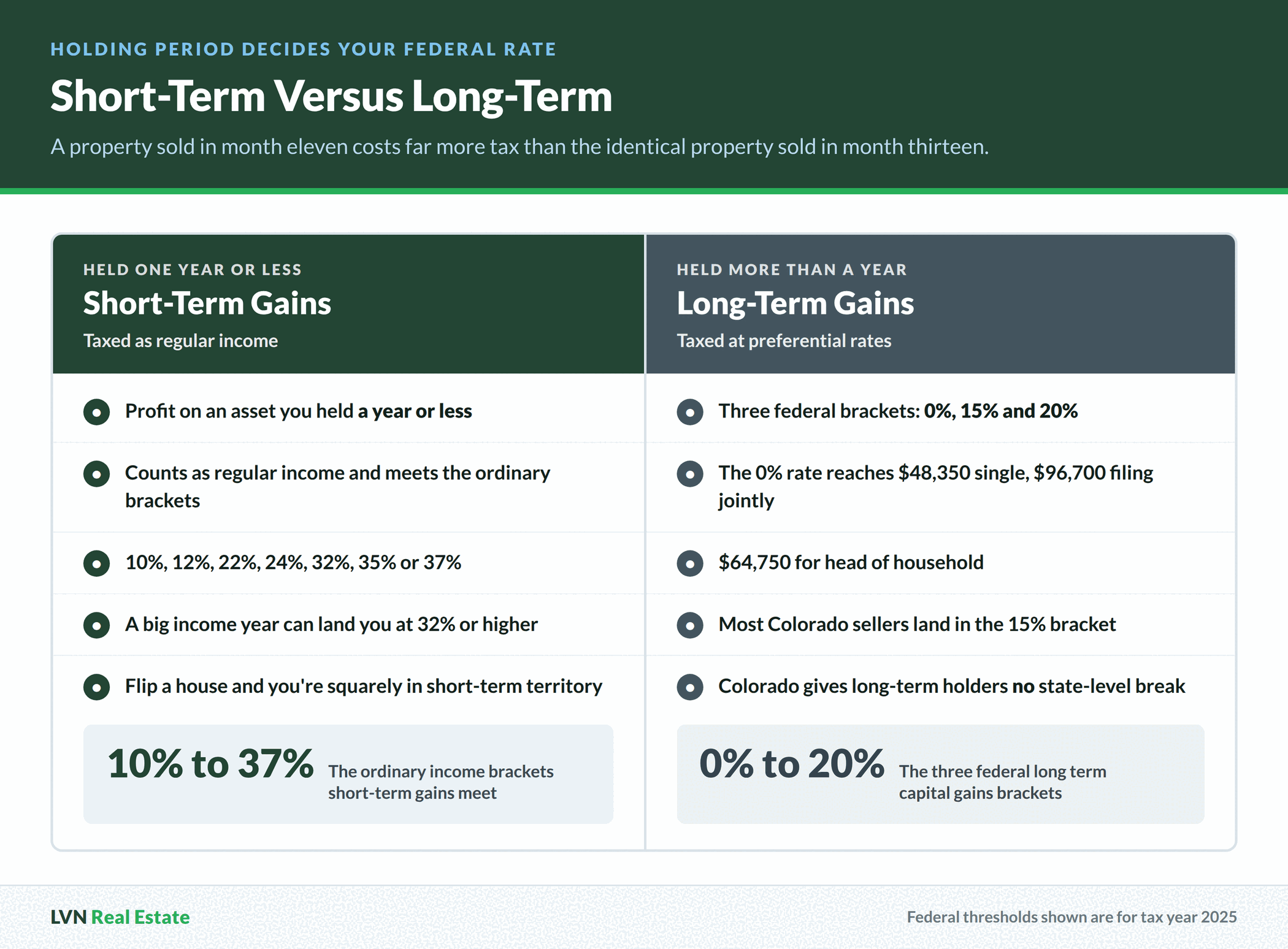
Most Colorado sellers land in the 15% bracket. The 20% rate starts higher up. Single filers with taxable income between $48,350 and $533,400 in 2025 sit in the 15% band. Add the Colorado rate and the surcharge covered below, and the real number runs well above the headline. Walk the thresholds past a CPA, since they shift with inflation every year.
Where Your Cost Basis Comes From
Cost basis is the starting point for every capital gains tax calculation. Every dollar of basis you can document is a dollar of profit the tax never touches. Your original cost basis is generally what you paid for the property, including the purchase price, certain closing costs you covered as the buyer, and transfer taxes from the original transaction. Title insurance, attorney fees, and origination points all lift your cost basis, which shrinks the taxable gain later.
Improvements move the figure too. Capital improvements you’ve made over the years raise your adjusted cost basis, and a higher basis lowers the bill directly. A new roof, an addition, a finished basement, a full kitchen remodel: all of it counts. Routine maintenance doesn’t. Painting a room isn’t a capital improvement. Adding a bathroom is. Improvement costs come off the top of your gain at sale. Put $40,000 of documented improvements into a house and the taxable gain falls by that same amount.
Your HUD-1 or Closing Disclosure from the original buy is the most valuable page in the file. Lost yours? The title company or closing attorney may still have a copy. Before you sell, pull together that settlement statement, your improvement costs, and any depreciation schedules. An accurate basis can decide whether you owe capital gains tax on $200,000 or on $140,000, and the document hunt pays for itself.
The Primary Residence Exclusion and the Two Out of Five Year Rule
For homeowners, the primary residence exclusion is the most valuable break on the board. The Section 121 exclusion caps at $250,000 for a single filer and $500,000 for a married couple filing jointly. Nothing else in the tax code shelters that much profit on a home sale. Gains that fit inside the cap escape both bills.
Two tests decide it, and both run on the five years before you sell. You must have owned the home for at least two of those years. You must also have lived in it two years, and those months don’t have to run back to back inside that window. Live in the house 14 months, rent it out, then move back for 10 months. The two out of five year rule still clears.
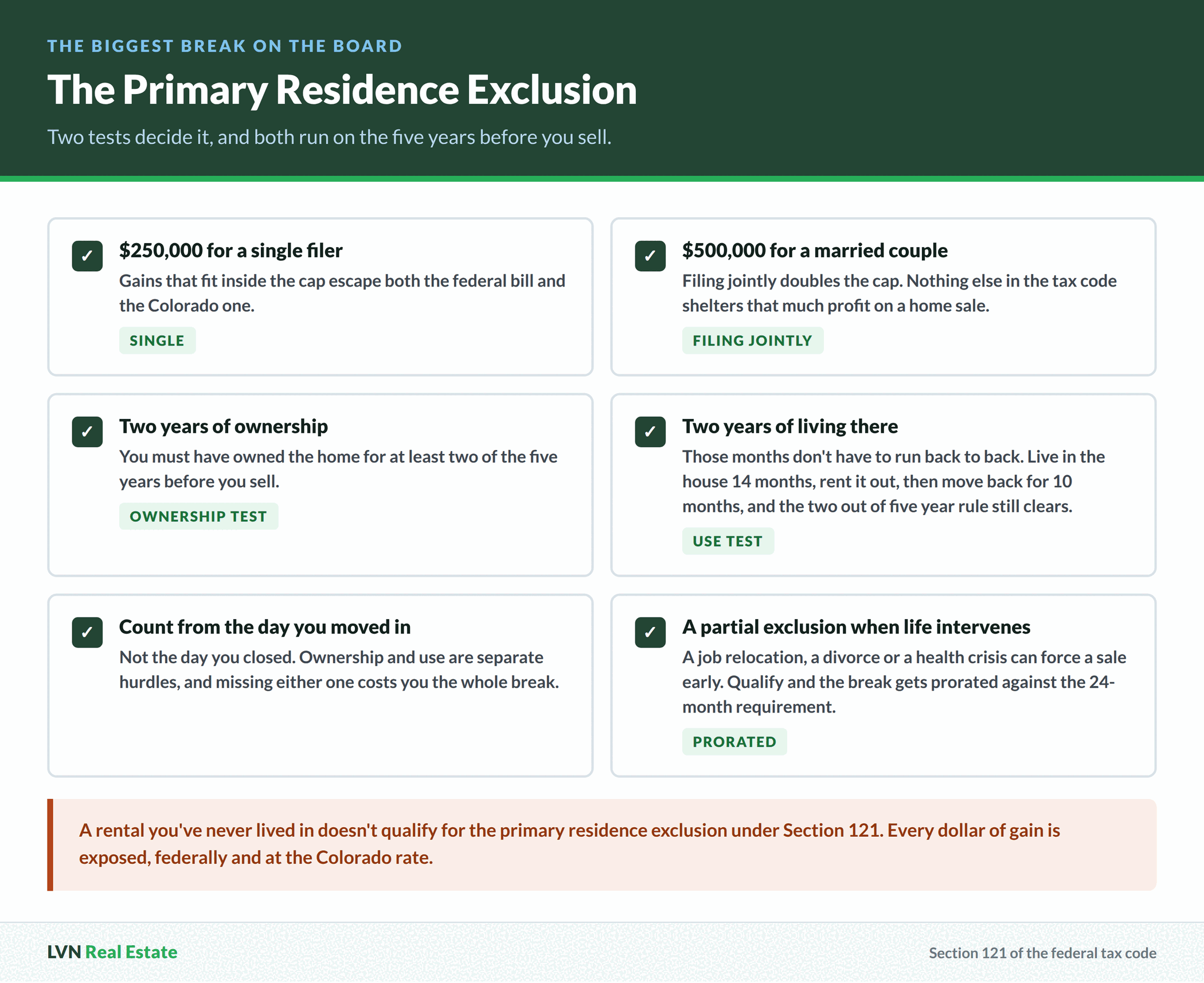
Ownership and use are separate hurdles, and missing either one costs you the whole break. Own a Colorado property for three years while living in it only 18 months, and the primary residence exclusion disappears. Count from the day you moved in, not the day you closed.
Life doesn’t schedule itself around the tax code. A job relocation, a divorce, or a health crisis can force a sale early. The IRS calls those unforeseen circumstances, and its list is narrower than most sellers hope. Qualify, and you get a partial exclusion, prorated against the 24-month requirement based on how many months you actually lived in the place before selling. A married couple with five years in a Denver home usually owes nothing on the gain.
How Rental Property and Depreciation Recapture Change the Math
Rental property runs on different rules, and the difference isn’t small. A rental you’ve never lived in doesn’t qualify for the primary residence exclusion under Section 121. Every dollar of gain is exposed, federally and at the Colorado rate. No exclusion waits to absorb any part of that profit.
Landlords selling a Colorado rental property tend to guess low here. They fixate on the sale price and forget depreciation entirely. Each year of rental deductions quietly shaved your adjusted cost basis, and the IRS collects on that when you sell. Your basis, not the price you got, sets the taxable gain.
Depreciation you took comes back at sale in a tier of its own. Tax people call it unrecaptured Section 1250 gain. The slice of a net gain from Section 1250 real property that must be recaptured beyond straight-line depreciation carries a maximum 25% rate. That one’s federal, so the state you sold in makes no difference. Colorado applies its flat rate to the recaptured amount as well.
An example helps. Say you bought a Colorado rental property for $300,000 and held it 10 years, claiming roughly $109,000 in depreciation. Your adjusted cost basis now sits near $191,000. Sell for $450,000, and the total gain runs about $259,000. That depreciation total faces recapture federally, and the remaining $150,000 meets long term capital gains rates. Two calculations, not one, so confirm your own schedule with a CPA.
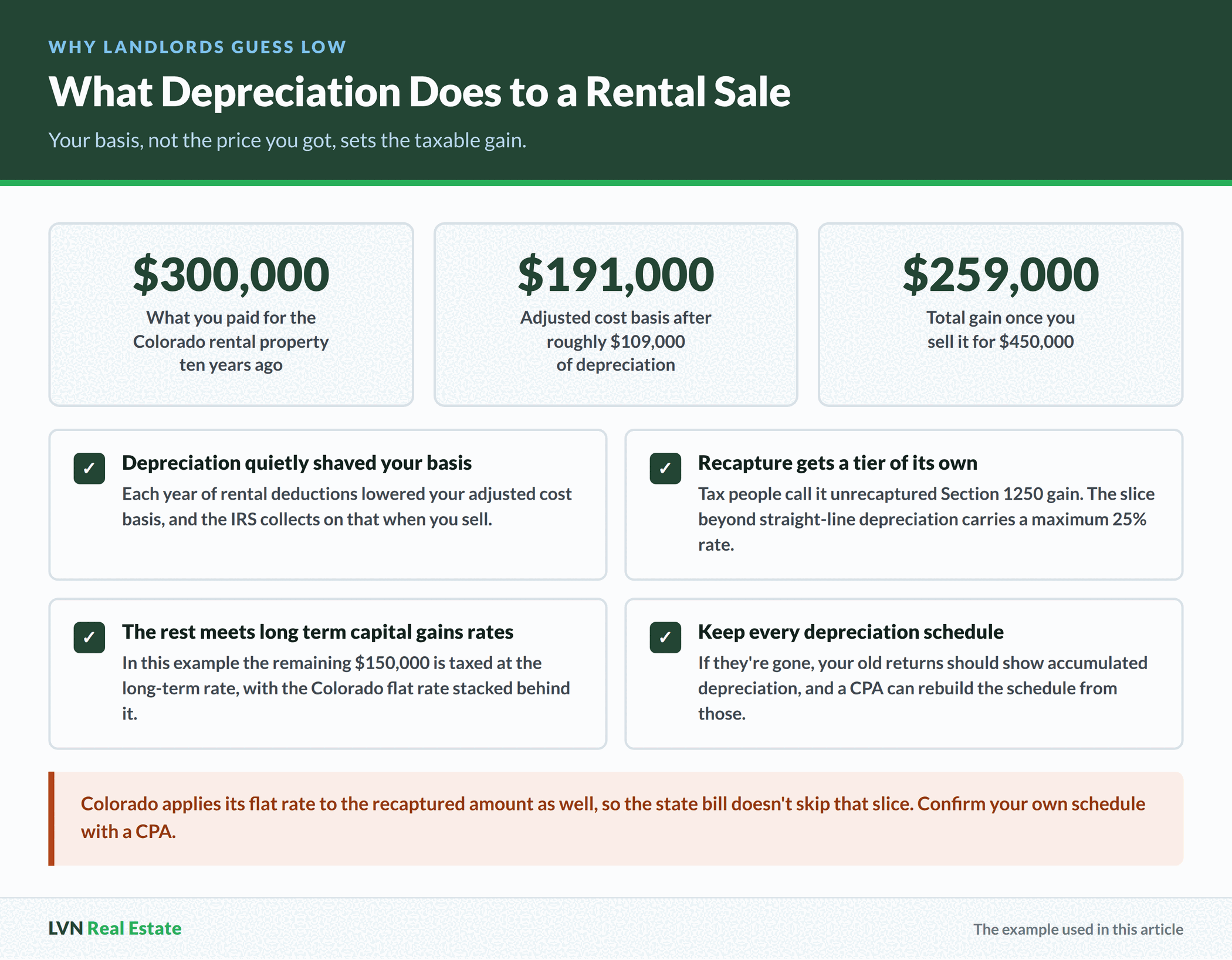
Hang onto the depreciation schedules for every year you owned the place. If they’re gone, your old returns should show accumulated depreciation. A CPA can rebuild the schedule from those.
The Net Investment Income Tax
The net investment income tax tacks a 3.8% surcharge onto everything else. You may owe the NIIT once your Modified Adjusted Gross Income clears $200,000 as a single filer or $250,000 filing jointly. It reaches rental income, capital gains from investment property, and the portion of a home sale gain that runs past the Section 121 exclusion.
For Colorado landlords, that surcharge changes the plan. Stack the federal long-term rate on the Colorado flat rate and add the NIIT, and the combined rate on the non-recaptured slice of your gain runs between 23% and 28%. Recaptured depreciation gets taxed at its own rate before any of that. Excluded gains stay outside the surcharge.
Ways to Defer or Reduce the Bill
Selling a rental property doesn’t have to hand the IRS a check the same year. A 1031 exchange lets you sell one investment property and roll the proceeds into another with no capital gains tax due at closing. The tax isn’t erased, only parked until you sell the replacement without exchanging again.
Timelines leave little room. You get 45 days from closing to identify a replacement property and 180 days to close on it. The replacement has to be worth at least as much as what you sold. Cash you pull off the table, known as boot, is taxable. An exchange won’t lower the Colorado capital gains tax rate you eventually face, though it can push the bill out years or even decades.
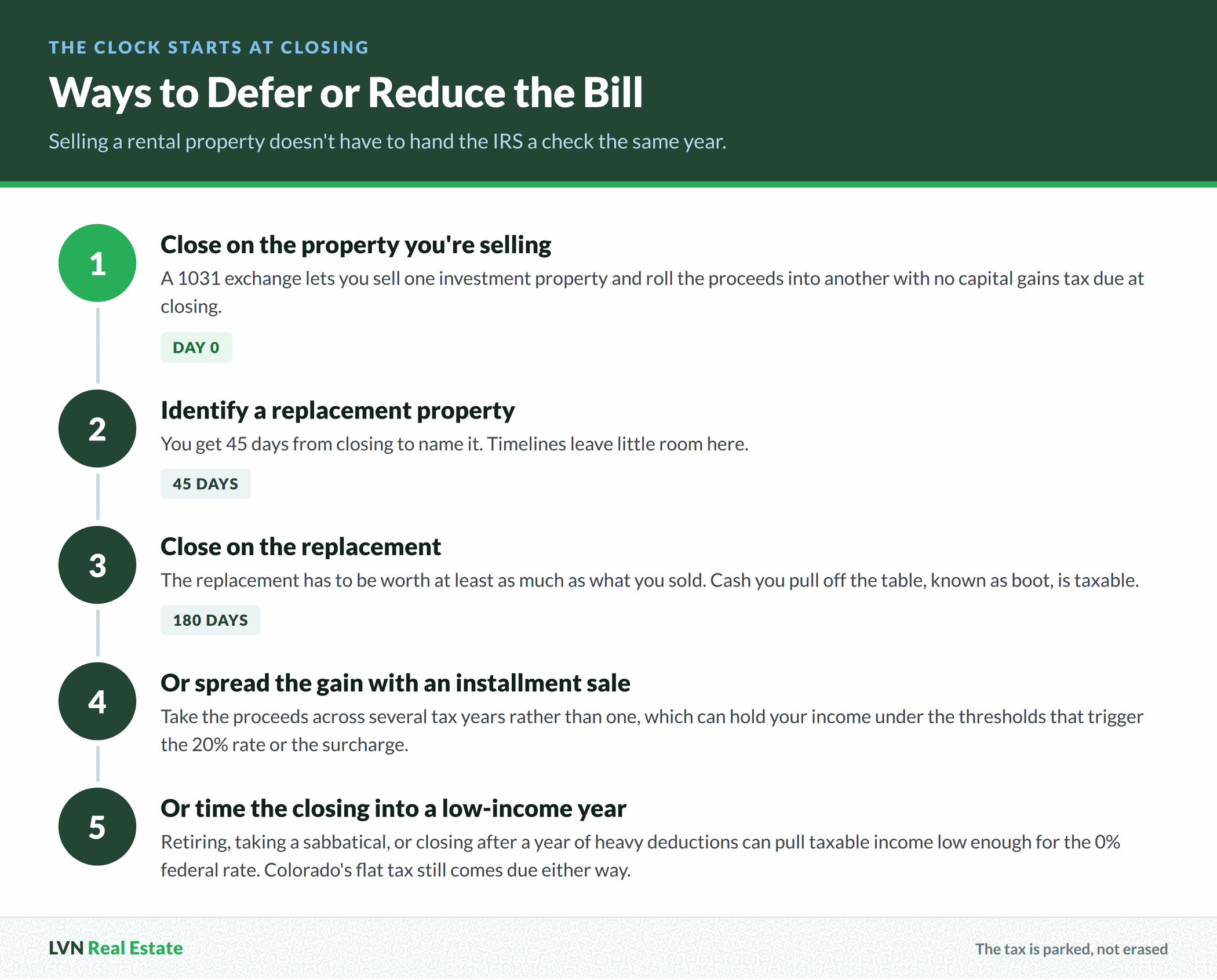
Timing the sale works too. Selling in a low-income year can drop you into a friendlier long-term bracket. Retiring, taking a sabbatical, or closing after a year of heavy deductions can pull taxable income low enough for the 0% federal rate. Colorado’s flat tax still comes due either way.
An installment sale is another route. Rather than take all the proceeds in one tax year, you spread the gain across several, which can hold your income under the thresholds that trigger the 20% rate or the surcharge. Walk through it with a Colorado CPA first.
What You Report on Schedule D and IRS Publication 523
Every taxable capital gain from a Colorado real estate sale runs through Schedule D on your federal Form 1040. You’ll file Form 8949 alongside it, listing each property sold, your basis, and the gain or loss. Title companies issue 1099-S forms at closing, and the IRS matches those against your return.
IRS Publication 523 is the reference for home sellers claiming the exclusion. It walks through the ownership test, the use test, and the partial exclusion rules. Rented out a room along the way? Publication 523 covers how that trims the break. Your Colorado return starts from federal adjusted gross income and applies the flat rate to the taxable portion.
Frequently Asked Questions About Colorado Capital Gains Tax
Does Colorado have its own separate capital gains tax rate?
No separate rate exists. Capital gains flow into your state taxable income and meet the same flat rate as wages and business income. The state gives long-term holders no preferential treatment, so short and long term gains alike meet that single figure. Confirm the current one with the Colorado Department of Revenue before you file.
Can I avoid capital gains tax if I lived in my rental property before selling?
A partial primary residence exclusion may apply if the rental served as your home for at least two of the five years before the sale. There’s a catch, though. Personal-use months have to add up to 24 months inside the 5 years before you sell, and rented months count for nothing. Depreciation recapture survives the exclusion too.
What counts as a capital improvement for cost basis purposes?
Capital improvements add value to the property, adapt it to a new use, or extend its useful life. A new roof, an HVAC replacement, a deck, a finished basement, or new windows all qualify. Fixing a leaky faucet or repainting a room does not. Keep receipts, contracts, and permit records for every project.
Do I owe capital gains tax if I sell at a loss?
No. Capital gains tax only lands when your sale price beats your adjusted basis. Sell for less and you have a capital loss instead. On a primary residence, that loss generally isn’t deductible at all. On a rental property, it can offset gains from other property sold in the same year, and anything left over carries forward.
When should I hire a CPA instead of handling this myself?
Any time you’re selling a rental, you’ve claimed depreciation, your gain might top the exclusion, or your income sits near an NIIT threshold. The math for a landlord runs through at least three layers, each with its own rate and rules. Long term capital gains, depreciation recapture, and the surcharge don’t stack the way you’d expect. A CPA who handles Colorado real estate sellers earns the fee back quickly.
Talk It Through Before You List
Colorado capital gains tax is one of the biggest pieces of a real estate sale, and one of the least understood. The flat state rate stacks on federal rates that run from 0% to 20% on long-term gains, with recaptured depreciation at its own rate and a possible surcharge behind that. Your primary residence exclusion is the one real shield, and investment property doesn’t get it.
The right moment to think this through is before you list, not after the contract is signed. Talk to a CPA who works Colorado real estate. Go through your cost basis, your depreciation schedule, and your income for the year. Weigh a 1031 exchange, an installment sale, or timing the closing into a lower-income year.
At LVN Real Estate, we’ve been buying Colorado homes as-is since 2013, and we work with sellers across the Front Range weighing every option. We’re not tax advisors and won’t pretend otherwise. We do know that a cash sale, a traditional listing, and holding the property longer each carry different tax consequences. Talking through the practical side costs you nothing. If you’d like a no-obligation cash offer, or just a sounding board, we’re here. Take your time, talk to your CPA, and pick the path that fits your situation.
Where We Buy Houses Around Denver and Beyond
Most of the property we buy sits in the Denver metro, though our map runs wider than that. If your house is in Denver, Aurora, Arvada, Boulder, Fort Collins or Colorado Springs, the Colorado capital gains tax math works the same way on your sale. What shifts from one county to the next is how quickly records get pulled and how the assessor handles a transfer. Our service area covers the Front Range, the mountain towns and the Western Slope.
What a Cash Sale Would Look Like for You
Nothing here needs deciding today. If you want a straight read on what a cash sale would look like next to a listing, contact us and we’ll come look at the house. No obligation, and no follow-up calls you didn’t ask for. Would you rather read first? Our common questions page covers how an offer gets built and what happens once you accept. You can also fill out the short form below and we’ll come back to you with a number. Run that number past your accountant, weigh the Colorado capital gains tax against your timing and your basis, and pick the path that fits your situation.