
Your buyer’s radon test came back high. Take a breath. Radon levels above the action line don’t end your sale, and they don’t mean something is wrong with your house. Radon in Colorado is ordinary. Mitigation is well understood, and you have more room to move than that lab report makes it feel like.
What a High Radon Test Means for Your Colorado Home Sale
Radon surfaces at the worst possible moment. You’ve accepted an offer, you’re half packed, and the home inspection report lands with a reading above 4 picocuries per liter. Radon gas seeps up through soil and slips into houses through foundation cracks, sump pits, and construction joints. It has no color and no smell. Nobody notices it. So it can sit in a basement for years, right up until a buyer’s inspector sets a canister on the floor.
Timing is what stings. Testing almost always happens inside the home inspection window, the tensest stretch of any Colorado sale. Radon levels above the EPA action level hand your buyer a numbered objection, and numbers negotiate better than opinions about a roof. Under a standard Colorado real estate contract that inspection period runs about ten days from acceptance, and a short-term radon test comes back in two to seven days. Scheduling alone can eat a day of that.
Mitigation takes calendar time to arrange. The install itself is four to six hours, one day at most. Permitting, contractor availability, and the post-mitigation retest stack days on top. Start moving the afternoon your results arrive and the sequence still fits.
Why Colorado Radon Levels Run Higher Than Most States
Colorado ranks among the highest-risk states in the country. Average indoor radon here runs about 6 pCi/L, several times the national figure. A Colorado home sitting at the state average is already well above the threshold where the EPA tells you to act. Radon levels that high come from geology, not from anything the owner did wrong.
Blame what sits under the ground. Radon moves out of uranium-bearing granite deposits in the soil and into the air above. Colorado holds some of the most uranium-rich rock in the country, especially along the Front Range. Your home is usually warmer, and at slightly lower air pressure, than the dirt around it. Soil gases drift toward that low pressure and into your living space. Basements, crawl spaces, and slab-on-grade foundations each offer their own entry points.
Radon levels above the action threshold turn up in 46.9% of Colorado homes, according to the Colorado Department of Public Health and Environment (CDPHE). That isn’t a scare statistic. It’s context. Because the gas follows the path of least resistance, one house can measure 2.0 pCi/L while the place next door reads 20.0 pCi/L.
That variability is why the radon zone map only gets you so far. EPA sorts counties by predicted average indoor screening level. Zone 1 counties average above 4 pCi/L, Zone 2 lands between 2 and 4, and Zone 3 covers anything under 2. Most of Colorado is Zone 1. EPA says plainly that the map is not to be used in lieu of testing, and your buyer’s test result is the only number that moves your sale.
How Radon Is Measured and What the Numbers Mean
Radon levels get reported in a unit most Colorado sellers have never seen. A curie measures radioactivity, a picocurie is a trillionth of one, and “per liter” means a liter of air. So picocuries per liter tells you how much radioactivity sits in each liter of air inside your home. A higher result simply means more radon gas indoors.
You don’t need the physics. Two benchmarks carry the whole conversation. EPA recommends action at 4 picocuries per liter, and indoor air nationwide averages about 1.3 pCi/L. Everything in your buyer’s results gets measured against those two marks.
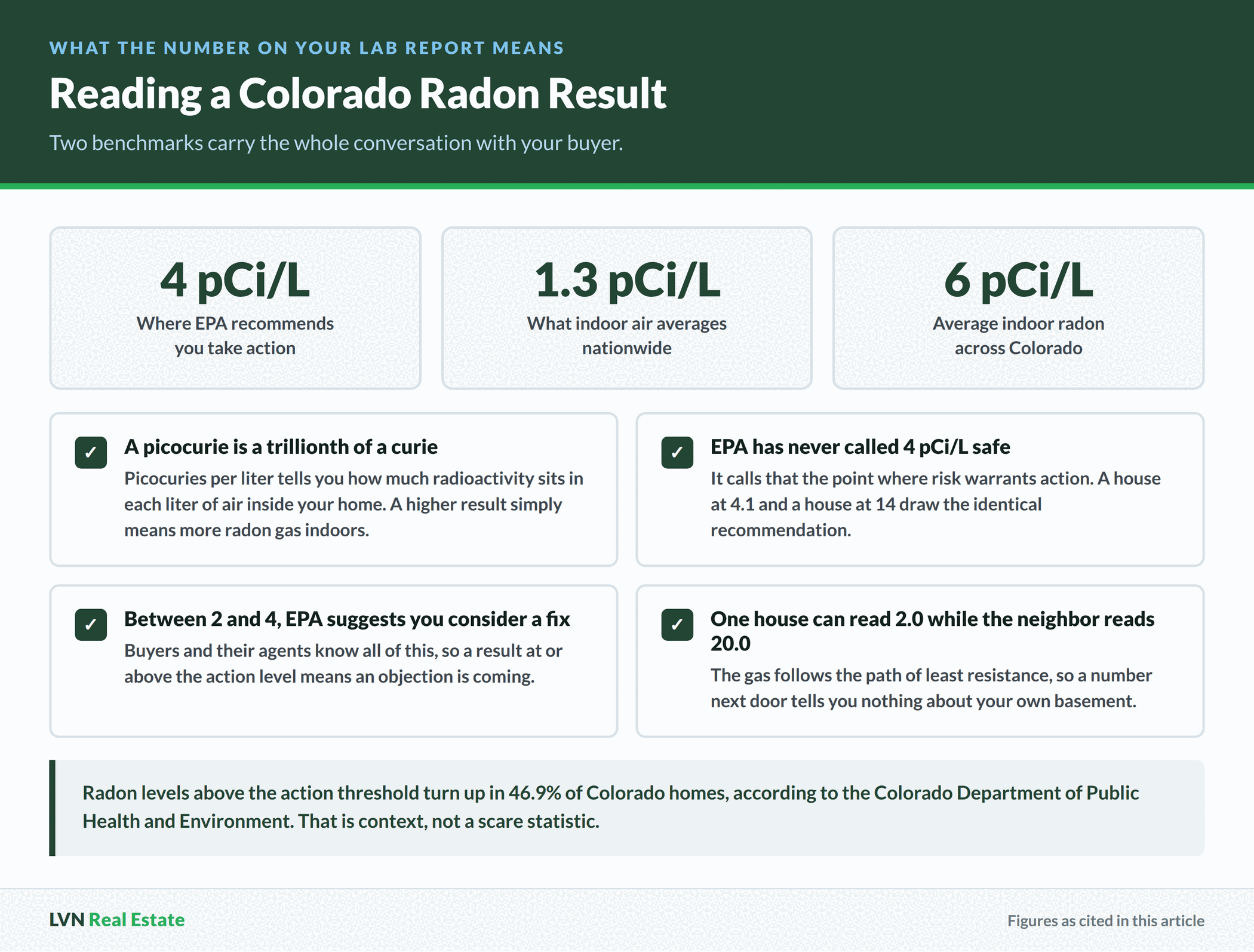
EPA has never called 4 pCi/L safe. It calls that the point where risk warrants action, which is a different claim. A house at 4.1 and a house at 14 draw the identical recommendation even though the risk isn’t identical. Between 2 and 4, EPA suggests you consider a fix. Buyers and their agents know all of this, so a result at or above that mark means a buyer objection is coming.
Short-Term and Long-Term Testing, and When to Question a Result
A short-term radon test runs a minimum of 48 hours, usually two to seven days, using a charcoal canister or an electret ion chamber placed in the lowest livable area. Buyers pick it during a Colorado home inspection because it fits the window. A long-term radon test runs 90 days or more and describes what people actually breathe across a year. Longer sampling averages out the swings.
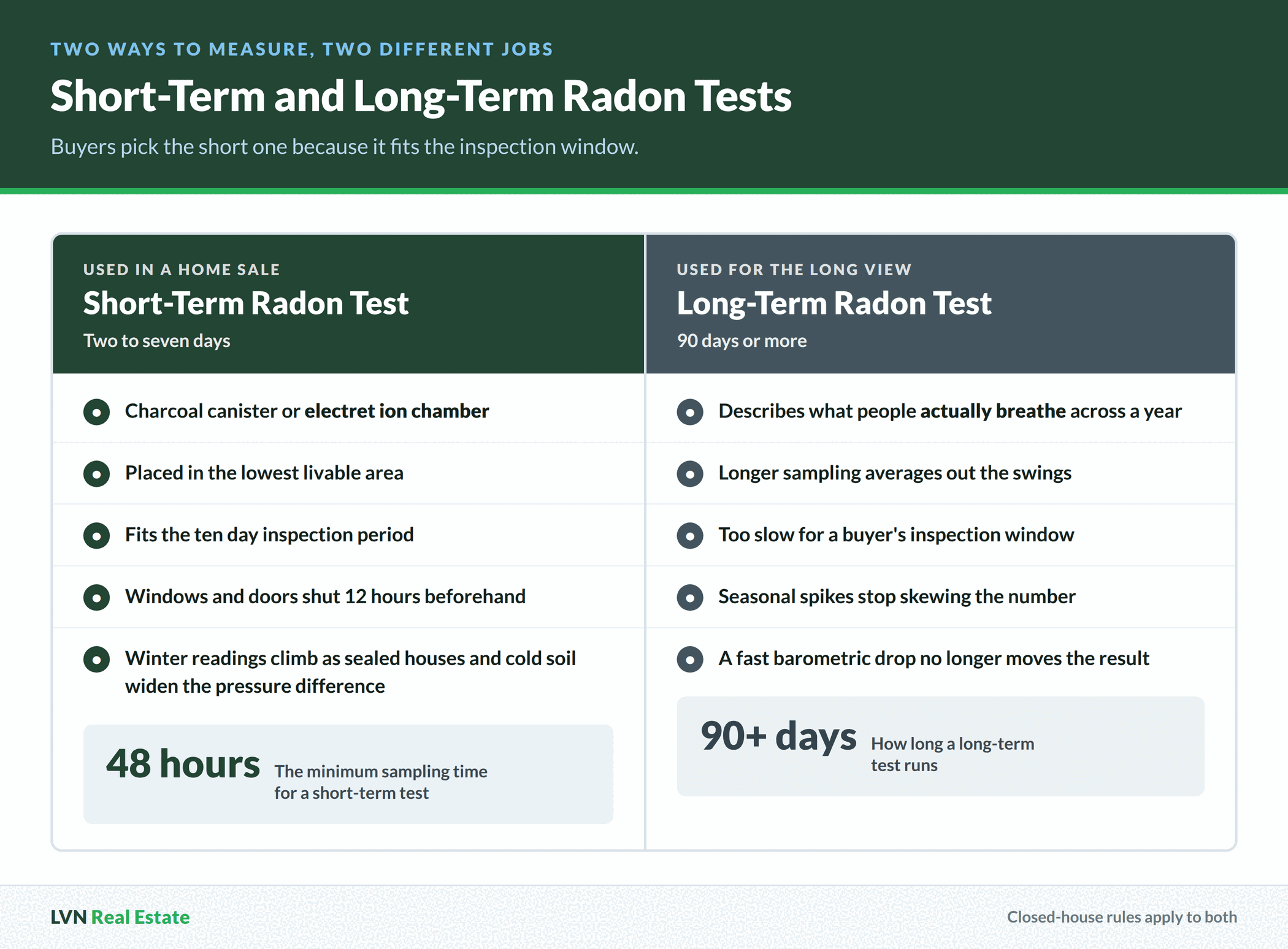
Conditions push a short-term test around. Closed-house rules mean windows and doors stay shut for at least 12 hours beforehand and throughout the sampling period. Winter radon levels climb, because sealed houses and cold soil widen the pressure difference. A January measurement in a Denver basement often runs higher than the same house in July. A fast barometric drop ahead of a Front Range storm can add several pCi/L for a day.
Asking for a retest is a legitimate move when the result sits close to 4, or when the closed-house protocol clearly slipped. EPA generally recommends measuring the lowest living area. During a real estate transaction, it recommends the lowest area that could be finished into living space, such as an unfinished basement. CDPHE standards call for 100% of occupied ground contact floor areas to be measured, and 10% of occupied rooms on each upper floor. Use a certified measurement professional, not a general inspector with a kit off the shelf.
Your Legal Obligations Under Colorado Seller Property Disclosure
Colorado law changed in 2023. Lawmakers approved Senate Bill 23-206 that June, and it requires landlords and home sellers to give written disclosures about the health risks of radon gas to future occupants. Your seller property disclosure packet now includes that notice plus an acknowledgment that the buyer received it. You also hand over the most recent radon brochure CDPHE publishes. None of it is optional.
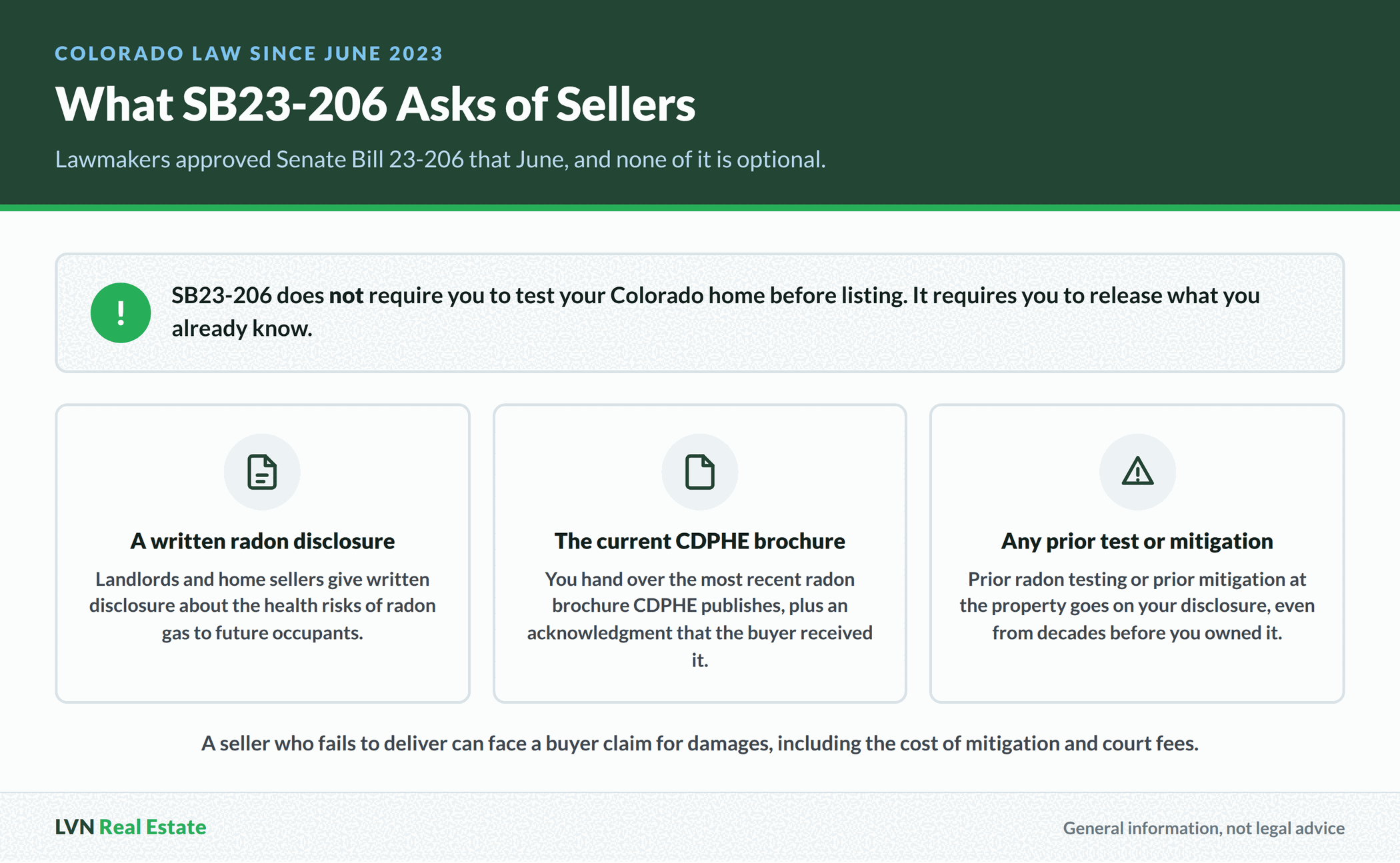
Skipping the paperwork isn’t a slip you patch up later. A seller who fails to deliver can face a buyer claim for damages, including the cost of mitigation and court fees. This is general information rather than legal advice, so ask your agent or a Colorado real estate attorney what your own packet needs.
Sellers get the next part wrong more often than anything else in the statute. SB23-206 doesn’t require you to test your Colorado home before listing. It does require you to release what you know about prior radon testing or prior mitigation at the property, even from decades before you owned it. A test from five years back that came in at 7 pCi/L still belongs on your disclosure, whether or not anyone acted on it. Old paperwork paired with a working radon mitigation system is a fine story to tell.
Working Through the Inspection Objection and Inspection Resolution
A high result in the home inspection report gives your buyer a few moves. The common one is an inspection objection asking you to install a Colorado-approved radon mitigation system before closing, or to credit what one costs. Some buyers want the system plus a post-mitigation retest showing radon levels under 4 pCi/L, which ends the argument cleanly. A few buyers accept the result and move on without asking for anything.
What you rarely see is a buyer walking away over radon gas alone. Radon in Colorado turns up almost everywhere, and agents on both sides recognize a solvable problem. An inspection objection opens a negotiation rather than ending one.
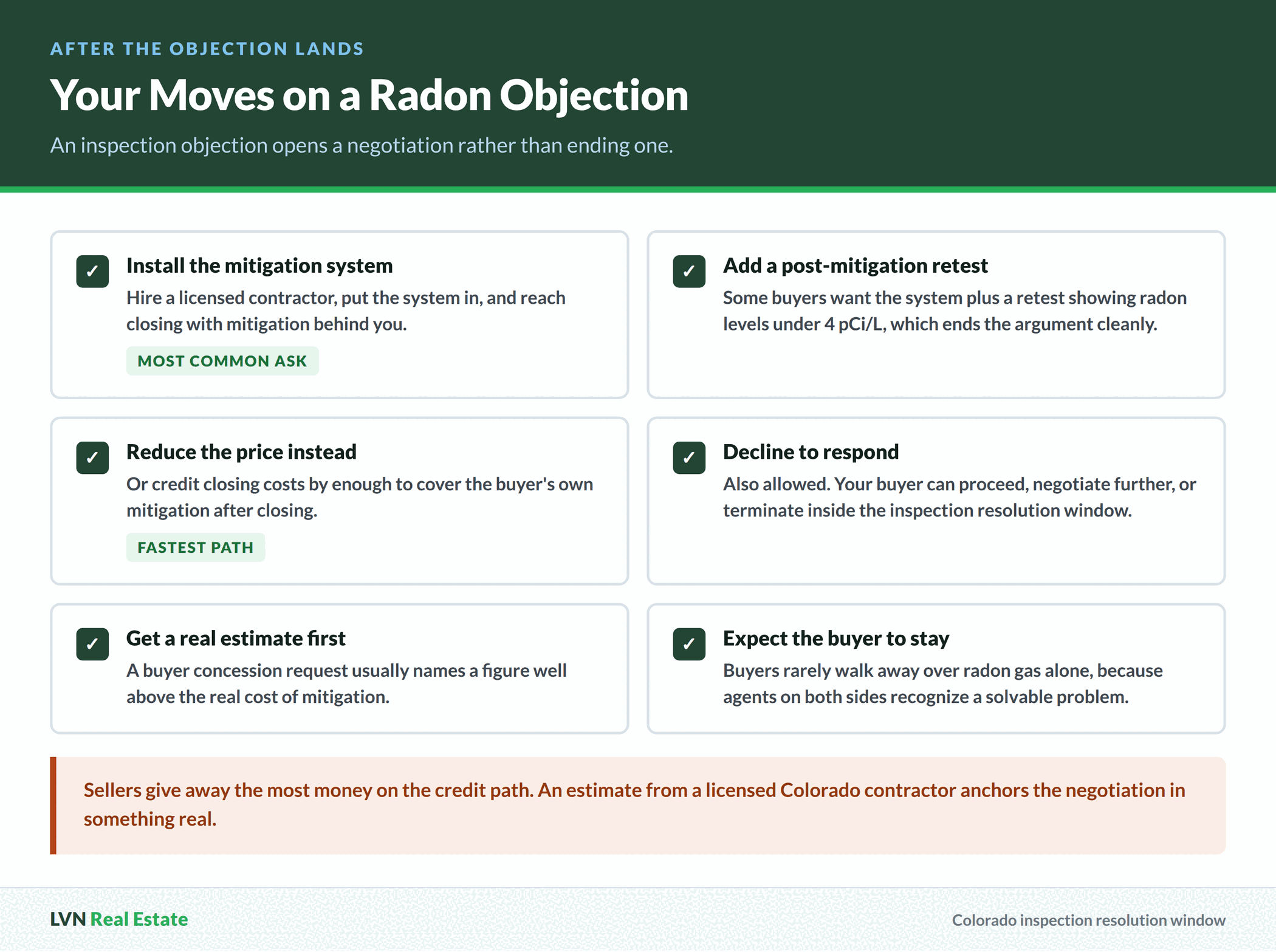
Three realistic paths open up. Hire a licensed contractor, put the mitigation system in, confirm it with a post-mitigation retest, and reach closing with mitigation behind you. Reduce the price instead, or credit closing costs by enough to cover the buyer’s own mitigation later. Declining to respond is also allowed, which leaves your buyer to proceed, negotiate further, or terminate inside the inspection resolution window.
Sellers give away the most money on that middle path. A buyer concession request usually names a figure well above the real cost of mitigation. Get an actual estimate from a licensed Colorado contractor first. That number anchors the negotiation in something real.
How Radon Mitigation Works in a Colorado Home
Sub-slab depressurization is the standard mitigation method in Colorado, and it works. A contractor drills one or more holes through the basement slab, inserts PVC piping, and connects a fan that runs continuously. The fan pulls gas from beneath the slab and vents it outside above the roofline. Negative pressure under the slab intercepts the gas before it reaches your living space, and indoor radon levels drop within 24 hours. A properly sized system runs for years.
In a finished basement, the contractor cores through the slab in a utility closet. Pipe routes up the interior or an exterior wall and ends above the roofline under a weatherproof cap. The fan usually sits in the attic or outside, running quietly enough that most homeowners stop noticing it. In a crawl space, a heavy polyethylene membrane goes over the soil and the same suction zone gets built underneath. None of it is an eyesore, and the system transfers with the house.
Colorado licenses this trade. Your licensed mitigation contractor needs a license from the Colorado Department of Regulatory Agencies. They also carry certification from the National Radon Proficiency Program or the National Radon Safety Board. Colorado requires at least $500,000 in professional liability insurance. CDPHE keeps a searchable list by county.
Then comes the post-mitigation retest, which runs 24 to 48 hours under closed-house conditions with nobody in the house. The result needs to land below 4 pCi/L to satisfy a Colorado buyer who asked for radon mitigation as part of inspection resolution. Book that measurement when you book the contractor, or scheduling will cost you two days.
What Radon Mitigation Costs and How It Hits Your Net
A radon mitigation system in Colorado usually costs about $1,000 to $2,000 unless the contractor hits a difficult design problem. Statewide numbers for 2026 sit a little wider, $1,200 to $2,500, with $1,500 the most common all-in price. Simple houses with one basement zone and an accessible slab land at the low end. Crawl spaces, big square footage, and mixed foundations push it up. An install can climb as high as $5,000 when a home needs a more advanced gas-reduction design.
Ask what an estimate covers, because a system with two suction points costs more than one. For most Front Range sellers with an ordinary basement, the installed price falls in the $1,200 to $2,000 range.
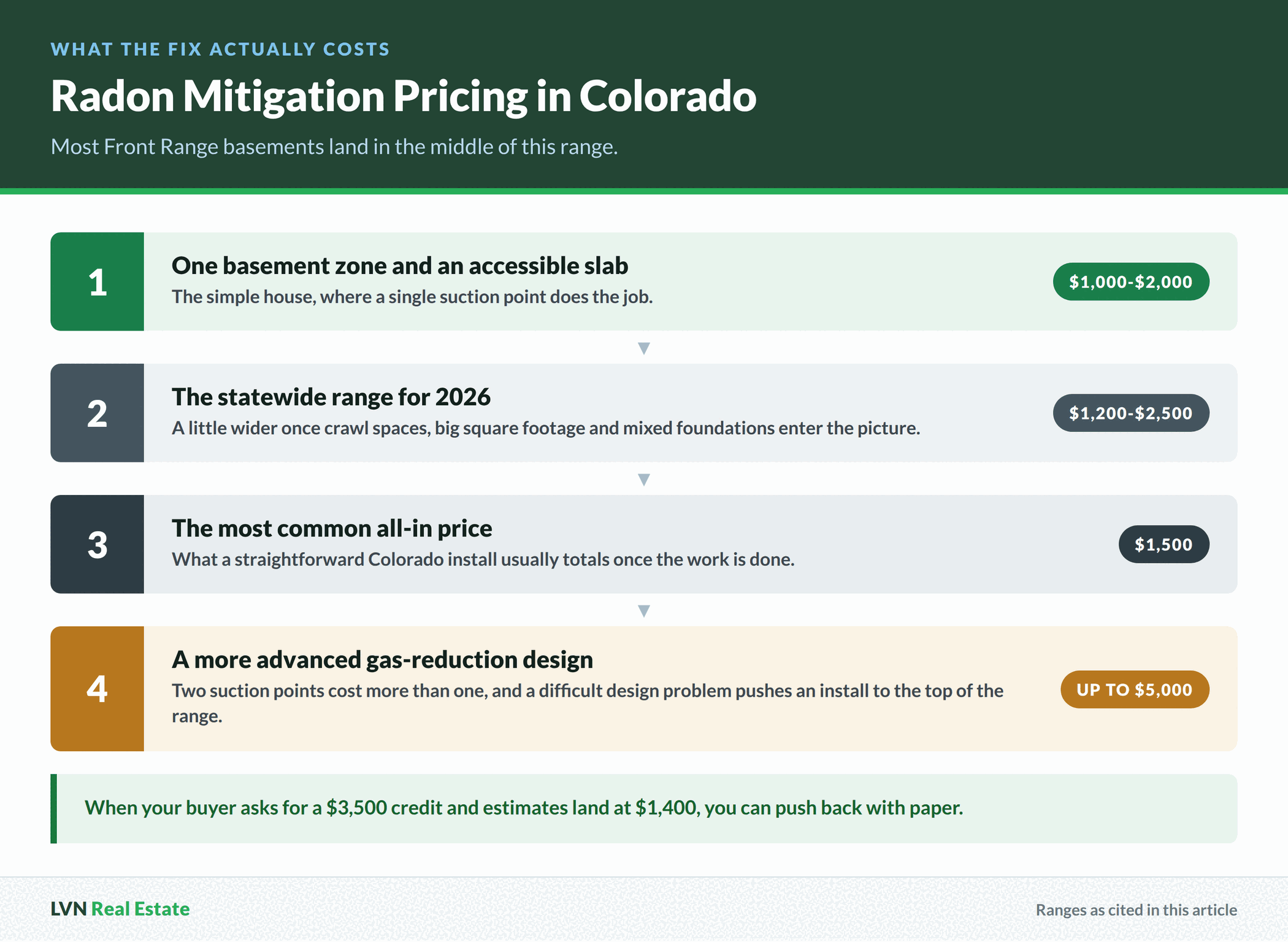
The math usually favors mitigating. When your buyer asks for a $3,500 credit and estimates land at $1,400, you can push back with paper. Handle it yourself and you control the quality and the schedule, and the house goes to closing documented. Speed is the one thing a credit buys you. With closing a week out and no room to schedule anyone, writing the check may be the only workable answer.
Keeping the Sale Moving After a High Radon Test
Start calling the day your test results reach you. Two or three licensed contractors, that same afternoon, for availability and pricing. Waiting for the formal inspection objection to arrive burns the only slack you have. Colorado’s inspection resolution window is short and contractor calendars fill up fast, so mitigation is a scheduling problem more than a money problem.
Book the work before you sign your response. Get written confirmation that the mitigation install and the post-mitigation retest both finish ahead of the agreed deadline, and pass that along to the buyer’s agent in writing. Silence is what wrecks a smooth closing. A buyer’s agent who hears nothing after filing an inspection objection assumes the worst. Share those results as soon as they land, attach the lab report, and both sides can look toward the closing table.
Frequently Asked Questions About Radon in Colorado Home Sales
Does a high radon test mean my home is unsafe to live in right now?
Not in the immediate sense. The health risk builds through long-term exposure across months and years, not through brief contact. EPA links prolonged exposure to lung cancer, and the risk rises with both exposure time and concentration. Sellers who’ve lived in the house for years without a radon mitigation system aren’t in fresh danger during the last few weeks before closing. Take personal health questions to your doctor.
Can the buyer walk away from the sale because of radon gas?
Yes. A buyer can terminate during the inspection period for any reason, and a high result counts. In practice buyers rarely do, because radon in Colorado is common enough that experienced buyers and their agents treat it as a negotiating point. What decides it is whether the buyer sees you respond reasonably and quickly. The lab report is a line item, not a verdict on your home.
Will radon mitigation guarantee the home passes a retest?
No contractor can promise you a specific number. A properly installed sub-slab system does bring radon levels down in the large majority of Colorado houses, and EPA’s position is that any home with a radon problem can be fixed. The post-mitigation retest shows whether the system got below 4 pCi/L. If the first attempt falls short, your contractor adds suction points, reroutes the pipe, or upgrades the fan, then measures again.
Who pays for the radon mitigation system, the buyer or the seller?
Whatever the two of you negotiate. No Colorado statute assigns that cost to either party. In practice, sellers who want the sale to keep moving either pay for mitigation or credit enough to cover it, and buyers who badly want the home sometimes take it on after closing. Your agent’s read on buyer motivation matters most here.
Moving Forward After a High Radon Test Result
A high test result during a Colorado home sale is genuinely manageable. This is the most common inspection hurdle in the state, and Colorado’s real estate industry has worn a groove handling it. Nothing about that result makes your home hard to sell.
Start with SB23-206 so your disclosure is clean. Learn what the result actually says, then get a real estimate before you negotiate anything. Weigh mitigation against a credit using your own timeline, and keep the buyer’s agent informed.
Some sellers would rather skip all of it. If the contractor scheduling and the post-mitigation retest window sound like more than you signed up for, selling as-is for cash is a straightforward alternative. At LVN Real Estate, we buy Colorado homes as-is across the Front Range and beyond, with no radon mitigation to arrange and no inspection objections to answer. We’ve been buying here since 2013, and we’re BBB accredited. Curious what a cash offer on your home would look like? Reach out. No pressure, no obligation, just a number and a conversation.
Where LVN Real Estate Buys Houses With a Radon Problem
Radon in Colorado shows up all along the Front Range, so a high test result is nothing new to us. We buy houses in Denver, Aurora, Lakewood, Arvada, Littleton and Colorado Springs with the radon question still wide open. You don’t have to install a radon mitigation system first, book a post-mitigation retest, or answer an inspection objection before you talk to us. Our service area runs the length of the Front Range and reaches the mountain towns and the Western Slope.
Talk Through Your Options After a High Radon Test
Nothing has to happen today. If you want a straight read on what your home is worth in a cash sale, and how that compares with mitigating radon and listing it, contact us and we’ll take a look. There’s no obligation and nobody chasing you afterward. If you’d rather read first, our common questions page covers how a cash offer gets built and what happens once you accept. Or fill out the short form below and we’ll come back to you with a number, whatever your radon test said about the home.