A seller in Lakewood once asked me to guess her biggest cost at closing. She guessed property taxes. Not even close. The commission line was bigger than her taxes and title work put together, and she’d signed off on it without reading past page one. If you’re selling anywhere in Colorado, from the Front Range to the Western Slope, what realtors charge will likely be the biggest cost you choose to take on.
How Much Do Realtors Charge to Sell a House in Colorado?
Six percent is not the law and never was, no matter what you hear at the kitchen table.
An August 2026 survey of agents put the average total commission in Colorado at 5.47%. On the listing side, the average was 2.78% in that same survey. A few February 2026 industry surveys came in a bit higher, near 5.71% statewide. Either way, what realtors charge here sits close to the national number.
Now run that against real prices. Redfin put the Colorado median sale price at $547,606 in October 2026, down about half a percent from a year earlier. At that rate, a hair over $29,900 comes off the top of a median Colorado sale. Most sellers I sit down with have never done that math.
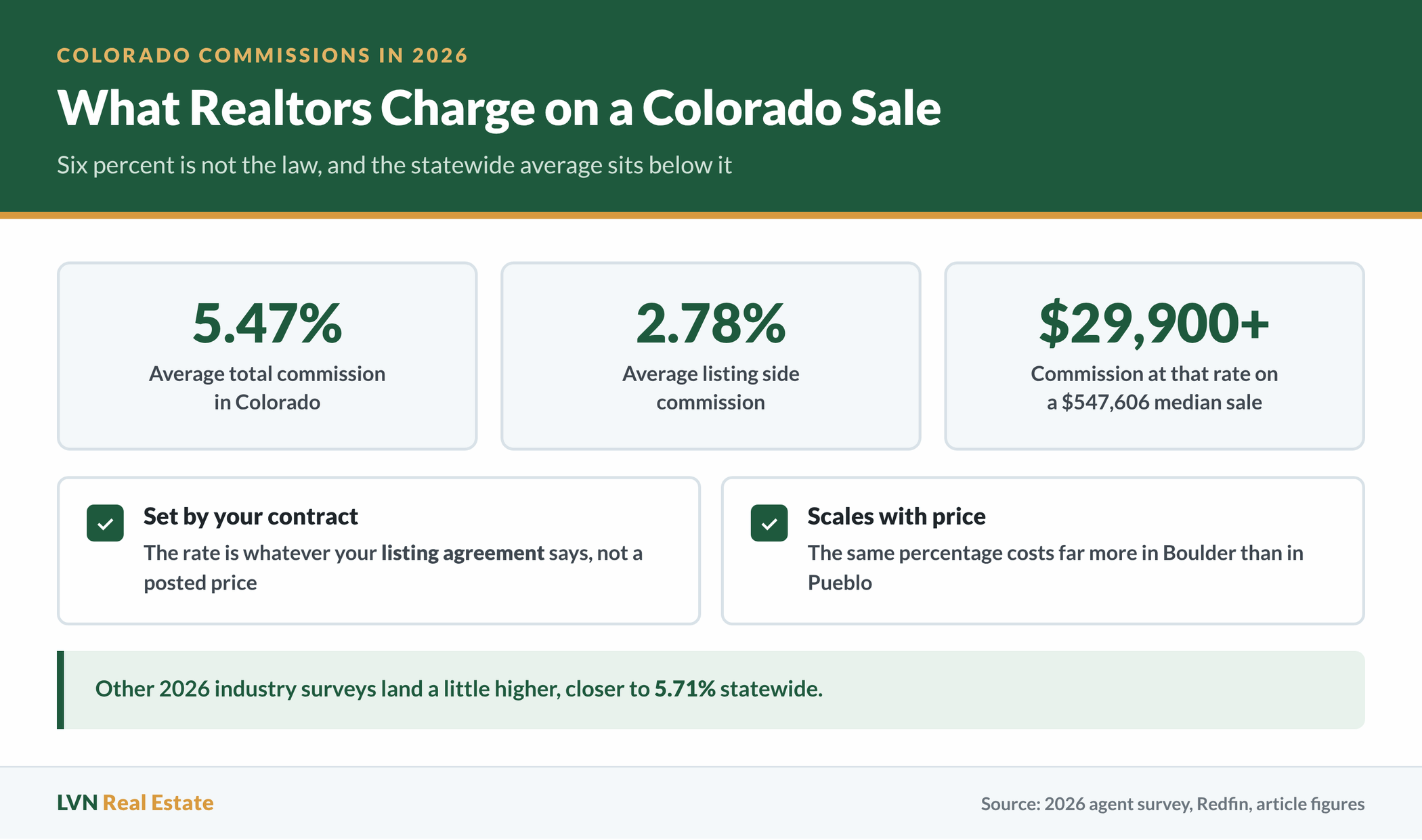
What realtors charge grows with your price, so the math stings more in Boulder than in Pueblo. A Cherry Creek seller and a seller in Fort Morgan pay the same percentage. They just hand over very different dollars for about the same work.
A couple of years ago I bought a small ranch home in Greeley from a retired couple who’d inherited it. They rented it out for six years and never once wanted to be landlords. By the end, Saturday calls about the swamp cooler had worn them down, and the garage still held the last tenant’s weight bench. We closed without a listing, which was the whole point for them.
Commissions here aren’t posted on a wall anywhere. They live in your listing contract, and the number in that contract is the number you owe.
What Do Realtors Charge for When You Sell a Home?
Before: a cluttered split-level in Westminster, priced wrong, with zero showings in three weeks. After: repriced, cleaned out, given pro photos and under contract in nine days. Everything in between is the work.
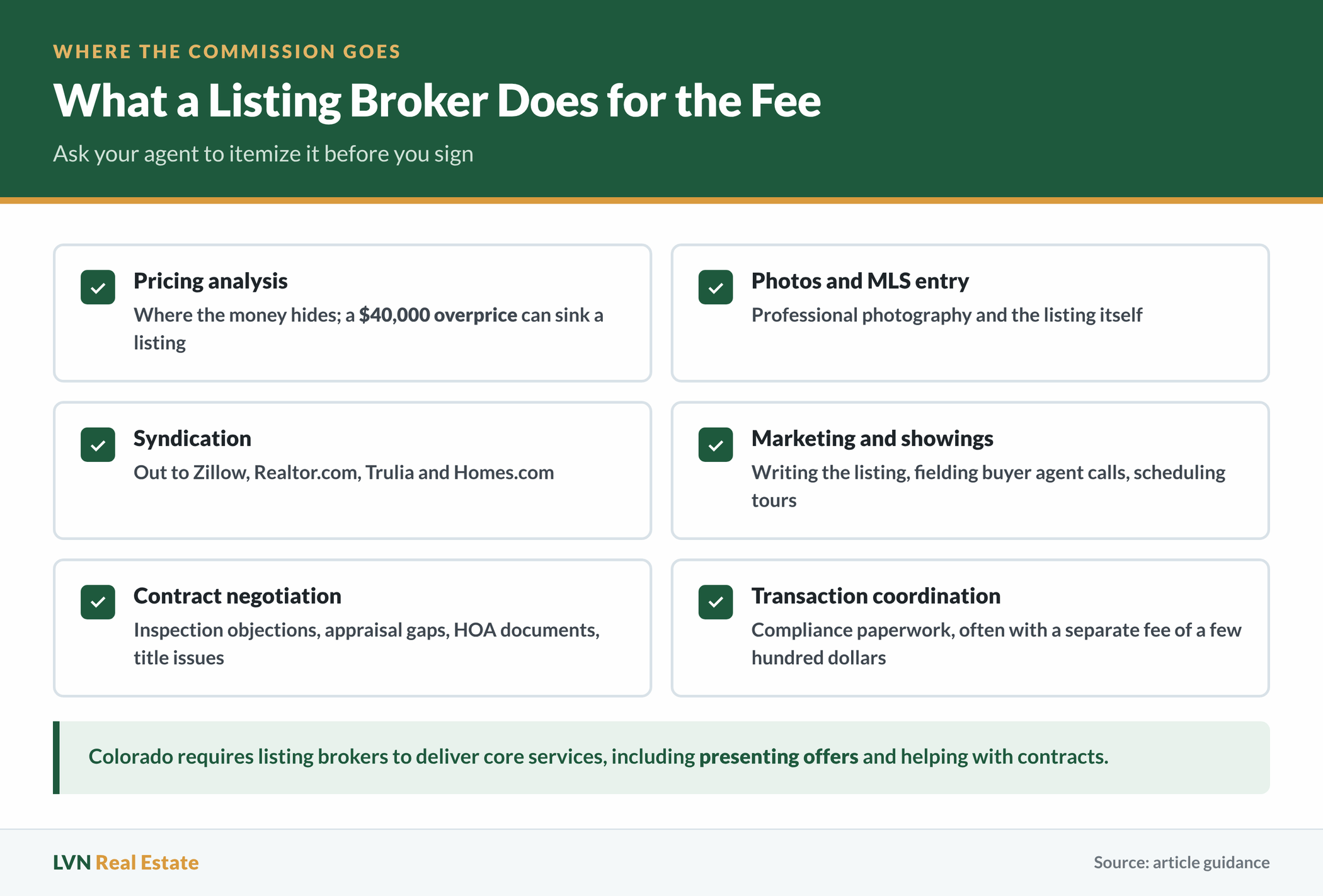
So what realtors charge pays for pricing analysis first, and pricing is where the money actually hides. An agent who talks you out of a $40,000 overprice in a buyer’s market has earned the fee right there.
Photos, MLS entry, and feeds to Zillow, Realtor.com, Trulia, and Homes.com come with it. Your listing broker also writes the marketing, takes buyer agent calls and books showings.
Few people value contract negotiation until an inspection objection shows up. Colorado uses standardized Commission-approved contracts with hard deadlines built in. Miss one of those dates and you could lose the earnest money fight. Counteroffers, appraisal gaps, HOA documents and title objections fill a listing broker’s week.
One Colorado rule matters here. The state makes listing brokers do certain core jobs, like presenting offers and helping with contracts. That minimum service standard is why pure limited-service listings aren’t offered the same way here as they are in some other states.
Paperwork and deadline tracking finish the list. Many brokerages add a separate transaction fee for that, often a few hundred dollars, and you can negotiate it like anything else.
Have you ever asked a listing agent to break down what realtors charge you for? Most will. The ones who get defensive are telling you something too, and it’s worth listening before you sign anything with them.
What Fee Structures Do Colorado Realtors Charge?
A seller in Arvada called me after interviewing four agents. She got four proposals, and no two matched. One agent wanted 3% flat and another offered a tiered rate. The third folded marketing into a higher percentage, and the last quoted a flat dollar fee.
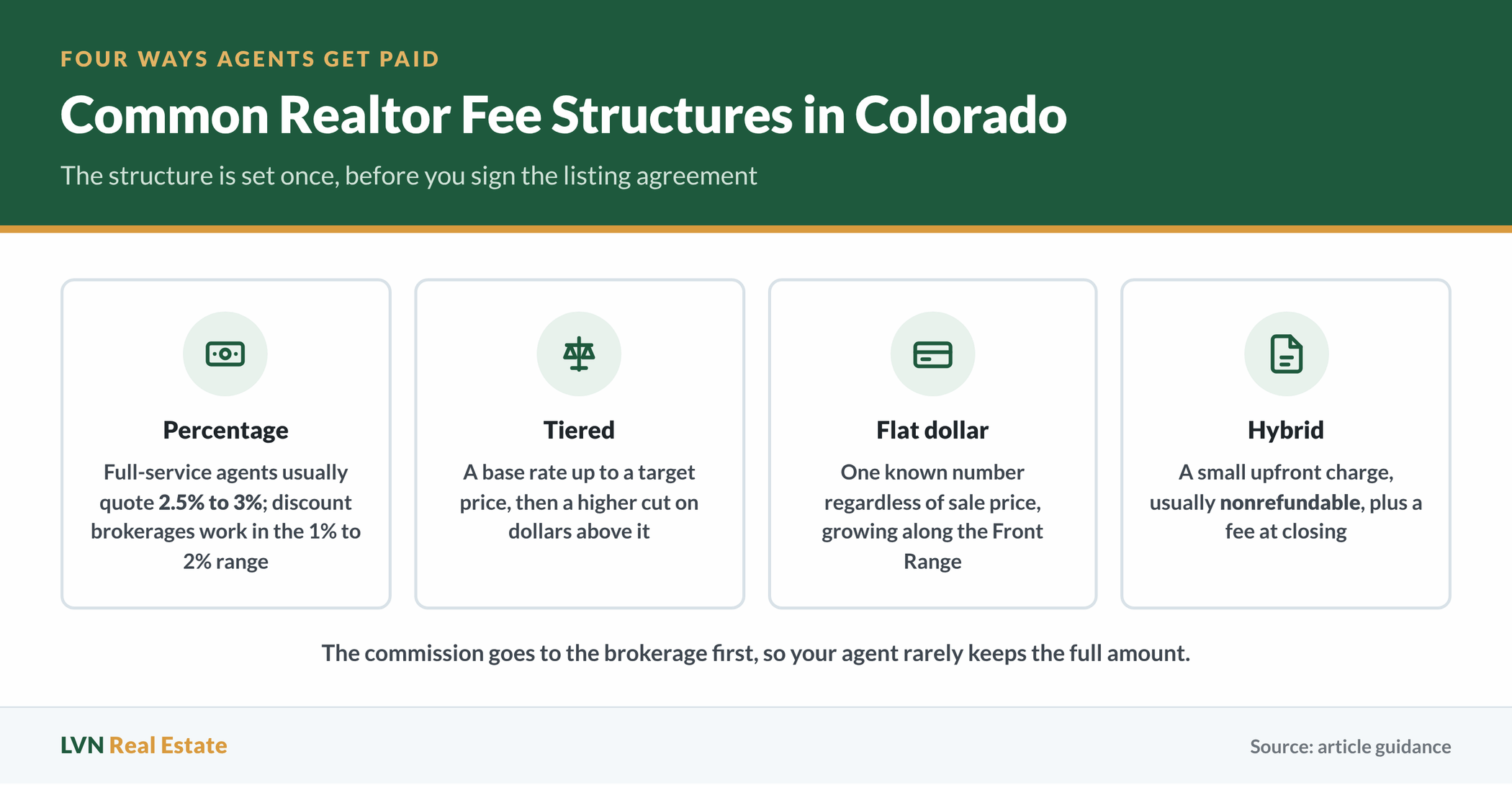
For most agents here, what realtors charge starts as a percentage-based commission. Full-service listing agents tend to quote 2.5% to 3%. Discount firms sit in the 1% to 2% range, or they offer a flat figure instead.
Tiered structures exist, though few agents bring them up unless you ask. The broker takes a base percentage up to a target price, then a bigger cut of every dollar above it. It ties their incentive to yours on the last few thousand.
Flat-dollar full service is the fastest-growing setup along the Front Range, and you pay one known number no matter what the house sells for.
Then there’s the hybrid, which pairs a small upfront charge with a percentage or flat settlement fee collected only at closing. Read these carefully, because the upfront piece is usually nonrefundable whether or not your house sells.
What realtors charge gets split before anyone banks it, too. The commission goes to the brokerage first, and the brokerage pays your agent their cut. Whoever is standing in your living room rarely keeps the whole amount. Keep that in mind when you push on the rate.
One pattern I keep seeing is sellers who bargain hard with buyers on price and never question the structure with their own agent. You settle that structure once, before you sign. After that, it’s locked in for the life of the listing agreement.
Flat Fee Realtors in Denver: What Do They Charge?
That locked-in structure is a big reason flat fee models caught on in Denver. Some flat fee firms charge $95 upfront to list in Denver, which gets you onto REcolorado and out to the big portals.
Full-service flat fee works differently. Denver brokers in this lane charge somewhere in the low-to-mid four figures, paid at settlement. They still handle showings, negotiation and contract-to-close like a regular listing broker.
Does the cheaper version of what realtors charge make sense for your house? It can if you’ve sold a house before and you’re comfortable reading a Colorado contract. If a surprise title issue or a lowball counteroffer would rattle you, those savings disappear fast.
Before you pick, compare what realtors charge under each model at your actual Denver price point. On a home in the mid-$600,000s, a standard listing fee runs near $16,000. A flat-fee full-service package might cost about a quarter of that.
Flat fee listings have one weakness nobody advertises: your pricing strategy is still on you. The MLS doesn’t care if you’re $50,000 too high. In a market where Colorado homes took a median of 51 days to sell this past October, an overpriced listing just sits and ages.
Capitol Hill and Baker don’t move like Green Valley Ranch. A flat fee broker who covers the whole metro may not know your block the way a local agent who works your area does. If you want a straight read on which model fits your house, the team at LVN Real Estate will walk through the numbers without pushing you toward a listing.
Who Pays What Realtors Charge in a Colorado Sale?
Last year, a homeowner in Pueblo sold her late mother’s house and found out buyer agent fees don’t work the old way anymore. Since the 2024 NAR settlement, buyer agent pay in Colorado is negotiated separately. It can’t be advertised on the MLS as a blanket offer of cooperation now.
In practice, the seller still covers what realtors charge most of the time, because both sides get paid out of the sale price at closing. The difference is that it’s now an open negotiation, not something everyone assumes.
Buyers now sign their own agreements with their agents before they tour homes. Some buyers then owe their own broker a fee and ask you to cover it as a concession in the offer.
This is where Colorado sellers get tripped up. A buyer concession cuts your net just like a commission does, except it sits on another line of the contract. Sellers compare two offers by gross price and take the higher one. Then they lose on net.
Who pays what realtors charge is now a lever you can pull in negotiation. A buyer who drops their concession request is in effect bidding higher, and on a $500,000 Colorado sale that’s real money.
Cash buyers change the math completely. Direct buyers close without listing brokers involved, so no commission comes off the top. Your net offer reflects the house’s condition and holding costs instead.
There are more homes for sale across Colorado now. The Colorado Association of REALTORS reported single-family sales down 19% in October 2026, with the median price slipping 0.7% to $575,000. With softer demand, buyers ask for more, and concession requests have gotten bolder around the Denver metro.
When Do You Pay the Fees Realtors Charge?
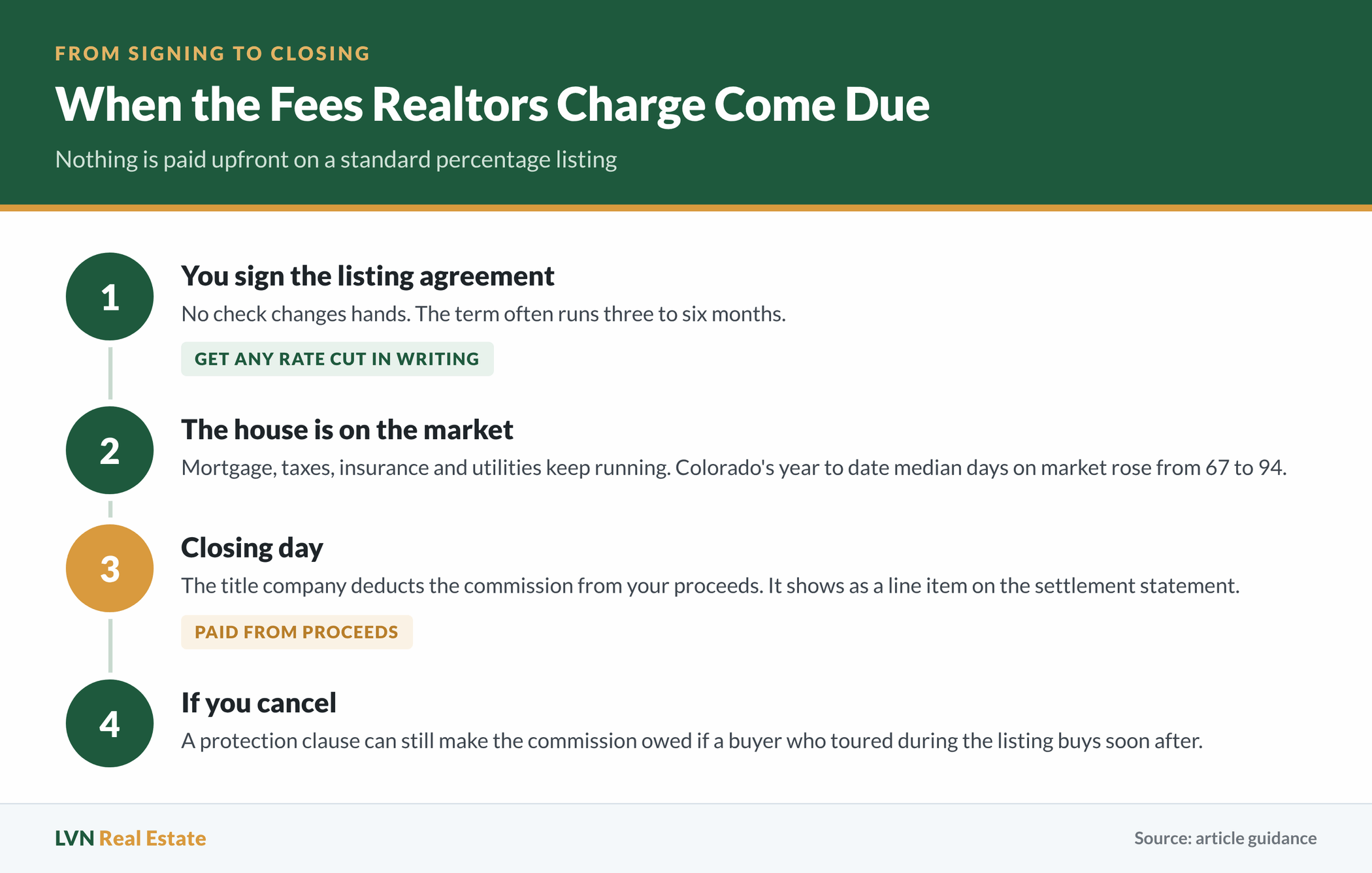
Nobody writes their agent a check on signing day. It’s why the listing agreement feels free up front.
What realtors charge comes out at the closing table. The title company deducts it from your proceeds before you see a dollar. It shows up as a line item on the settlement statement, and the wire that hits your account is already net of it.
Colorado sellers who change their minds can hit a catch. Your listing agreement runs for a set term, often three to six months, and many include a protection clause. If a buyer who toured during your listing comes back and buys soon after you cancel, the commission can still be owed.
Verbal rate agreements won’t hold up in Colorado, so if your broker agreed to lower their percentage, get that change written into the listing contract before closing.
What if your sale falls apart? You likely owe nothing. A standard percentage commission pays only when the sale closes. The exception is any upfront marketing or listing fee from a hybrid model, since that money is already gone.
Carrying costs keep running the whole time, and they’re easy to forget. Your mortgage, taxes, insurance and utilities keep draining money while the listing sits. Colorado’s year-to-date median days on market rose from 67 to 94 as of November 2026, so that drain lasts longer than it did two years ago.
Get the numbers early. Ask for a seller’s net sheet before you list, not three days before closing. Any decent Colorado broker can put one together in fifteen minutes.
Can You Negotiate What Realtors Charge in Colorado?
For years I figured agents held firm on their rate and that asking would only sour things. I was wrong on both counts.
Commission rates here come down to what you and the broker agree on. Colorado commissions are negotiable and are not fixed by state law, which leaves room most sellers never use.
Your leverage is strongest on higher-priced homes in move-in shape. You also have more pull if you’re buying your next place through the same broker. A Boulder or Castle Pines listing in good condition really is easier to sell, and the percentage should show it.
Ask for a tiered rate instead of a flat cut. You can also request that the brokerage transaction fee be waived. Find out what the rate looks like if the broker ends up on both sides of the sale. Dual agency isn’t permitted in Colorado, though a transaction-broker arrangement is.
Negotiating what realtors charge down by half a point on a median-priced Colorado home saves roughly $2,700. That covers part of a new roof or a good chunk of your moving budget.
Where I’d push back is on chasing the cheapest listing fee you can find. A broker who cuts their rate without blinking may also cut their marketing budget. Sixty extra days sitting in a cooling Colorado market costs more than you saved.
One homeowner in Louisville reached out mid-divorce. Both owners wanted the house gone, and neither wanted to manage showings. Lawyers were already in the picture, and the basement was still full of ski gear nobody had claimed. We bought it quietly on the timeline they picked, without a single open house. For sellers who want a plain comparison between listing and selling direct, LVN Real Estate is a solid Colorado resource.
Common Questions About What Realtors Charge in Colorado
Sellers tend to ask the same few things once the listing paperwork shows up. It comes down to whether the rate can still move and whether you can skip what realtors charge altogether. The short answers below match what’s covered above.
Frequently Asked Questions
Can I Change the Commission After I Sign the Listing Agreement?
You can, if your broker agrees and the change goes into the written contract as an amendment. Handshakes and texts won’t hold up at closing. If your broker won’t budge, read the exit terms before you walk away, since a protection clause may still apply.
Do Realtors Still Get a 6% Commission?
Not usually, and not in Colorado. Statewide averages now sit below that old benchmark, and the listing side alone tends to land in the mid-two to three percent range. Buyer agent pay is negotiated on its own now, so what realtors charge on any one Colorado sale varies more than it used to. Treating one percentage as standard will cost you money.
Do I Have to Pay the Buyer’s Agent in Colorado?
No rule requires it anymore. Buyer agent pay is negotiated now, so a buyer may ask you to cover their agent’s fee as a concession in the offer. Weigh that request against the price, since it cuts into your net the same way the rest of what realtors charge does.
Can I Sell My Colorado House Without Paying Any Commission?
You can. Selling straight to a buyer, listing for sale by owner, or using a flat fee service all skip a traditional listing percentage. Each path trades money for effort or exposure, so compare your likely net under each one instead of the headline savings.
If you’d like to talk through what a listing would really net you compared with a direct sale, we’re happy to run those numbers with you. There’s no pressure and no listing agreement to sign.
The Denver Metro Market Right Now
Across the seven-county Denver metro, the Colorado Association of REALTORS put the October 2026 median sales price at $571,000, with 4.4 months of supply. With more homes to pick from, buyers push harder, and what realtors charge plus any concessions takes a bigger bite out of your proceeds. That holds for sellers in Lakewood just as much as it does in Denver.
LVN Real Estate works with homeowners selling in Denver who would rather skip the listing and the commission line on the settlement statement.
Compare a Cash Offer Before You List
A cash offer from LVN Real Estate skips what realtors charge, and we buy the house as it sits. Put that number next to a listing net sheet and pick the one that works for you.
Reach out to LVN Real Estate with a few details about your property, or fill out the form below. There’s no obligation to accept the offer.