

A house in Arvada worth four hundred grand can land in court. Same family, same death certificate, completely different paperwork. More Colorado families get tripped up by that gap than any dollar threshold, because the question of whether an estate has to go to probate isn’t really answered by a number at all. It’s answered by what the deceased person owned and how the title was written. I’ve spent years buying houses from heirs across Colorado, and I want to walk you through what triggers court, what doesn’t, and where the real costs hide.
Does Every Estate Have to Go to Probate in Colorado?
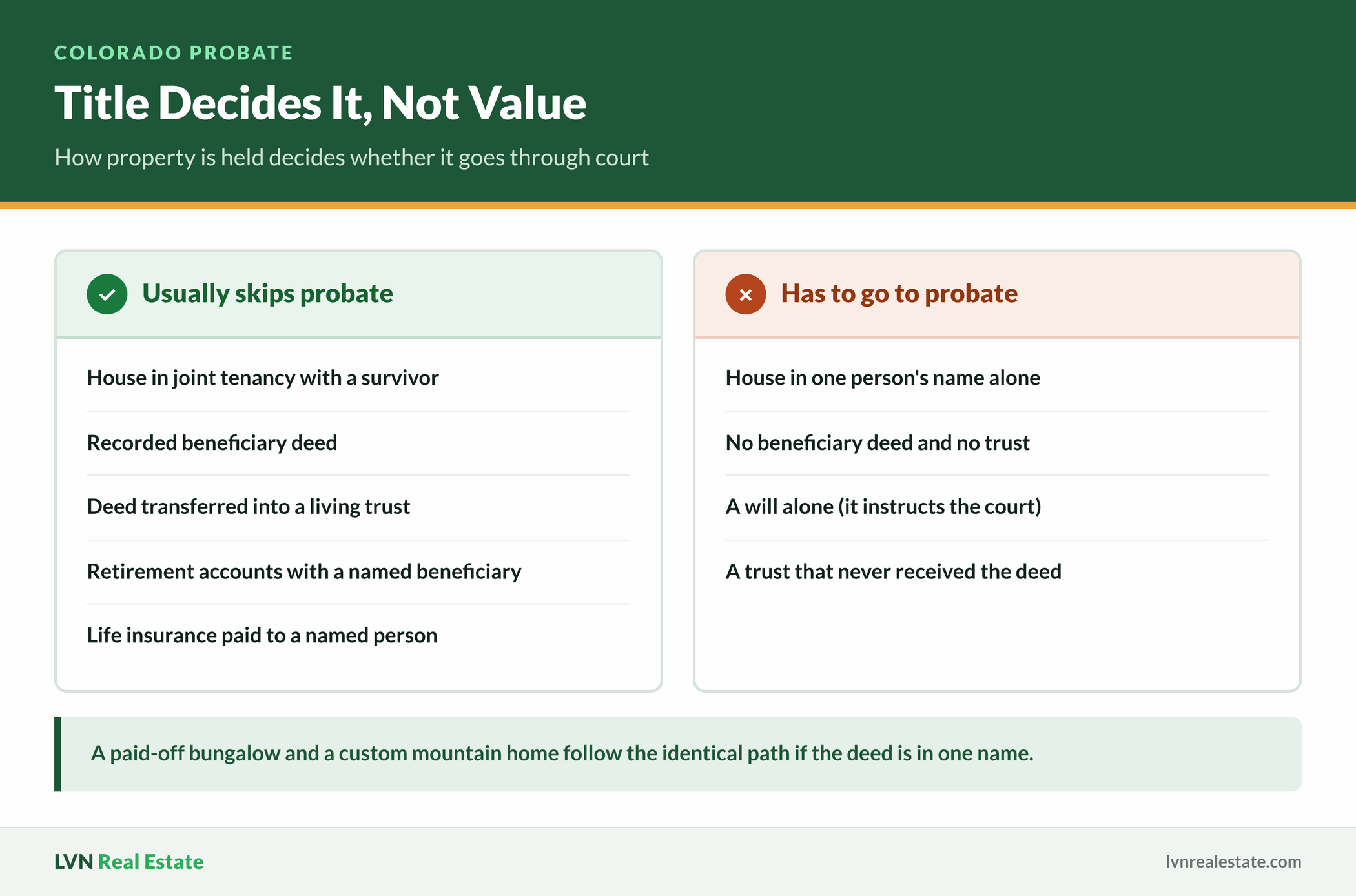
Not every estate has to go to probate here. Plenty of wealth moves without a judge ever seeing it. A joint tenancy deed transfers to the surviving owner automatically, and retirement accounts with a named beneficiary pay out directly. Courts here also recognize beneficiary deeds for real estate. That’s a recorded document that moves title on death, and the owner can revoke it beforehand by recording a proper revocation. The Colorado Bar Association’s estate planning chapter lays out those mechanisms in plain language.
If a Colorado house sits in one person’s name alone, with no beneficiary deed and no trust holding it, that property has to go to probate before anyone can legally sell it. Value doesn’t rescue you. A paid-off bungalow in Pueblo and a custom place outside Durango follow the identical path.
A few years back I bought from a retired couple in Brighton who’d inherited a small rental from her mother and spent two winters chasing late rent they never wanted in the first place. Because the deed still carried the mother’s name, they couldn’t sign anything until the court appointed one of them personally.
Does a will keep you from having to go to probate? No. A will is instructions for the court, not a substitute for it. This single misunderstanding probably causes more delay than anything else in Colorado estate work, and attorneys will tell you the same thing if you ask them directly.
What Assets Count Toward an Estate’s Worth for Probate Purposes?
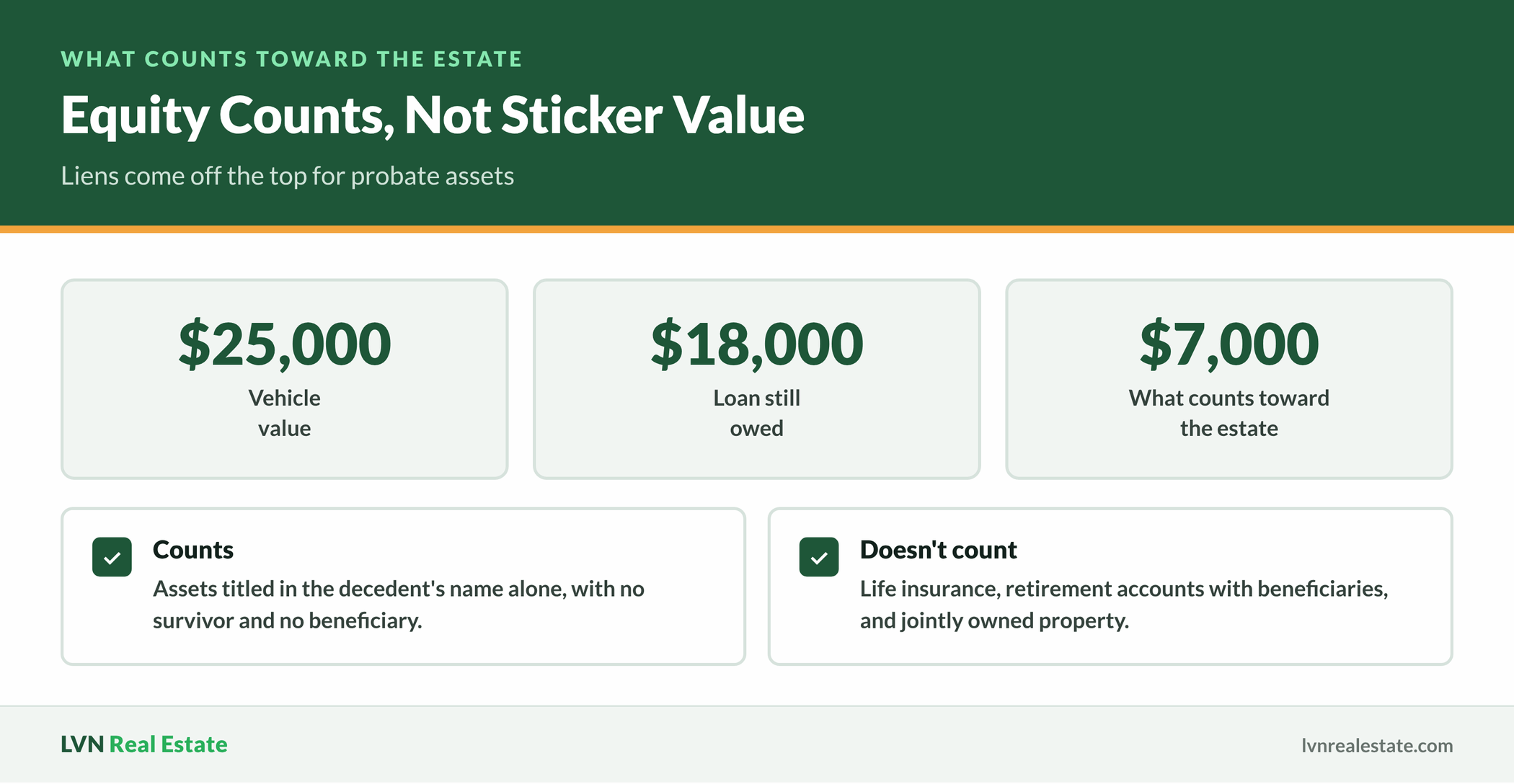
Only probate assets count. Those are things titled in the decedent’s name alone, with no survivor and no named beneficiary attached. Life insurance paid to a daughter sits outside that circle. Assets carrying named beneficiaries, like life insurance and retirement accounts, along with jointly owned property, move outside the intestate rules entirely.
Liens come off the top. A vehicle worth $25,000 carrying an $18,000 loan contributes $7,000 toward the count, not the full sticker value. Mortgages work the same way against real estate. Equity is what matters, not gross value, and that distinction changes the math for a lot of Colorado households carrying debt on their property.
Real estate here is expensive, so equity alone pushes most estates past any simplified route. Statewide, homes sold for a median price of $547,606 in October 2026, down about half a percent from a year earlier. Even a half-paid mortgage on a typical home here leaves equity far north of the small estate cap. One property is usually all it takes to make an estate go to probate.
Personal property still counts toward the threshold calculation: vehicles, bank accounts, furniture, tools, that Jeep in the garage. I’ve walked through Colorado garages holding a snowblower, four generations of camping gear, and a motorcycle nobody knew existed.
How Does an Estate’s Worth Change If There’s No Will in Colorado?
Say a Denver homeowner passes away without ever signing a will, leaving three adult children to sort things out. Dying without a will doesn’t change the dollar value of an estate by a single penny.
Colorado’s intestate statute does the dividing. Based on the family circumstances, the statute sets the surviving spouse’s share, and when more than one circumstance applies, the one producing the largest spousal share wins.
Blended families are where the numbers get complicated, and the state runs those base figures through an annual inflation adjustment. If stepchildren are in the picture, ask a Colorado probate attorney for the current-year amounts rather than trusting a number you read somewhere. The Justia listing of Title 15, Article 11 shows how many sections feed into that calculation.
Without a will, the estate still has to go to probate for the court to appoint someone. Courts in Colorado call that person the personal representative.
My honest opinion on the common advice is that it skips the part people actually need to hear. Everyone says “get a will,” and sure, do that. Still, a will does nothing to keep Colorado property out of court. If keeping your heirs out of the courthouse is the actual goal, a revocable living trust or a recorded beneficiary deed accomplishes it; a will does not.
If no relatives surface at all, the estate escheats to the State of Colorado after the search works down through descendants, parents, siblings, and grandparents. I’ve only seen that come up once in Colorado, and the property had sat vacant through three winters before anyone noticed.
How to Find Out What an Estate Is Worth Before Filing for Probate
Don’t pay for a formal appraisal first.
Start free with the county assessor. Every Colorado county publishes assessed values online, and in a stable market that gets you within a reasonable range for a first pass.
Assessor values lag the market, though. Denver metro’s median closed price climbed 3% from September to October 2026, moving from $575,000 to $592,000. Median days in the MLS fell from 33 to 31 over the same month. So a value set during the last reassessment cycle may miss by a wide margin in either direction. REcolorado’s monthly reports are a decent sanity check if you’re in the metro.
Pull a title search too. Colorado county clerk and recorder offices hold those records, and a local title company will run a search cheaply.
For the property itself, ask two or three local buyers or agents what they’d pay today. Three opinions from people with current Colorado numbers beats one guess. Teams like LVN Real Estate will walk a property and give you a straight number without pushing you to list. That’s genuinely useful when you’re still deciding whether the estate even needs to go to probate.
How much is enough precision? For deciding whether to go to probate, ballpark is fine. A good-faith inventory is what the court needs, not a certified appraisal, unless an heir disputes the numbers.
What Estate Value Triggers Probate Court in Colorado?
Two siblings in Longmont thought their mother’s estate was simple: a modest bank balance and a condo.
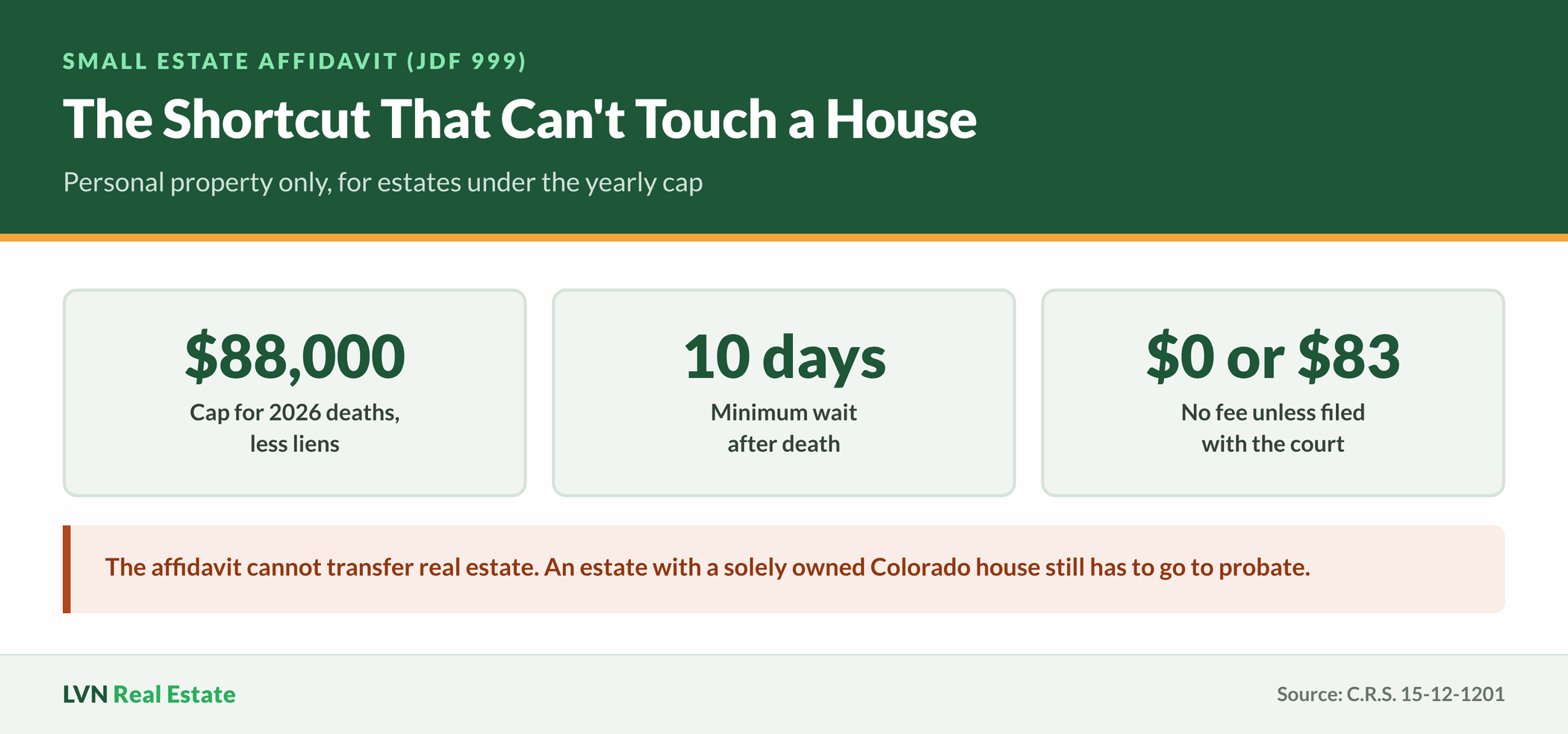
Here, the small estate affidavit follows a straightforward threshold. A small estate affidavit is available when property passing by will or intestacy, less liens, totals $88,000 or less for 2026 deaths, with the figure adjusted each year for inflation. The statute sets that cap, which applies the same in every county. Governing is the limit in effect on the date of death, not the date you file.
Real estate breaks the whole thing. There’s no separate small estate affidavit for real property, which means an estate holding a solely owned home must go to probate. The dollar figure stops mattering the moment a solely owned Colorado house enters the conversation.
You’ll hit this threshold almost no matter where you buy here. Colorado Springs saw an October 2026 median sale price of $455,000, down 4% from $473,500 the year before. Even the state’s more affordable markets clear the threshold several times over. A free-and-clear house in Pueblo West or Grand Junction still has to go to probate, same as a place in Cherry Creek.
Which estates genuinely avoid having to go to probate? Renters. People whose house was already jointly titled with a spouse. Families where a beneficiary deed got recorded years earlier. That’s roughly the list, and everyone else holding real property should expect to go to probate.
Small Estate Affidavit: Can You Avoid Probate in Colorado?
Families hear “small estate affidavit” and picture one form that transfers Mom’s house. The form doesn’t reach real estate at all, and that’s not a technicality you can argue around.
The affidavit is limited to personal property and cannot be used to transfer real estate. It does nothing for a deed in Lakewood or a cabin near Buena Vista.
You just wait at least ten days after the date of death, with no personal representative appointed or pending. After that, an eligible heir presents a notarized affidavit directly to the bank, employer, or whoever holds the asset, with no probate case and no court filing. The form is JDF 999, published by the Colorado Judicial Branch, and the court’s self-help center posts the current-year dollar limit.
The small estate affidavit carries no court fee when it isn’t filed, or $83 if you do file it with the court. Compare that to an estate that has to go to probate and the difference is thousands.
A warning worth taking seriously: don’t count payable-on-death accounts against the limit. Including a payable-on-death account in the calculation can push an estate over the cap for no reason. I’ve watched Colorado families open a full probate case they never needed because they added up every statement on the kitchen table instead of asking which accounts had beneficiaries attached.
Would I use the affidavit for a parent’s bank account? Without hesitation. I’d still confirm eligibility with a Colorado probate attorney before presenting it to a bank. An affidavit signed by the wrong person creates liability.
What Happens If an Estate’s Worth Exceeds the Probate Threshold?
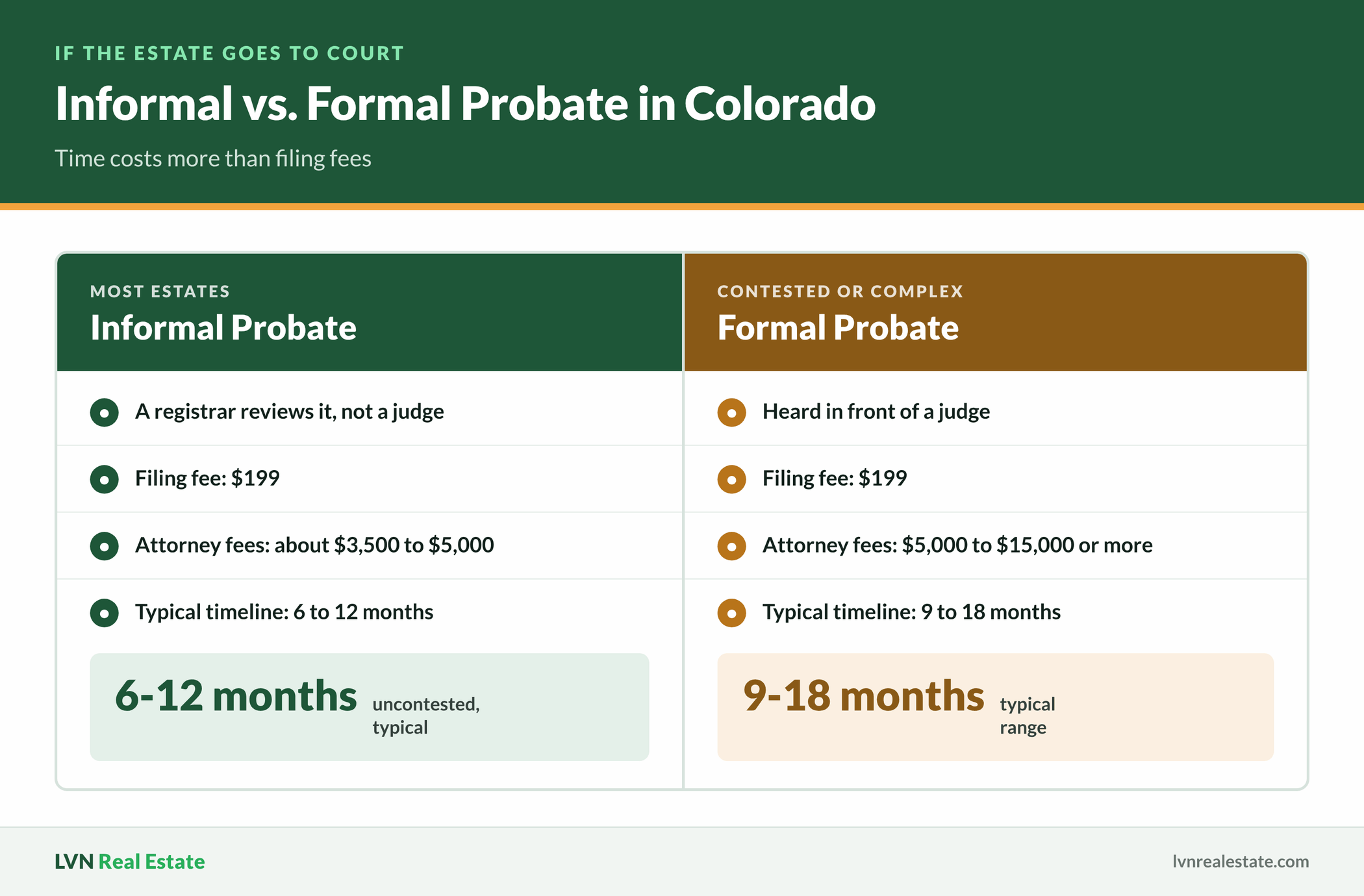
Less than people fear on filing fees, more than they expect on time and professional help. The Colorado court filing fee runs $199 for both informal and formal probate. Attorney fees generally fall between $3,500 and $5,000 for informal work. That number climbs to $5,000 to $15,000 or more once a case turns formal or contested. Publication in a local newspaper adds a few hundred on top.
Timeline is the expensive part. Uncontested informal probate in Colorado typically runs six to twelve months, with a minimum six-month creditor period built in, and formal probate stretches nine to eighteen. Mortgage payments, Colorado property taxes, insurance, and winter utilities keep running the entire time.
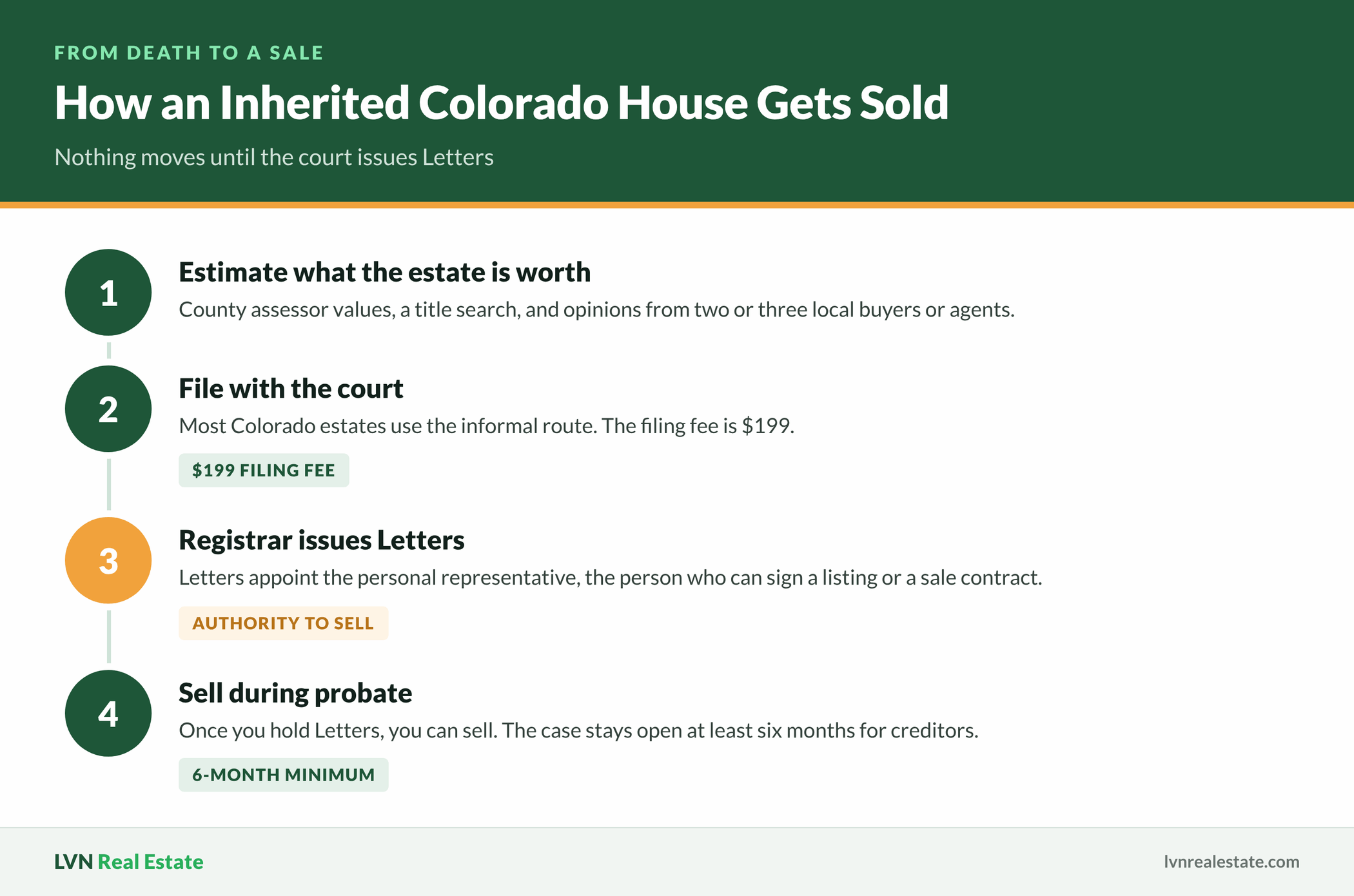
Most estates that go to probate here take the informal route. In informal probate, the probate registrar reviews the application and issues the Statement of Informal Probate along with Letters appointing the personal representative. Those Letters are the document that lets you sign a listing agreement or a purchase contract. Nothing moves before they’re issued.
Can you sell during probate? Yes, once you hold Letters, and plenty of Colorado families do exactly that rather than carrying a vacant house through a Front Range winter. The Colorado Judicial Branch probate overview covers which forms apply to which situation.
A woman in Fort Collins called me on a Tuesday about her father’s place, a brick ranch he’d owned since the seventies. She kept a box of photographs and his old fishing rods, and we took the house as it stood. Her brothers signed from out of state.
That pattern repeats across Colorado: the person nearest the house carries all the work. If the cleanout math doesn’t pencil out, selling as-is isn’t quitting, it’s just accurate arithmetic, and I’ve seen plenty of heirs learn that the hard way. LVN Real Estate handles those situations regularly and will tell you honestly when listing would net you more.
Frequently Asked Questions
What Does Probate Actually Cost a Colorado Family?
The court’s filing fee is modest, as noted above, and it’s usually the smallest line item. Attorney fees, newspaper publication, certified copies of your Letters, and appraisals add up faster, and the real expense is carrying a property through months of taxes, insurance, and utilities. Colorado doesn’t use a percentage-of-estate fee schedule like some states, so what you pay a lawyer depends on how complicated your family situation is.
Can I Handle a Small Estate Affidavit Without Hiring a Lawyer?
Yes, and many Colorado families do. The form comes free from the Colorado Judicial Branch. You fill in each asset with account numbers and a fair market estimate, then get it notarized before presenting it to whoever holds the property. Some situations call for help, though. If an heir might disagree, debts exceed assets, or you’re unsure whether an account has a beneficiary attached, book an hour with a Colorado probate attorney. It’s cheap insurance against signing something you’re personally liable for.
Is Colorado a Difficult State for Probate Compared to Others?
Not at all. Colorado adopted the Uniform Probate Code, which makes it one of the more straightforward states to work through, especially with the informal track where a registrar handles things instead of a judge. States that require court supervision of nearly every step, mandate percentage-based attorney fees, or run on slow court calendars are the painful ones. Colorado’s weak point isn’t the process; it’s that home equity here is high enough that most estates have to go to probate regardless.
Does a Living Trust Keep Colorado Property Out of Court?
It does, provided the deed was actually transferred into the trust while the owner was alive. That last step gets skipped constantly. A revocable living trust sitting in a drawer with the house still titled personally gives you a document and no protection, and the estate goes to court anyway. If you’re doing estate planning in Colorado, confirm with your attorney that the deed was recorded in the trust’s name.
How Soon Can I List an Inherited Colorado House?
Not until the court issues Letters naming you personal representative, which is the whole reason an estate with real property has to go to probate in the first place. Once you have them, you can sign a contract and market the property like any other Colorado seller. Many families start cleanout and repair decisions during the waiting period so they’re ready to move the day authority lands.
What If the House Has a Mortgage Still on It?
The loan doesn’t disappear, and the lender expects payments whether or not the estate has cleared court. Interest keeps accruing, and a missed stretch of payments can put a Colorado property into foreclosure while heirs are still waiting on paperwork. Talk to the servicer early; most will work with a personal representative once you send the death certificate and your Letters.
Do All the Heirs Have to Agree Before Selling?
Legal authority to sell sits with the personal representative, but a sale that blindsides siblings tends to end up back in front of a judge, which turns an informal case into a formal one. Getting everyone on the same page in writing before you accept an offer saves months. In Colorado blended families especially, where intestate shares split in ways people don’t anticipate, that conversation is worth having early.
If you’re sitting with a Colorado property that has to go through court and you’re not sure what it’s worth or what your options look like, reach out. We’ll talk it through, give you a real number, and if listing with an agent makes more sense for your situation, we’ll tell you that too. No pressure, no obligation, and no rush on your timeline.
Selling an Inherited House in Denver and Across Colorado
A vacant house costs an estate money every month it sits. Closed sales across the seven-county Denver metro fell 20.6% in October 2026, according to the Colorado Association of REALTORS. Fewer sales can mean a longer wait for an estate that plans to list. LVN Real Estate buys inherited houses around Denver once the personal representative holds Letters.
We also buy in smaller towns and rural counties. Here’s where we buy in Colorado.
Have Questions About an Estate Property?
Start with the deed and the assessor’s value, then ask a Colorado probate attorney which route fits. If the house will need to be sold, we can give you a cash offer to share with the other heirs. Contact LVN Real Estate or fill out the form below. There’s no obligation and no rush.